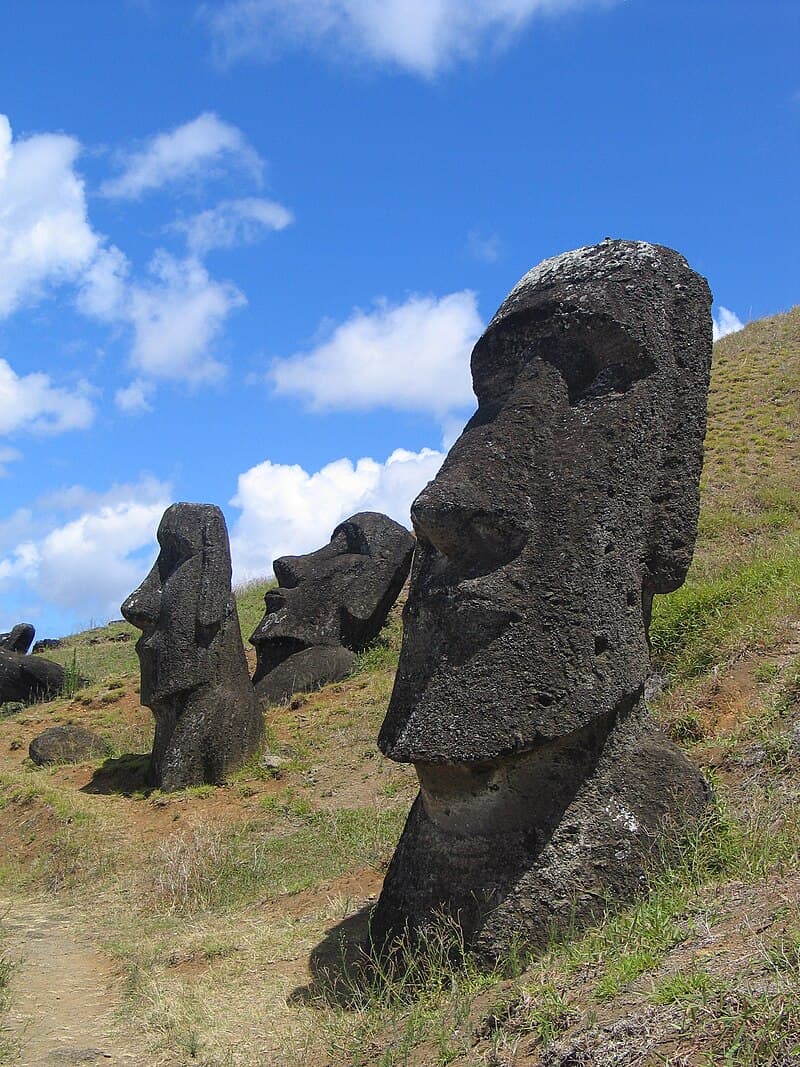
Moai (Easter Island Statues)
by Unknown Artist, 1250
Artwork Details
Details
- Year
- 1250
- Medium
- Volcanic rock (tuff)
- Size
- Average 4 m (13 ft) tall, largest 10 m (33 ft)
The Moai are monolithic human figures carved by the Rapa Nui people on Easter Island between 1250 and 1500 CE. Nearly 900 statues dot the remote Pacific island, most standing with their backs to the sea, gazing inland over villages they once protected. The statues represented deified ancestors who watched over the living, a function not unlike Ancient Egyptian funerary sculpture.
The average Moai stands 4 meters tall (13 feet) and weighs 14 tons, though the largest erected statue reaches 10 meters (33 feet). Most were carved from compressed volcanic ash at the Rano Raraku quarry, then transported miles across the island. How the Rapa Nui moved these massive statues without wheels or large animals remains debated. Recent experiments suggest they may have "walked" the figures using ropes.
Easter Island (Rapa Nui) lies in the southeastern Pacific Ocean, over 3,500 kilometers from mainland Chile. The island became a Chilean territory in 1888 and a UNESCO World Heritage Site in 1995. Many Moai were toppled during tribal conflicts or by earthquakes, but restoration efforts have re-erected dozens along the coast. Some Moai were taken to museums: the British Museum holds Hoa Hakananai'a, one of the most important examples.
About Moai (Easter Island Statues)
The average Moai stands about 4 meters (13 feet) tall and weighs 12.5 tonnes. But they range widely. The largest one successfully erected, called Paro, is 10 meters tall. An unfinished one in the quarry would have been over 21 meters (70 feet). Most were carved from compressed volcanic ash called tuff from the Rano Raraku quarry.
About 887 Moai have been documented. Nearly half remain at the Rano Raraku quarry in various stages of completion. The rest were transported to stone platforms called ahu around the island's perimeter. The Rapa Nui people carved them between roughly 1250 and 1500 CE.
They're the living faces of deified ancestors. The Rapa Nui called them 'aringa ora' (living faces). Each statue was placed on an ahu facing inland, watching over the clan's territory. The oversized heads, which make up about three-eighths of the body, emphasized the skull as the seat of sacred power.
The exact method is still debated, but experiments suggest the Rapa Nui may have 'walked' them upright by rocking them side to side using ropes, similar to how you'd move a refrigerator. Other theories involve wooden sledges, log rollers, or combinations. When Europeans first arrived in 1722, the statues were still standing. By the late 1800s, all had toppled.
Own Art Like This
Luxury wall art with the same mood and energy. Gallery-quality canvas, no museum crowds.
Browse Collection