Salvador Dalí
Spanish·1904–1989
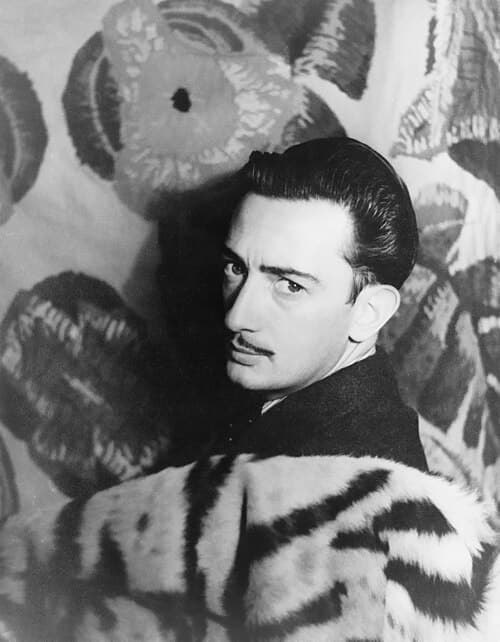
Spanish Surrealist painter Salvador Dalí (1904-1989) became the most publicly famous artist of the 20th century, his melting clocks and hallucinatory imagery defining Surrealism in popular consciousness. Born in Figueres, Catalonia, he studied at the Royal Academy of Fine Arts in Madrid before discovering Sigmund Freud's writings and joining the Paris Surrealists in the late 1920s. His development of the "paranoiac-critical method" produced dreamlike images where objects transformed into multiple meanings. In 1929, he met Gala, a Russian émigré who became his wife, manager, model, and muse for life.
The Persistence of Memory (1931), with its soft watches draped over a barren landscape, became Surrealism's most iconic image. First exhibited at the Julien Levy Gallery and sold for $250, it entered the Museum of Modern Art's collection in 1934, where it remains. Dalí's technical virtuosity matched Old Masters while serving irrational content, and he worked across painting, sculpture, film, jewelry, and commercial design. His collaborations with Luis Buñuel produced the films Un Chien Andalou and L'Age d'Or. After disputes with André Breton, Dalí focused increasingly on religious themes and science. The Dalí Theatre-Museum in Figueres, designed by the artist and opened in 1974, houses his own collection; Dalí is buried beneath its stage. The Museo Reina Sofía in Madrid and the Salvador Dalí Museum in St. Petersburg, Florida, hold major collections of his surrealist works.
Follow Salvador Dalí's Journey
Explore the places where Dalí lived, worked, and created masterpieces
Paintings by Salvador Dalí
7 paintings catalogued with museum locations
Museums with Salvador Dalí's Work
4 museums display Dalí's works. Click any museum to see visiting info and the specific works they hold.

Related Artists
Other Surrealism artists you might like
About Salvador Dalí
Dalí was a leading figure of Surrealism, joining the Paris group in 1929 and developing the 'paranoiac-critical method' to access subconscious imagery. He claimed to induce hallucinatory states to create his distinctive dreamscapes. Though André Breton expelled him from the official Surrealist movement in 1934, Dalí remained synonymous with Surrealism in public consciousness throughout his life.
The Persistence of Memory (1931) with its iconic melting watches hangs in the permanent collection of the Museum of Modern Art in New York. This small painting (24 x 33 cm) has become one of the most recognizable images in art history, representing Surrealism's exploration of dreams and the unconscious mind.
The Dalí Theatre-Museum in his hometown of Figueres, Spain, holds the world's largest collection, designed by the artist himself. Major works are at Museo Reina Sofía in Madrid and the Salvador Dalí Museum in St. Petersburg, Florida, which houses over 2,400 objects including oil paintings, watercolors, and sculptures.
Gala (Elena Ivanovna Diakonova), born in Russia in 1894, was Dalí's wife, muse, business manager, and constant model from 1929 until her death in 1982. She had been married to Surrealist poet Paul Éluard. Dalí credited her as essential to his artistic output and bought her a castle where she received visitors alone.
Yes, Dalí collaborated with director Luis Buñuel on Un Chien Andalou (1929) and L'Age d'Or (1930), two landmark Surrealist films. He designed a dream sequence for Hitchcock's Spellbound (1945) and worked with Walt Disney on the animated short Destino, completed posthumously in 2003. He also created advertisements and designed jewelry.
Dalí is buried in a crypt beneath the stage of the Dalí Theatre-Museum in Figueres, Spain, which he designed and personally oversaw. He chose this spot himself. In 2017, his body was exhumed for DNA testing in a paternity suit. The museum, built on the ruins of a bombed theater, displays his work in theatrical installations.
Love Salvador Dalí's Style?
Explore art inspired by Surrealism.
Browse Collection