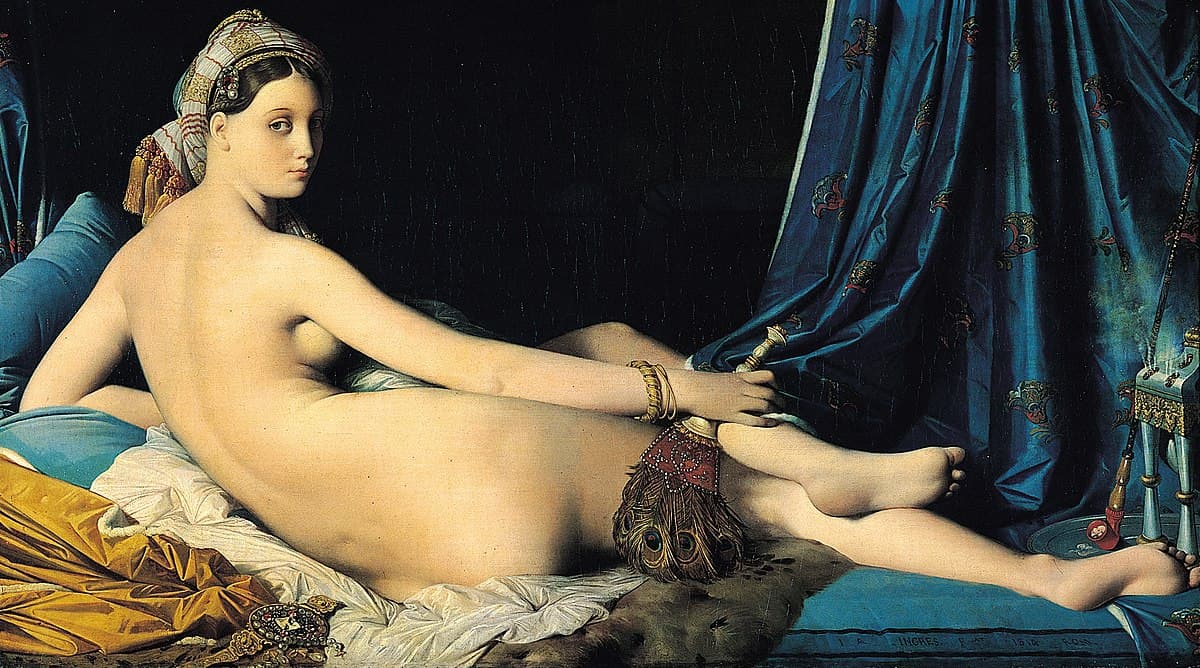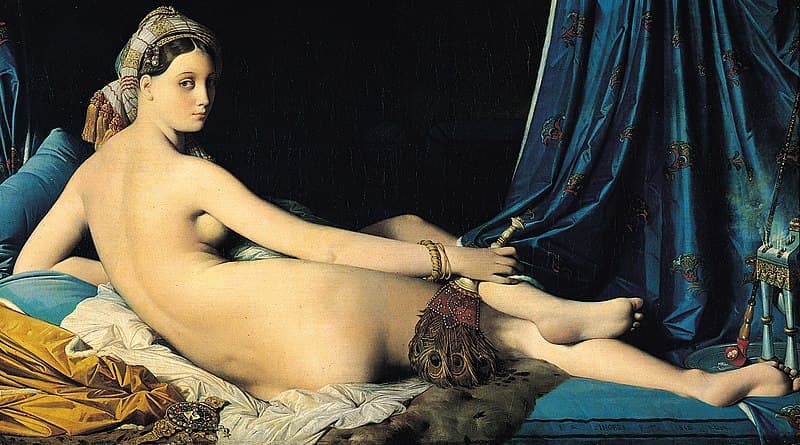
The Grande Odalisque
by Jean-Auguste-Dominique Ingres, 1814
Artwork Details
Details
- Year
- 1814
- Medium
- Oil on canvas
- Size
- 91 cm × 162 cm (35.8 × 63.8 in)
Cite or Embed This Work
APA · MLA · Chicago1-click academic citation and embeddable “On View” museum badge for articles, syllabi, and research.
Jean-Auguste-Dominique Ingres painted this reclining nude in 1814 for Napoleon's sister, Queen Caroline of Naples. The odalisque (a female slave or concubine in a harem) reclines on silks and blue drapery, looking back over her shoulder at the viewer. She holds a peacock-feather fan and an opium pipe rests nearby.
Critics immediately noticed anatomical impossibilities. Her spine appears to have three extra vertebrae, elongating her back beyond human limits. Her left arm is too long, her pelvis twisted at an impossible angle. Ingres knew anatomy perfectly well. These distortions were deliberate, creating an ideal of beauty that transcends reality.
The painting initially received harsh criticism for its "boneless" figure. Public opinion shifted over decades, and the Louvre acquired it in 1899. It influenced artists from Manet to Picasso.