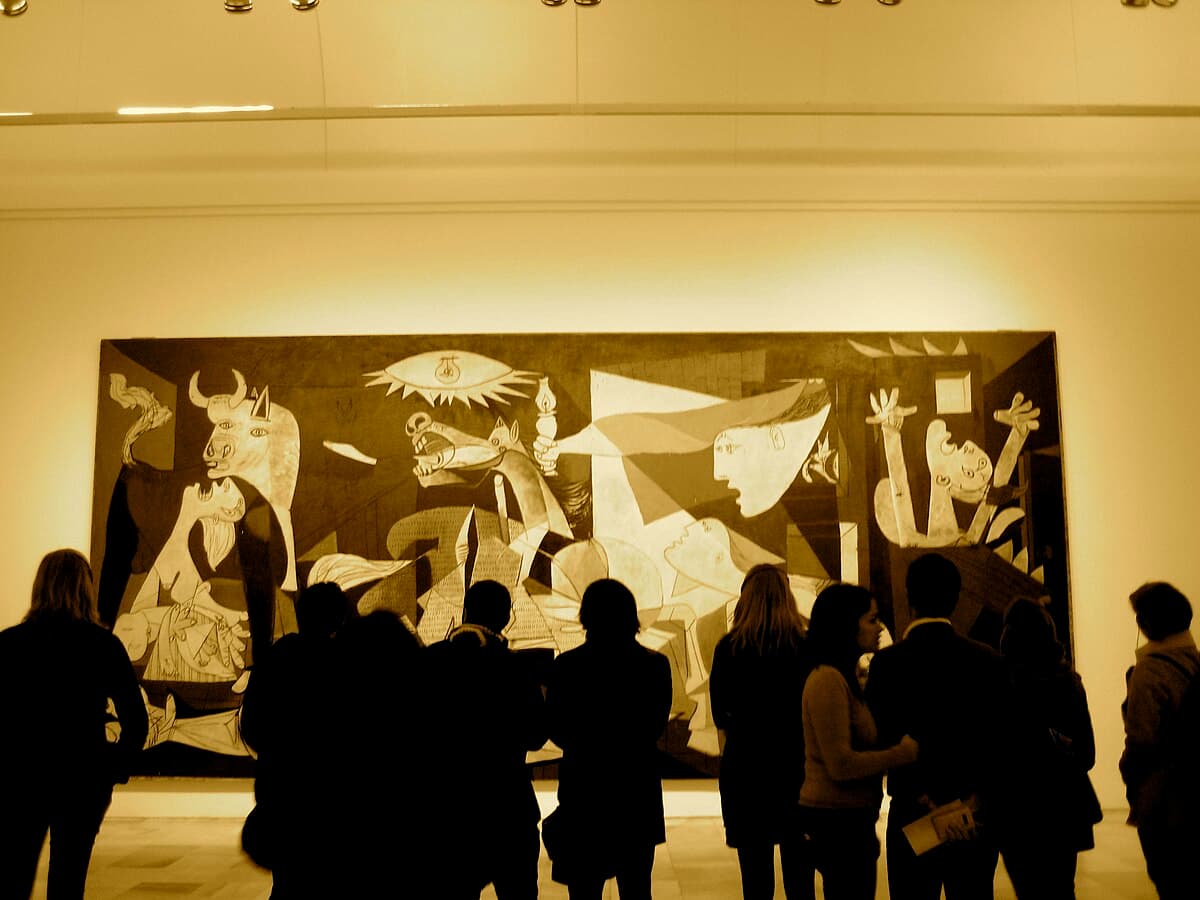
Wikimedia Commons - CC BY 2.0 (Photo of artwork)
Guernica
by Pablo Picasso, 1937
Artwork Details
Details
- Year
- 1937
- Medium
- Oil on canvas
- Size
- 349.3 cm × 776.6 cm
- Gallery
- Main Hall
Estimated Value
$200M
Expert estimate
On April 26, 1937, German and Italian bombers supporting Franco's Nationalists attacked the Basque town of Guernica during market day. Pablo Picasso, already commissioned to paint a mural for the Spanish Republic's pavilion at the Paris World's Fair, responded to the massacre with this monumental canvas. Working in just over a month, he created the 20th century's most powerful antiwar statement.
The painting shows fragmented figures in black, white, and gray: a screaming horse, a bull, a woman holding her dead child, a fallen soldier clutching a broken sword. Electric light and flames illuminate the chaos. Picasso drew on Cubist fragmentation and Surrealist nightmare imagery to convey horror without showing the bombers or the bombs themselves. The suffering is universal, not specific to one attack.
Picasso refused to let the painting enter Spain while Franco remained in power. It hung at MoMA in New York for decades before finally traveling to Madrid in 1981, six years after the dictator's death. Today it occupies its own gallery at the Museo Reina Sofía, protected by bulletproof glass and watched constantly by guards.
Historical Significance
Considered one of the most powerful anti-war paintings in history and a seminal work of Cubism.