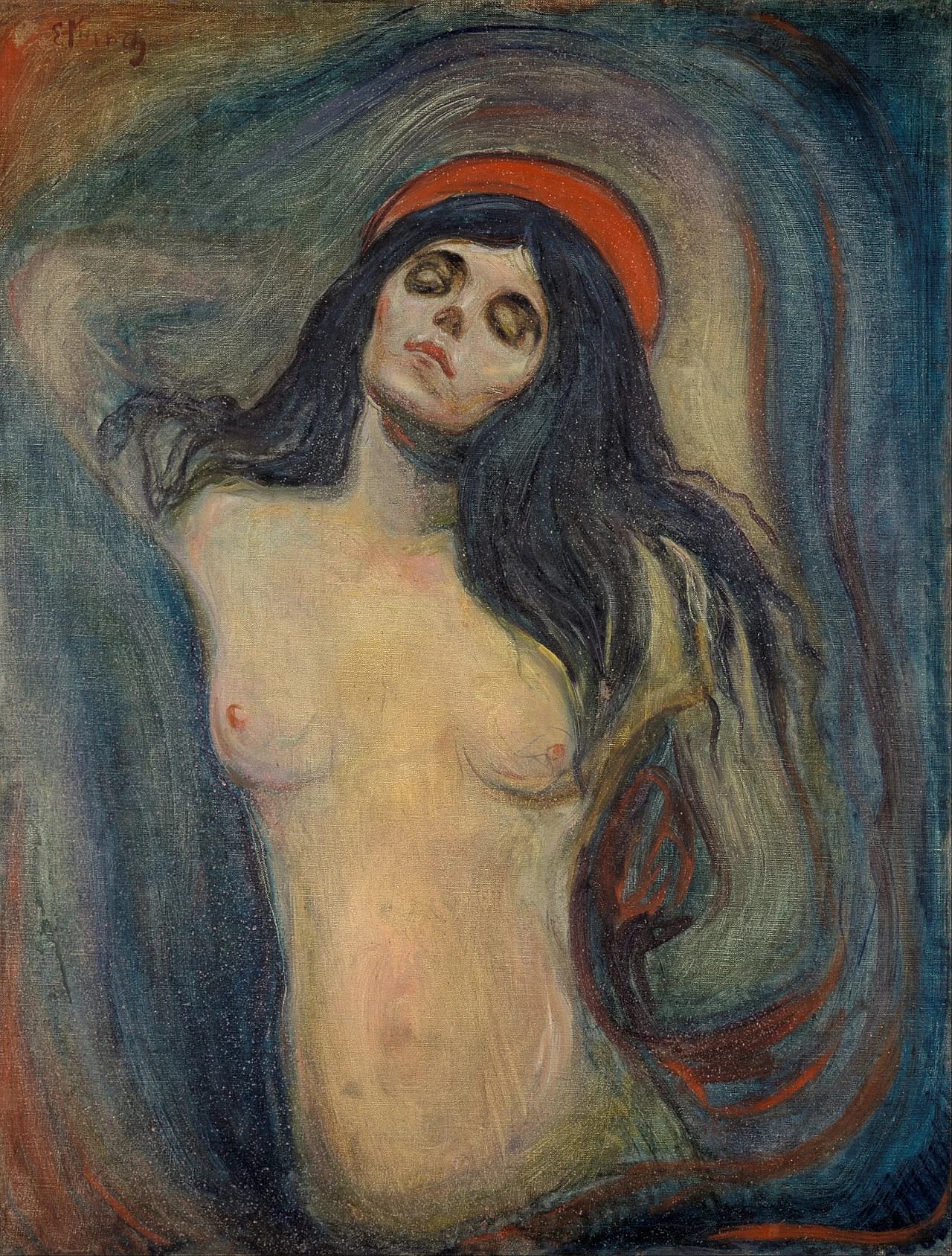
Madonna
by Edvard Munch, 1894
Artwork Details
Details
- Year
- 1894
- Medium
- Oil on canvas
- Size
- 91 cm × 70.5 cm
Cite or Embed This Work
APA · MLA · Chicago1-click academic citation and embeddable “On View” museum badge for articles, syllabi, and research.
Around 1894, Edvard Munch painted this Madonna between 1892 and 1895, creating at least five versions of the composition. A half-length woman appears against a swirling dark background, her eyes closed, her expression somewhere between ecstasy and death. She's nude from the waist up, her arms raised behind her head.
Whether this represents the Virgin Mary remains debated. Munch used titles like "Loving Woman" interchangeably with "Madonna." The model was Dagny Juel-Przybyszewska, a friend whose beauty captivated the artist's circle. Munch saw the image as representing the cycle of generation and decay. Love and death intertwined.
The version at the Munch Museum in Oslo measures 91 by 70.5 centimeters. In August 2004, armed thieves stole it along with The Scream. Police recovered both paintings two years later, damaged but repairable. Munch also created lithograph prints with a border of wriggling sperm and a fetus in the corner, making the procreative symbolism explicit.