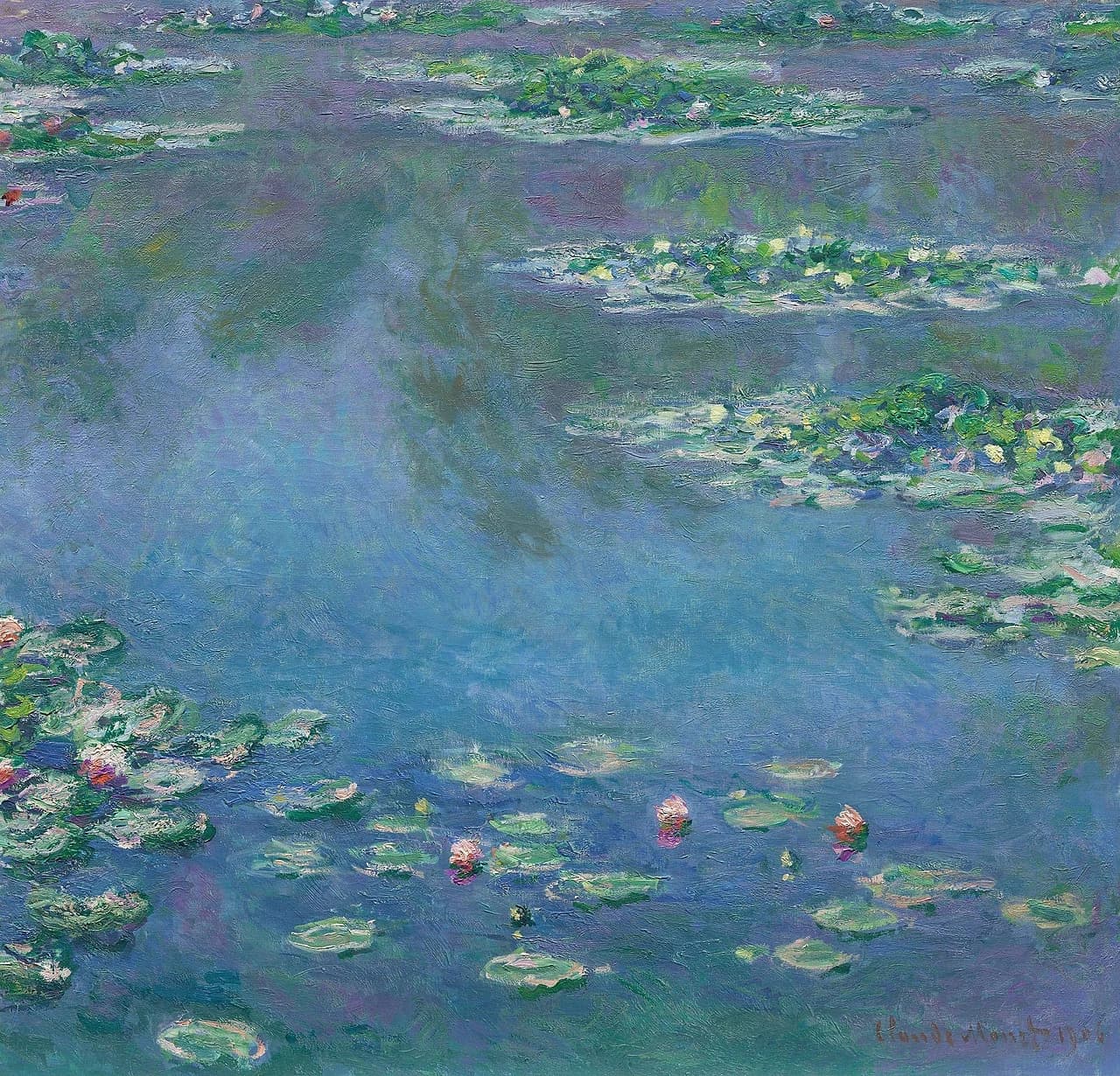
Water Lilies
by Claude Monet, 1906
Artwork Details
Details
- Year
- 1906
- Medium
- Oil on canvas
- Size
- 89.9 cm × 94.1 cm
- Gallery
- Gallery 5, Floor 5
Estimated Value
$80M
Expert estimate
For the last thirty years of his life, Claude Monet focused almost exclusively on the water garden he had built at his home in Giverny. This 1906 painting is one of roughly 250 Water Lilies canvases he produced, showing the pond's surface without any horizon line or shore to anchor the viewer. We float among the lily pads, looking down at flowers that seem to hover between water and reflection.
Monet was legally blind by the time he completed many of these late paintings, yet he continued working by memory and instinct. The Impressionist master applied paint in loose, gestural strokes that edge toward abstraction. Up close, the canvas dissolves into swirls of green, blue, and pink. Step back, and the forms resolve into recognizable lilies floating on water that reflects an unseen sky.
This particular version hangs at The Museum of Modern Art in New York. Monet's late water lily paintings influenced the Abstract Expressionists who would come to define American art decades later. The serene imagery has made Water Lilies a perennial favorite for nature art and calming interiors.
Historical Significance
These works pushed Impressionism toward abstraction and influenced Abstract Expressionism.