Frédéric Auguste Bartholdi
French·1834–1904
No Portrait Available
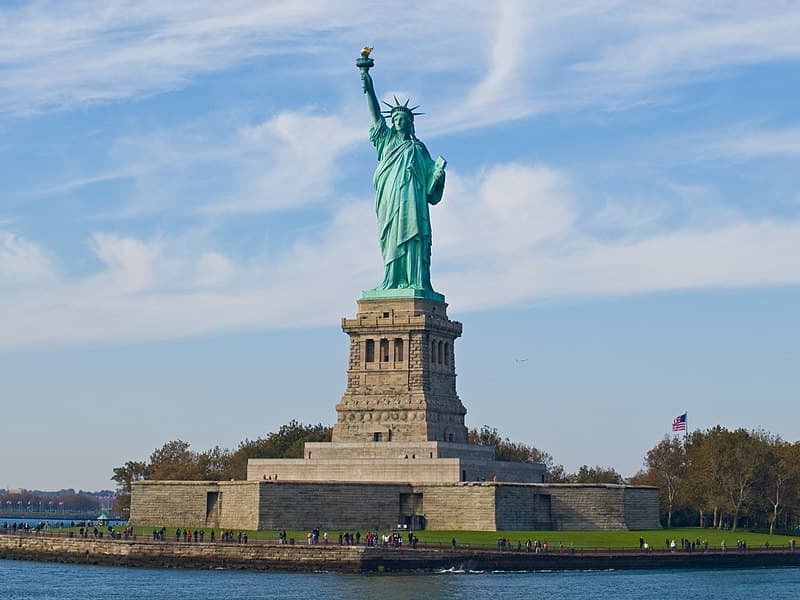
Frédéric Auguste Bartholdi (1834–1904) designed the most recognizable statue on Earth: the Statue of Liberty. Born in Colmar, Alsace (then France), he studied architecture and painting before turning to sculpture. A trip to Egypt in 1855 changed his artistic ambitions forever. Seeing the Sphinx and Pyramids ignited an obsession with monumental, colossal-scale works.
The Liberty idea started in 1865, when French political thinker Édouard de Laboulaye suggested a gift from France to America celebrating shared democratic values. Bartholdi ran with it. He designed a robed woman holding a torch aloft, drawing partly from his earlier (rejected) proposal for a lighthouse at the Suez Canal. The internal iron framework was engineered by Gustave Eiffel. Workers hammered copper sheets by hand over the skeleton, and the whole thing was assembled in Paris first, then shipped in 350 crates to New York.
President Grover Cleveland dedicated the Statue of Liberty on October 28, 1886. It was rumored in France that Bartholdi modeled the face after his mother. His other major work, the Lion of Belfort (1880), is a colossal sandstone lion carved into a cliff in eastern France. Bartholdi died of tuberculosis in Paris in 1904. His birthplace in Colmar is now a museum dedicated to his life and work.
Sculptures by Frédéric Auguste Bartholdi
1 sculpture catalogued with museum locations. Browse all sculptures
About Frédéric Auguste Bartholdi
Frédéric Auguste Bartholdi designed the exterior form. Gustave Eiffel (of Eiffel Tower fame) engineered the internal iron framework. French citizens funded its construction, raising over a million francs. It was a gift from France to the United States, dedicated in 1886.
French political thinker Édouard de Laboulaye proposed the idea in 1865 as a gift celebrating Franco-American friendship and democratic ideals. Bartholdi's visit to Egypt in 1855, where the Sphinx and Pyramids ignited his love of monumental sculpture, shaped the statue's colossal scale.
His other masterwork is the Lion of Belfort (1880), a massive sandstone lion carved into a cliff face in eastern France. He also created the Bartholdi Fountain in Washington, D.C. His hometown of Colmar has several of his monuments.
Workers hammered 300 copper sheets by hand over an iron framework designed by Gustave Eiffel. It was fully assembled in Paris first, then disassembled and shipped to New York in 350 crates. The reassembly on Bedloe's Island took four months.
Love Frédéric Auguste Bartholdi's Style?
Explore art inspired by their style.
Browse Collection