Willem Claesz. Heda
Dutch·1594–1680
No Portrait Available
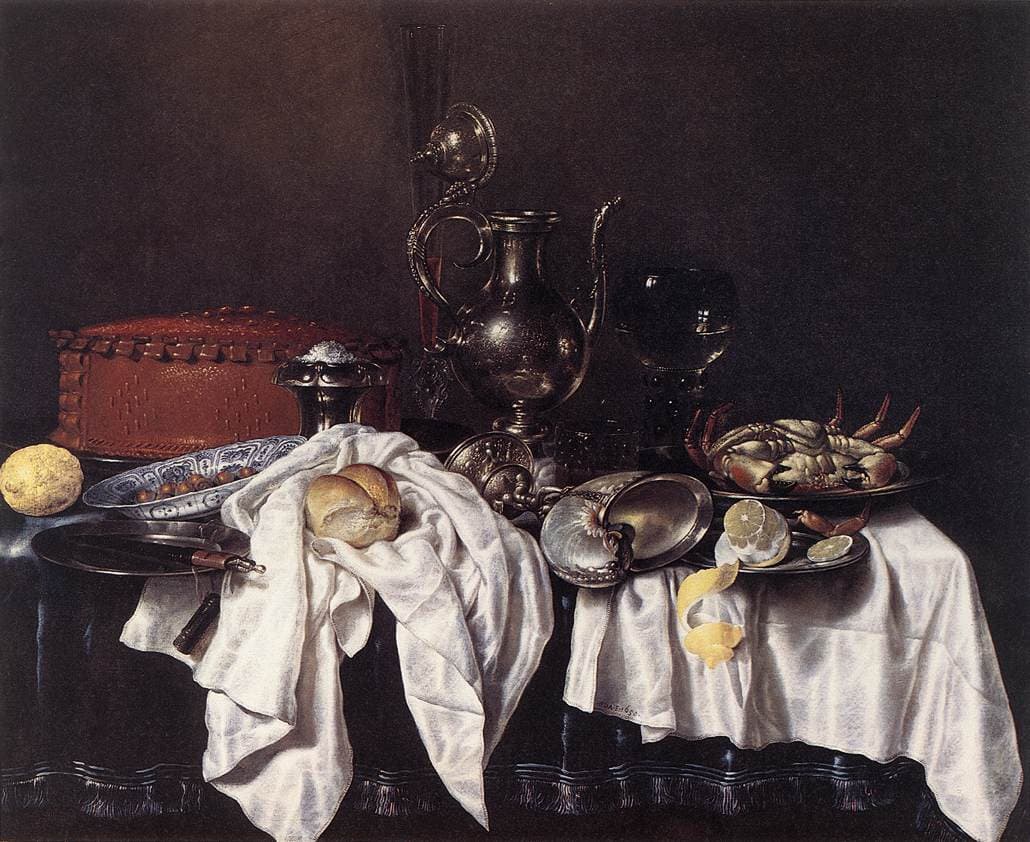
Dutch Golden Age still life painter Willem Claesz. Heda (1594-c. 1680) helped establish the "breakfast piece" as a major genre in Dutch art, depicting tabletop arrangements with cool gray tones and refined handling of light. Born in Haarlem to the city architect, he spent his entire career there, joining the Saint George civic guard in 1616 and marrying in 1619. His first known work, a Vanitas composition, dates to 1621. Along with Pieter Claesz, Heda became one of the most important ontbijt (breakfast piece) painters in the Netherlands.
Heda's breakfast pieces display arrays of food, glassware, and pewter on rumpled white tablecloths, all rendered with delicate brushwork that vividly conveys textures of bread crusts, lemon peel, oyster shells, and metallic surfaces. His distinctive palette features cool gray tones rather than the warmer hues of other still life painters. During his later phase, he introduced Venetian glass and oriental porcelain, possibly influenced by Willem Kalf. French critic Théophile Thoré rediscovered Heda in the 1860s, praising his ability to animate humble objects. His son Gerrit continued painting in a similar manner, making their hands difficult to distinguish. Works hang at the Rijksmuseum, the Metropolitan Museum of Art, the Louvre, the National Gallery in London, and the National Gallery of Art in Washington.
Notable Works by Willem Claesz. Heda
1 painting catalogued with museum locations
Museums with Willem Claesz. Heda's Work
1 museum displays Heda's works. Click any museum to see visiting info and the specific works they hold.
Related Artists
Other Dutch Golden Age artists you might like
About Willem Claesz. Heda
Heda was a Dutch Golden Age still life painter who helped establish the 'ontbijt' or breakfast piece genre in Haarlem during the 1620s and 1630s. Together with Pieter Claesz, he developed monochromatic compositions featuring tabletop arrangements of food and glassware that became Haarlem's signature contribution to still life painting.
Breakfast pieces (ontbijt) are still life paintings showing tabletop arrangements of modest Dutch foods: bread, cheese, herring, ham, and beer alongside glassware and pewter. Often depicting interrupted meals on rumpled tablecloths with tipped vessels and peeled lemons, they served as spiritual reminders about gluttony while showcasing painters' technical virtuosity.
Works hang at the Rijksmuseum in Amsterdam, the Metropolitan Museum of Art, the Louvre, and the National Gallery in London. The Museo Thyssen-Bornemisza in Madrid also holds excellent examples of his breakfast pieces and pronkstilleven.
Heda painted in distinctive cool gray tones rather than warm colors, creating atmospheric harmonies of silver, pewter, gray-green glass, and bleached linen tablecloths. His subtle lighting animates reflections on metal surfaces, bubbles in römer glasses, and textures of bread crusts and lemon peel. This tonal unity became Haarlem's trademark still life approach.
His son Gerrit Willemsz. Heda painted still lifes in his father's manner, and their similar techniques make distinguishing their hands difficult for scholars even today. Willem was dean of Haarlem's Guild of St. Luke on several occasions from 1637, training apprentices and influencing the next generation of Dutch still life painters.
Love Willem Claesz. Heda's Style?
Explore art inspired by Dutch Golden Age.
Browse Collection