The White Stag in Mythology: Celtic and Norse Legends in Art
|
Time to read 7 min

|
Time to read 7 min
The white stag appears across Celtic, Norse, and Arthurian legend as a messenger from the otherworld, always glimpsed at the edge of the forest and never quite caught. This piece traces its roots from Cernunnos and the Gundestrup Cauldron through Arthurian quest tales, Norse stag lore, and its later use by King Richard II and Christian saints.
At a glance
| Gundestrup Cauldron | c. 200 to 100 BCE |
| Norse stag | Eikthyrnir, atop Valhalla |
| Richard II's emblem | Adopted around 1390 |
| Core meaning | Messenger, boundary crosser |
Something about the white stag captures the imagination in a way ordinary deer never could. Across Celtic, Norse, and Arthurian traditions, this pale creature appears at the edge of the forest, just visible through the mist, always one step ahead of the hunter. To see one was to receive a message. To pursue one was to cross into the otherworld.
The white stag's power lies in its impossibility. Albino deer exist in nature, but they're rare enough to feel supernatural. Ancient peoples understood that rarity meant significance. When something so unusual crossed your path, the gods were speaking.
In Celtic tradition, white animals of any kind were considered messengers from the Otherworld. The color white marked them as belonging to the world of spirits and gods rather than the mortal world.
Before discussing the white stag specifically, we need to understand the Celtic relationship with deer in general. Cernunnos, the horned god of Celtic mythology, wore stag antlers and sat surrounded by animals. His name translates roughly to "the horned one," and he represented the wild places, fertility, and the cycle of life and death.
The most famous depiction of Cernunnos appears on the Gundestrup Cauldron, a silver vessel from around 200-100 BCE found in a Danish peat bog. He sits cross-legged, holding a torc in one hand and a ram-headed serpent in the other. A stag stands at his right, antlers matching his own.
Cernunnos on the Gundestrup Cauldron, c. 200-100 BCE. Photo via World History Encyclopedia.
The connection between Cernunnos and the stag runs deeper than appearance. Antlers shed and regrow each year, making them natural symbols of regeneration and the cycle of seasons. The Celts carved antler fragments into amulets. They saw in the stag's annual transformation a mirror of their own beliefs about death and rebirth.
Arthurian romance transformed the white stag into a plot device with a specific purpose: to initiate quests. When a white stag appeared at Camelot, knights abandoned whatever they were doing to chase it. The creature could never be caught, of course. That wasn't the point.
The chase mattered more than the capture. Following the white stag led knights into enchanted forests where they encountered damsels in distress, enemy champions, or magical tests of character. The stag was a narrative engine, a way to separate heroes from the safety of court and thrust them into adventure.
In the Welsh Mabinogion, the hero Pwyll encounters a white stag while hunting. By taking prey killed by another hunter's hounds, he accidentally trespasses against Arawn, lord of the Otherworld. This single encounter with a white stag sets in motion an entire mythological cycle.
The message is consistent across these stories: the white stag marks boundaries between worlds. To follow it is to leave the ordinary world behind. There's no going back unchanged.
Norse mythology features Eikthyrnir, a stag that stands atop Valhalla eating from the world tree Yggdrasil. Water drips from its antlers and flows down to form every river in the world. This golden stag connects the world of the gods to the mortal world through the life-giving element of water.
Four other stags graze on Yggdrasil as well: Dainn, Dvalinn, Duneyrr, and Durathror. They represent the four directions or perhaps the four seasons, nibbling at the world tree's branches while its leaves sustain them. The tree feeds the deer, and the deer, in consuming it, spread its influence throughout the cosmos.
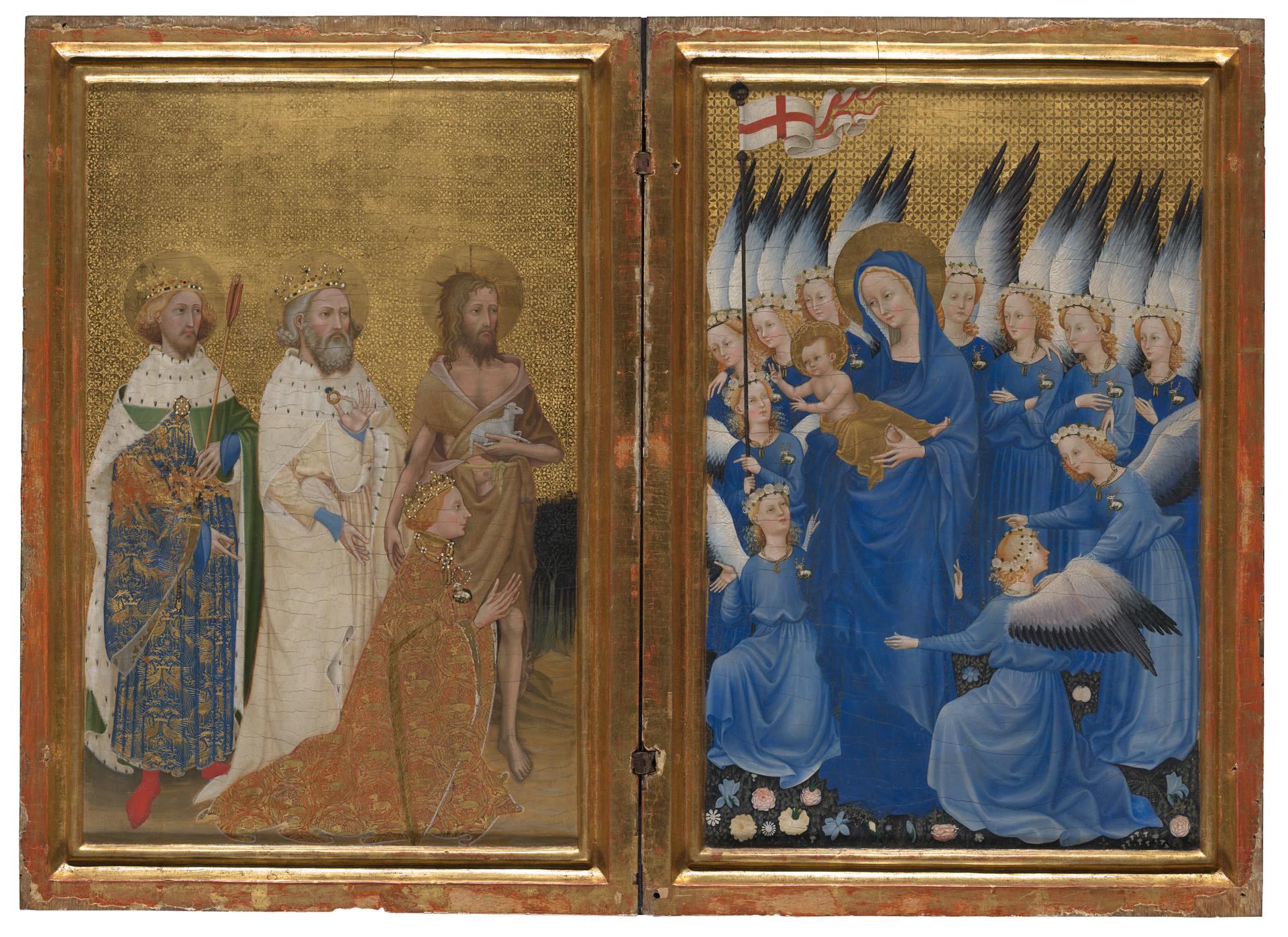
The white stag moved from mythology into politics when King Richard II of England adopted the white hart as his personal emblem around 1390. The Wilton Diptych, one of England's greatest medieval paintings, shows Richard wearing a white hart badge while angels bearing the same symbol attend the Virgin Mary.
The symbolism was calculated. By associating himself with an otherworldly creature from Arthurian legend, Richard claimed a divine mandate for his rule. The white hart suggested that his kingship connected the earthly world to something higher, something magical. His reign ended badly, but the imagery endured.
The Wilton Diptych, c. 1395-1399. Public domain via Wikimedia Commons.
Hungarian mythology tells how twin brothers Hunor and Magor were hunting when they spotted a magnificent white stag. They pursued it for days through unknown wilderness until it finally vanished near a new land abundant with game and fresh water. Unable to find their way back, the brothers settled there and founded the Hun and Magyar peoples.
This origin story transforms the white stag from a spiritual messenger into a national symbol. The creature doesn't represent the otherworld so much as destiny itself, leading an entire people to their homeland. Similar stories appear in the founding myths of other Eurasian steppe cultures, suggesting ancient roots for the white stag as a guide between worlds.
Christianity absorbed pagan stag symbolism and redirected it. The legend of Saint Eustace tells how a Roman general named Placidus encountered a magnificent stag while hunting. Between its antlers, he saw a vision of Christ on the cross, and a voice commanded him to convert. He became Eustace and eventually died a martyr.
Saint Hubert's nearly identical story became the foundation for his patronage of hunters. The crucifix-bearing stag appears throughout medieval Christian art, particularly in illuminated manuscripts and church carvings. The pagan creature of the Otherworld became a vehicle for divine revelation, its essential nature as a boundary-crosser preserved even as its meaning shifted.
Stag Symbolism Across Cultures:
• Celtic – Messenger from the Otherworld, companion of Cernunnos
• Arthurian – Quest initiator, guide to adventure
• Norse – Cosmic connection, source of rivers
• Christian – Divine messenger, symbol of Christ
• Hungarian – Destiny guide, national founder
C.S. Lewis understood the white stag's mythological power when he included it in The Lion, the Witch and the Wardrobe. The Pevensie children, now kings and queens of Narnia, chase a white stag that can grant wishes. The pursuit leads them back through the wardrobe to England, reversing their original passage into the magical world. The stag once again marks a boundary between worlds.
Game of Thrones opens with a stag sighting that foreshadows the entire series. The House Baratheon sigil is a crowned stag, and Robert Baratheon's death while hunting one sets the plot in motion. Whether George R.R. Martin consciously drew on Celtic stag mythology or simply tapped the same archetypal well, the effect is the same: deer as harbingers of change.
The enduring appeal of deer symbolism explains why stag imagery works so well in interior design. A deer represents grace, natural beauty, and something slightly wild. It suggests connection to nature without the aggression of predator imagery.
Stag art particularly suits spaces intended for reflection: home offices, libraries, bedrooms. The creature's association with boundaries and transitions makes it appropriate for entryways and hallways. And its connection to nobility and heraldry gives it a certain sophistication that pure wildlife art sometimes lacks.
Browse our deer art collection to see how contemporary artists interpret these ancient symbols. For more wildlife that carries mythological weight, explore our wildlife art and nature art collections. From minimalist geometric stags to richly colored forest scenes, the deer remains as powerful a subject as it was when Celtic hunters first glimpsed white shapes moving through the mist.
The white stag symbolizes a messenger from the Otherworld in Celtic mythology. It represents the boundary between the mortal world and the supernatural. In Arthurian legend, it initiates quests and signals that adventure awaits. Across cultures, it represents something rare and sacred.
Cernunnos is the Celtic horned god associated with nature, animals, and fertility. He wears stag antlers and appears surrounded by wild creatures on the Gundestrup Cauldron. His antlers represent regeneration since they shed and regrow annually.
Richard II adopted the white hart as his personal emblem to associate his kingship with Arthurian legend and divine authority. The white hart (hart being an old word for stag) appeared on badges worn by his followers and in the famous Wilton Diptych. It was partly inherited from his mother.
In C.S. Lewis's The Lion, the Witch and the Wardrobe, the white stag is said to grant wishes to whoever catches it. The Pevensie children chase it as adult kings and queens, and the pursuit leads them back through the wardrobe to England, ending their time in Narnia.
Eikthyrnir, the golden stag in Norse mythology, stands atop Valhalla eating from Yggdrasil. Water dripping from its antlers forms all the world's rivers. It represents the cosmic connection between the world of the gods and the mortal world.
Saints Eustace and Hubert both converted after seeing a vision of Christ between a stag's antlers while hunting. The stag became a symbol of divine revelation in Christian art. Medieval artists adapted the Celtic otherworldly messenger into a vehicle for Christian mystical experience.
Deer symbolism combines natural beauty with nobility and mystery. Stag imagery works in spaces meant for reflection like offices and libraries. The creature's grace and heraldic associations give it sophistication that appeals across decorating styles from rustic to modern.
Written by Luxury Wall Art · Art experts passionate about helping you find pieces that speak to your space.