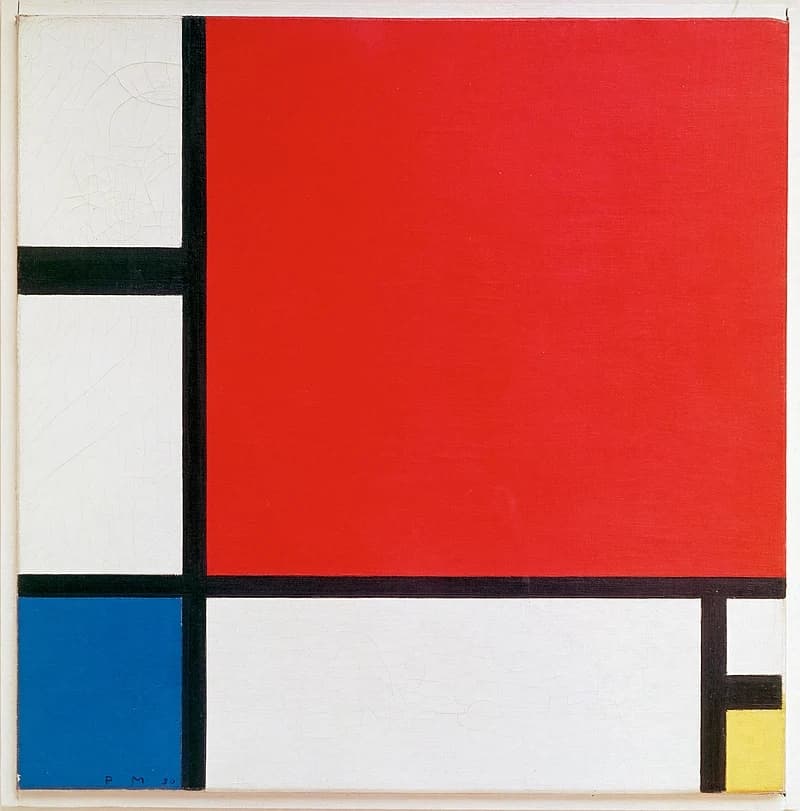
Composition with Red, Blue, and Yellow
by Piet Mondrian, 1930
Artwork Details
Details
- Year
- 1930
- Medium
- Oil on canvas
- Size
- 46 cm × 46 cm
- Gallery
- De Stijl Collection
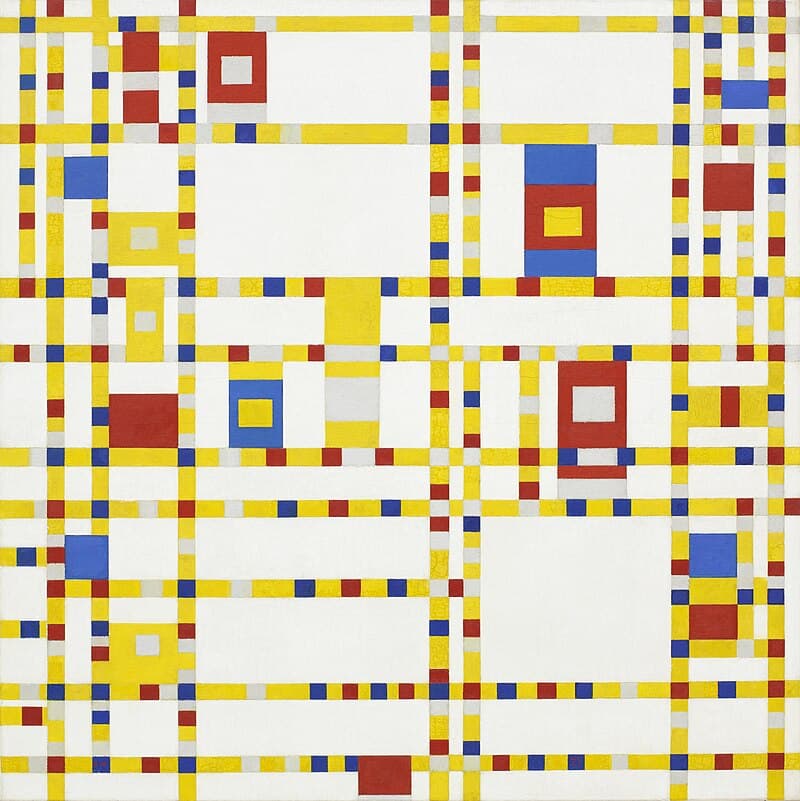
Dutch artist Piet Mondrian painted this Composition with Red, Blue, and Yellow in 1930, a defining work of Neoplasticism. Thick black lines divide a white background into rectangles filled with primary colors. Red dominates, filling roughly four-ninths of the canvas, with blue occupying one square and yellow just a quarter of one.
After a Cubist phase focused on light and dark, Mondrian arrived at his mature style around 1920. He used only vertical and horizontal lines, only primary colors plus black and white, seeking a universal visual language to express cosmic harmony. The mathematical proportions (4:1:¼) create a geometric hierarchy.
This work is at the Kunsthaus Zürich in Switzerland, measuring 46 x 46 cm. Mondrian's approach influenced Minimalist art, design, and architecture throughout the 20th century.
Historical Significance
One of the most recognized works of geometric abstraction, influencing design and architecture.