Wikimedia Commons • Public Domain
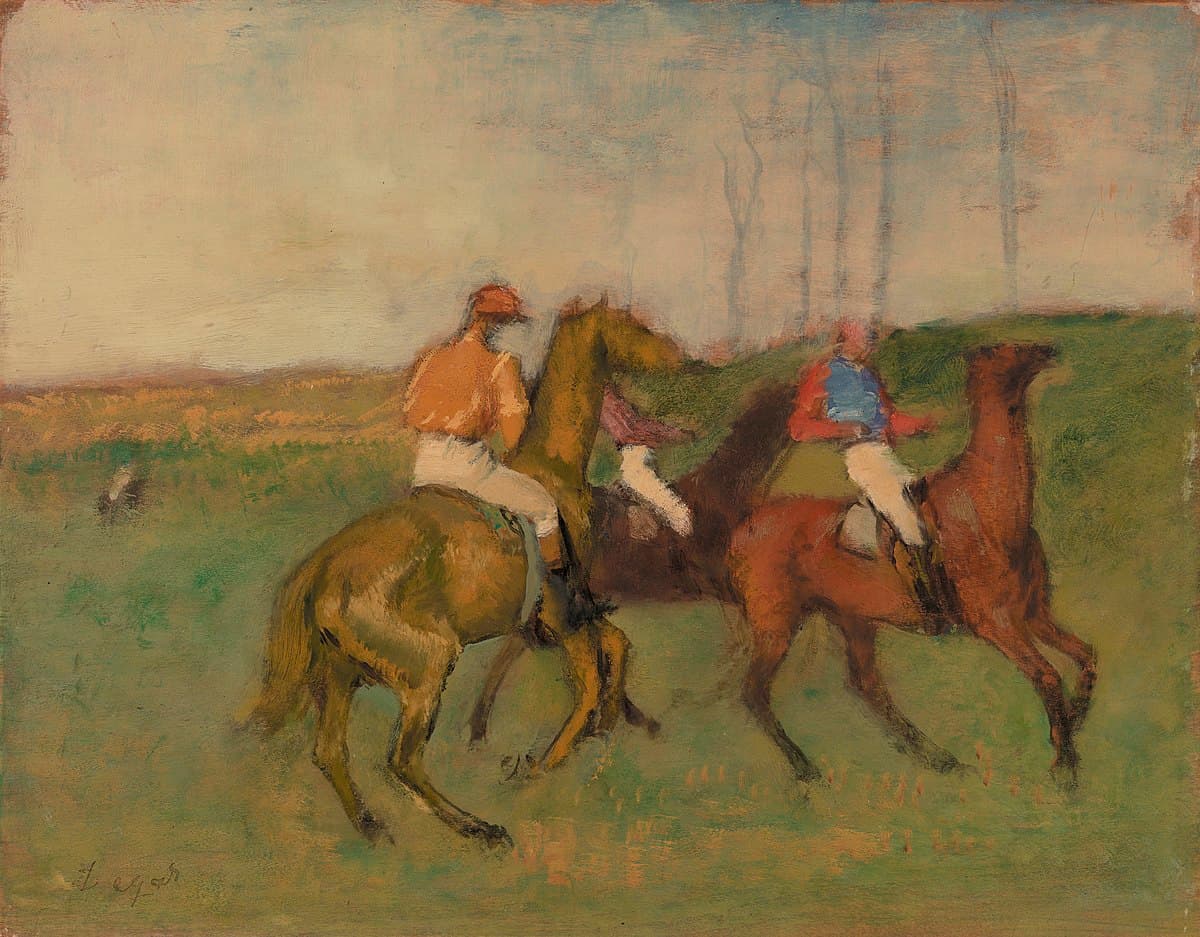
Horses and Jockeys
by Edgar Degas
Artwork Details
Edgar Degas painted the racing scenes throughout his career, manipulating horses and jockeys from one picture to the next. When Longchamps racetrack opened at the Bois de Boulogne in 1857, horse racing became fashionable among Paris's elite. As an upper-class man, Degas visited frequently, sketching and taking notes.
Unlike painters who depicted the glamorous moments of racing, Degas preferred the unglamorous before and after. His works function like snapshots taken off-track: horses gathering, jockeys adjusting equipment, animals cooling down. Some poses have distinguished pedigrees. The prancing mount in several paintings derives from Benozzo Gozzoli's "Journey of the Magi" in Florence, which Degas copied in 1859.
Degas combined direct observation with careful study of photographs. He wanted to capture movement accurately, watching horses with fascination and later working up finished paintings in his studio. This work is held at the Art Institute of Chicago.