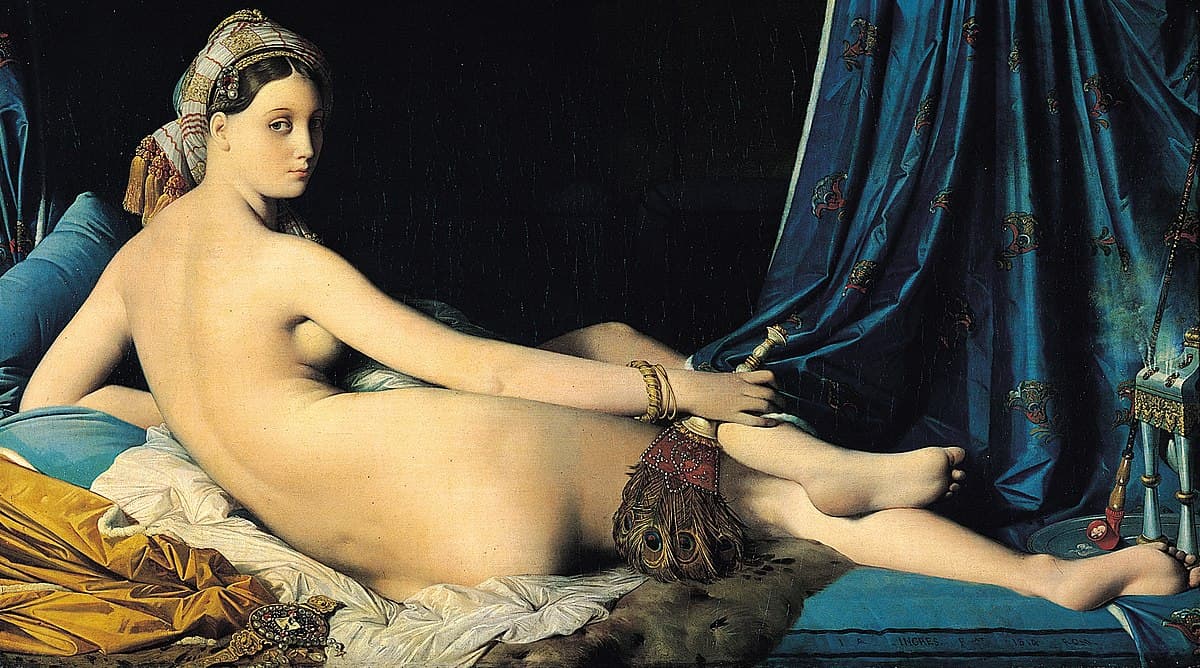
Grande Odalisque
by Jean-Auguste-Dominique Ingres, 1814
Artwork Details
Details
- Year
- 1814
- Medium
- Oil on canvas
- Size
- 91 cm × 162 cm
Jean-Auguste-Dominique Ingres completed this Grande Odalisque in 1814 for Napoleon's sister, Queen Caroline of Naples. The painting shows a reclining nude seen from behind, her body impossibly elongated. Critics have counted anywhere from two to five extra vertebrae in her spine. Her left arm appears shorter than her right. None of this was accidental.
When exhibited at the 1819 Salon, viewers attacked the anatomical distortions. One critic complained the figure had "neither bones nor muscle, neither blood, nor life." Ingres had studied Mannerist painters like Parmigianino, whose Madonna with the Long Neck played similar tricks with proportion. He stretched the odalisque's torso deliberately, perhaps to distance her thoughts from her body, to emphasize the gulf between her inner life and her role as a harem concubine.
The painting measures 91 by 162 centimeters and entered the Louvre collection in 1899. The blue and gold fabrics contrast with her pale flesh, creating a cool, detached sensuality that influenced later artists from Manet to Picasso.