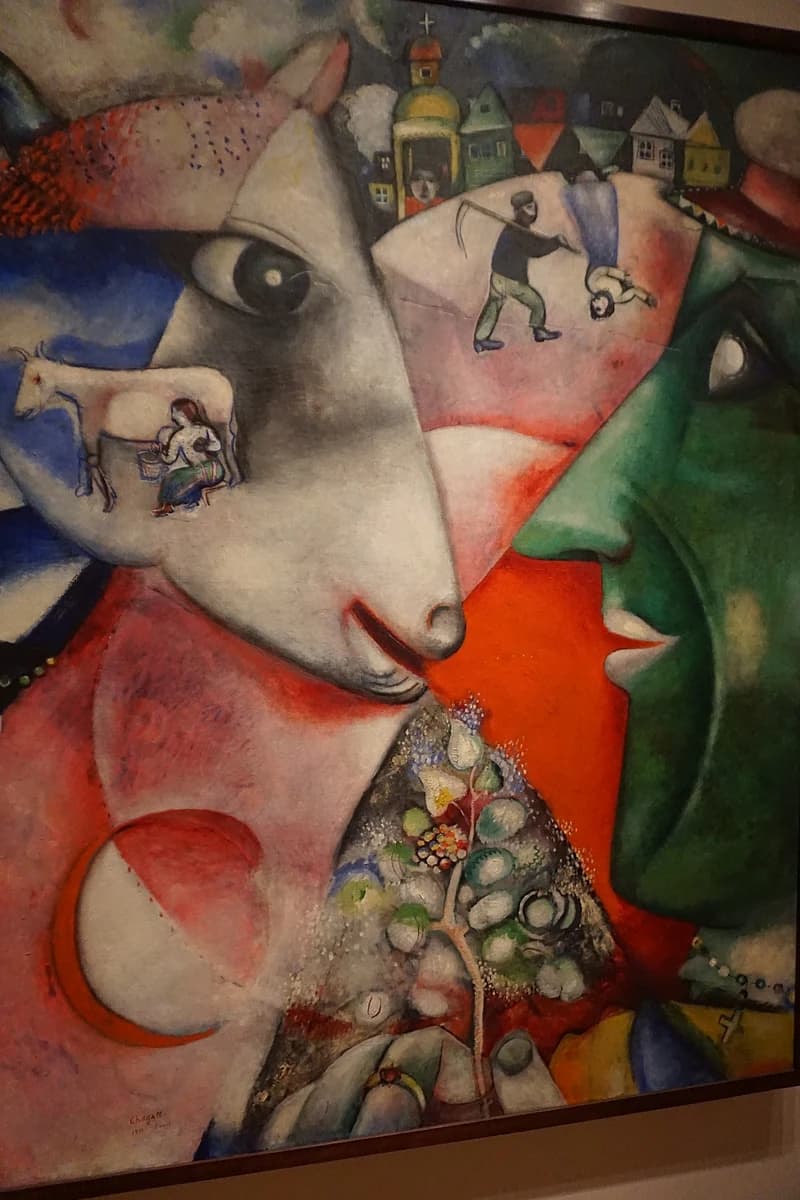
I and the Village
by Marc Chagall, 1911
Artwork Details
Details
- Year
- 1911
- Medium
- Oil on canvas
- Size
- 192.1 cm × 151.4 cm
- Gallery
- Modern Art Gallery
Find It In The Museum
Modern Art Gallery
Museum of Modern Art (MoMA), New York
Part of the permanent collection
Marc Chagall painted this dreamlike canvas in 1911, about a year after arriving in Paris from his native Belarus. A green-faced man stares at a goat, their profiles overlapping. A smaller image of a goat being milked appears on the animal's cheek. Behind them, a village with an Orthodox church floats upside down, an upside-down woman and a man with a scythe drifting past.
The painting blends Cubist structure with Belarusian and Jewish folklore from Chagall's childhood in Vitebsk. Green symbolizes growth and life, red evokes warmth, blue suggests nostalgia. The title itself hints at the connection between artist and homeland. Scholar H.W. Janson called it "a Cubist fairy tale."
Chagall kept the painting until 1916, when it went to Berlin. After changing hands several times, it entered the Museum of Modern Art collection in 1945, shortly after Chagall arrived in America as a refugee from Nazi-occupied Europe. MoMA featured it prominently in their 1946 Chagall retrospective.
Historical Significance
A masterpiece of early modernism combining Cubist structure with Chagall's personal mythology and Jewish folk imagery.