Wikimedia Commons • Public Domain
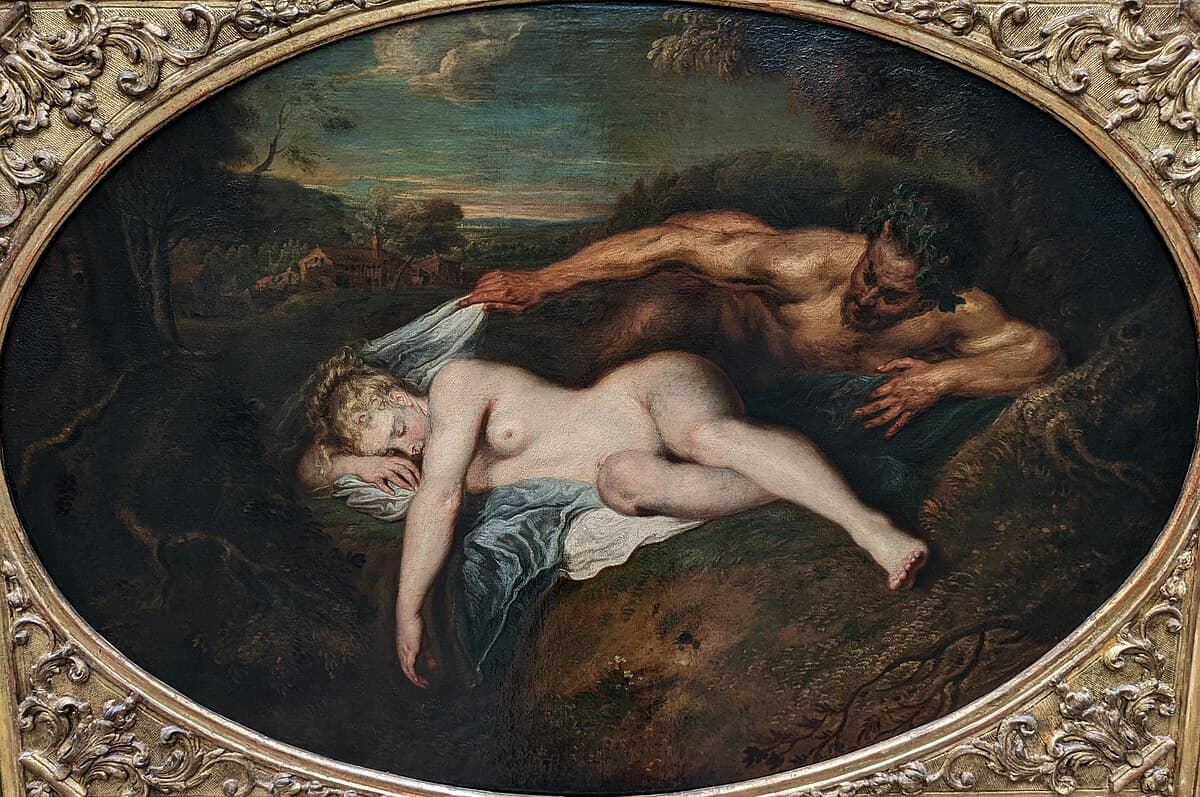
Nymph and Satyr, or Jupiter and Antiope
StyleRococo
GenreMythological
Artwork Details
Cite or Embed This Work
APA · MLA · Chicago1-click academic citation and embeddable “On View” museum badge for articles, syllabi, and research.
French artist Jean-Antoine Watteau painted this Nymph and Satyr around 1715-1716, an oval oil on canvas measuring 73.5 x 107.5 cm. The scene comes from Ovid's Metamorphoses: Jupiter disguised as a satyr approaches the sleeping nymph Antiope, lifting her veil to reveal her nude form. It's one of Watteau's most overtly erotic works.
The oval shape was designed for placement above a doorway. The composition echoes this frame, with Antiope's body forming the horizontal axis and her bent legs creating the vertical. The satyr's reaching arms curve parallel to the upper edge, repeating the oval within the image. Scholars debate whether to call the figure Jupiter or simply a satyr, since no identifying symbols like eagles or thunderbolts appear.
Léopold-Philippe d'Arenberg commissioned the work, paying 200 livres in May 1717. The painting passed through private collections in Brussels and Paris before entering the Louvre in 1869. Watteau's Rococo elegance and luminous pink flesh tones influenced later interpretations of classical myths.