Wikimedia Commons • Public Domain
Artist in his Studio
Artwork Details
Cite or Embed This Work
APA · MLA · Chicago1-click academic citation and embeddable “On View” museum badge for articles, syllabi, and research.
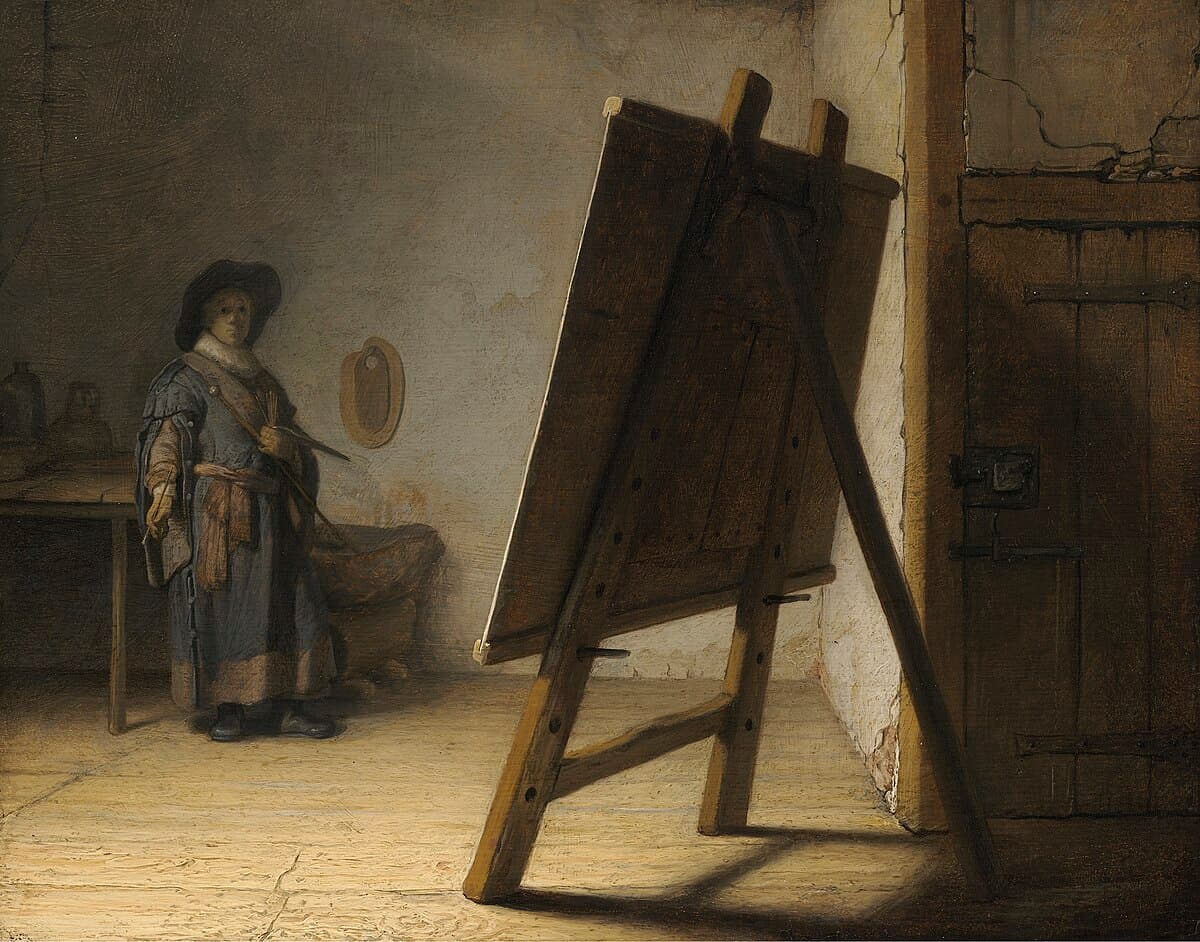
Rembrandt painted The Artist in his Studio around 1629, an early work depicting a painter standing back from his easel in a bare room. The figure is often thought to be Rembrandt himself, though some scholars suggest it might be his young pupil Gerrit Dou. The small figure stands far from the canvas, contemplating his work before approaching.
The studio contains only essentials: an easel with its back to the viewer, a grinding stone for preparing paints, two palettes on the wall, and bottles for oil and varnish. This spareness focuses attention on the psychological moment before creation, the artist gathering courage to begin. Warm earth tones suffuse the scene.
The panel measures 25 by 32 centimeters and hangs at the Museum of Fine Arts in Boston. Zoe Oliver Sherman donated it in 1938. At auction in 1850, it sold for only six guineas. The painting captures anxiety familiar to every artist facing a blank surface.