Public Domain
Jean Lutma
Artwork Details
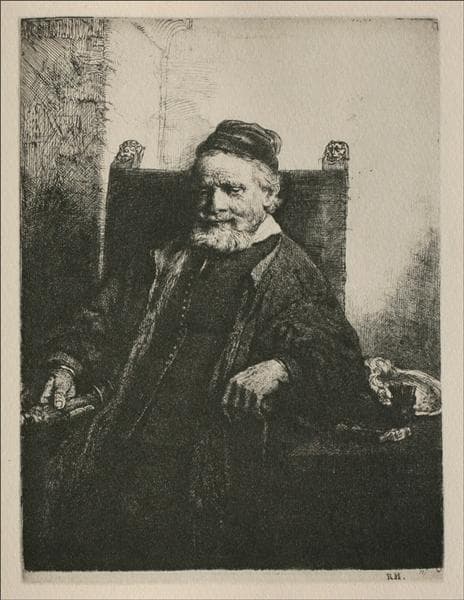
Rembrandt van Rijn made this etching and drypoint portrait of goldsmith Jan Lutma in 1656. The print shows Lutma seated in a leather-backed chair decorated with carved lion's head finials. He holds one of his own creations, a sculptured candlestick, while tools of his trade rest on the table beside him: a hammer, punches, and a small oval dish in the auricular style.
Lutma (c.1584-1669) was born in Emden, East Friesland, and moved to Amsterdam in 1621 after spending time in Paris. He became one of the city's most respected silversmiths, known for working in the auricular style, a flowing decorative approach that resembled ear cartilage. He received major commissions, including the rood screen for Amsterdam's Nieuwe Kerk. His son, Jan Lutma the younger, likely trained as an etcher in Rembrandt's studio.
The print exists in multiple states. In the second state, Rembrandt added a deep alcove and window behind the sitter, along with a glass bottle on the windowsill and his signature in the upper left window pane. The image measures about 19.7 by 14.9 centimeters (roughly 7.75 by 5.88 inches). Impressions are held by the Metropolitan Museum of Art, the Art Institute of Chicago, the British Museum, and other major collections.