Wikimedia Commons • Public Domain
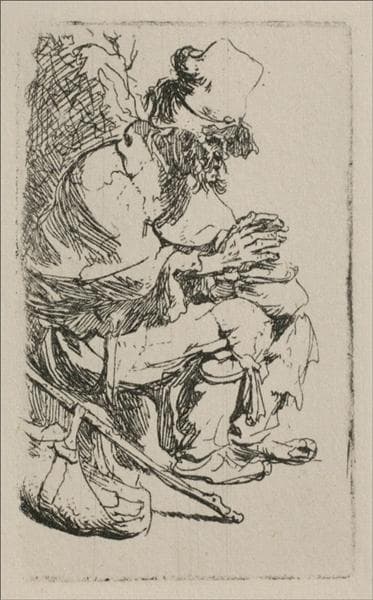
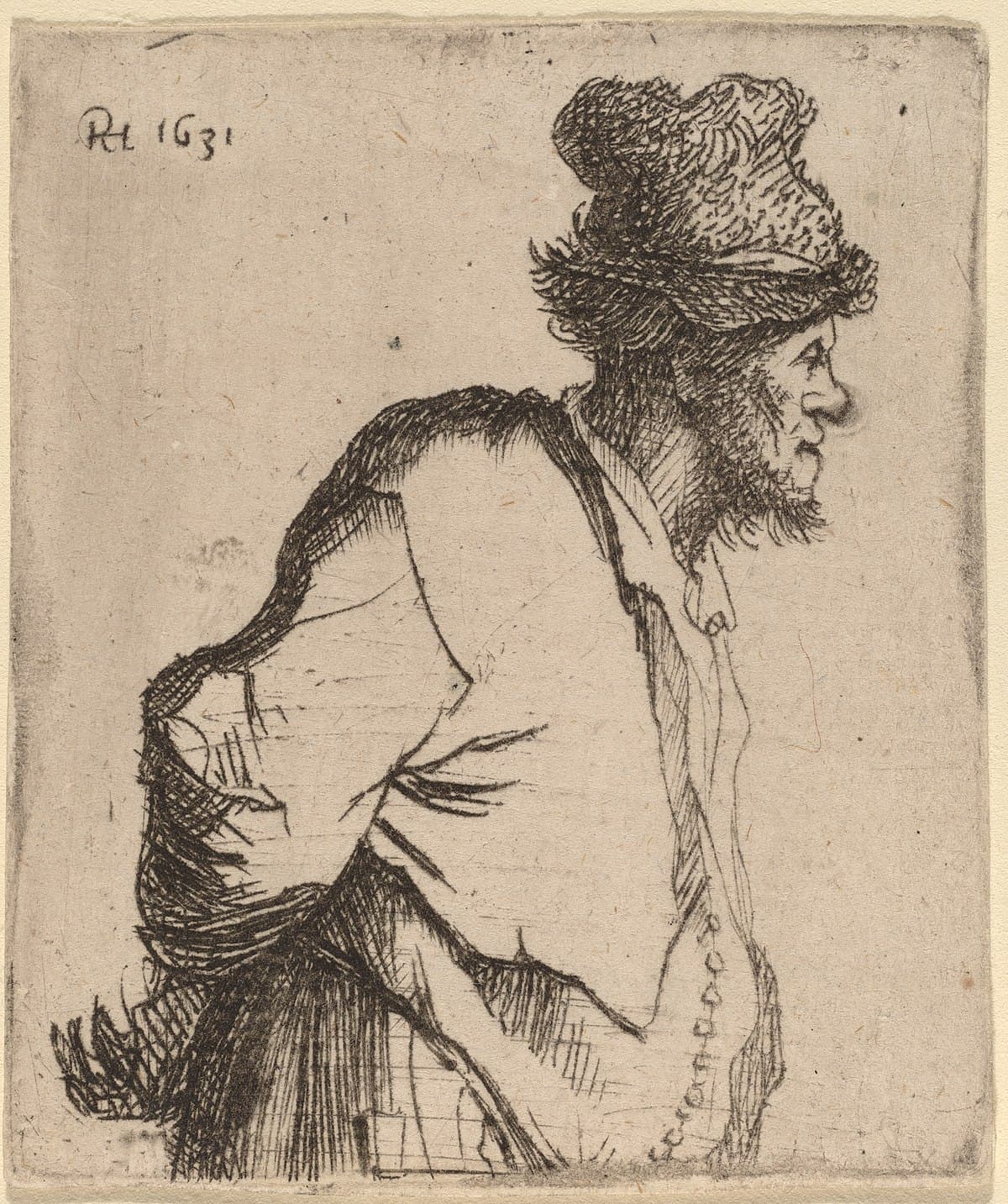
Peasant with his hands behind his back
Artwork Details
Rembrandt van Rijn made this small etching around 1629, early in his career. The print shows a peasant man turned in profile, his hands clasped behind his back in a moment of rest or contemplation. The figure wears simple, functional clothing with a turban-like head covering, an unusual touch that adds an exotic element to this depiction of a common man.
This work belongs to Rembrandt's explorations of genre subjects. His etchings of peasants, beggars, and street characters demonstrate his interest in ordinary people rather than just wealthy patrons and biblical figures. The weather-beaten face shows careful attention to expressive detail, with lines etched to convey age and labor.
The tiny plate measures only about 6 by 5 centimeters (2.4 by 2 inches), yet contains precise observation. Major collections hold impressions of this print, including the Rijksmuseum in Amsterdam, the Morgan Library in New York, and the Art Institute of Chicago. The State Hermitage Museum in St. Petersburg also holds Rembrandt's work. His early etchings established his reputation as a printmaker alongside his growing fame as a portrait painter.