Edward Hopper
American·1882–1967
No Portrait Available
American Realist painter Edward Hopper (1882-1967) captured urban isolation and psychological tension through ordinary scenes that shock viewers into recognizing the strangeness of familiar places. Born in Nyack, New York to a middle-class family, he studied at the New York School of Art under William Merritt Chase and Robert Henri, who urged students to paint the everyday conditions of their own world.
Hopper worked as a commercial illustrator for years while developing his personal vision. Three trips to Paris between 1906 and 1910 introduced him to Impressionism, but he found his true subjects in American diners, gas stations, movie theaters, and empty offices. He married fellow artist Josephine Nivison in 1924; she became his only model for female figures and kept detailed records of his work.
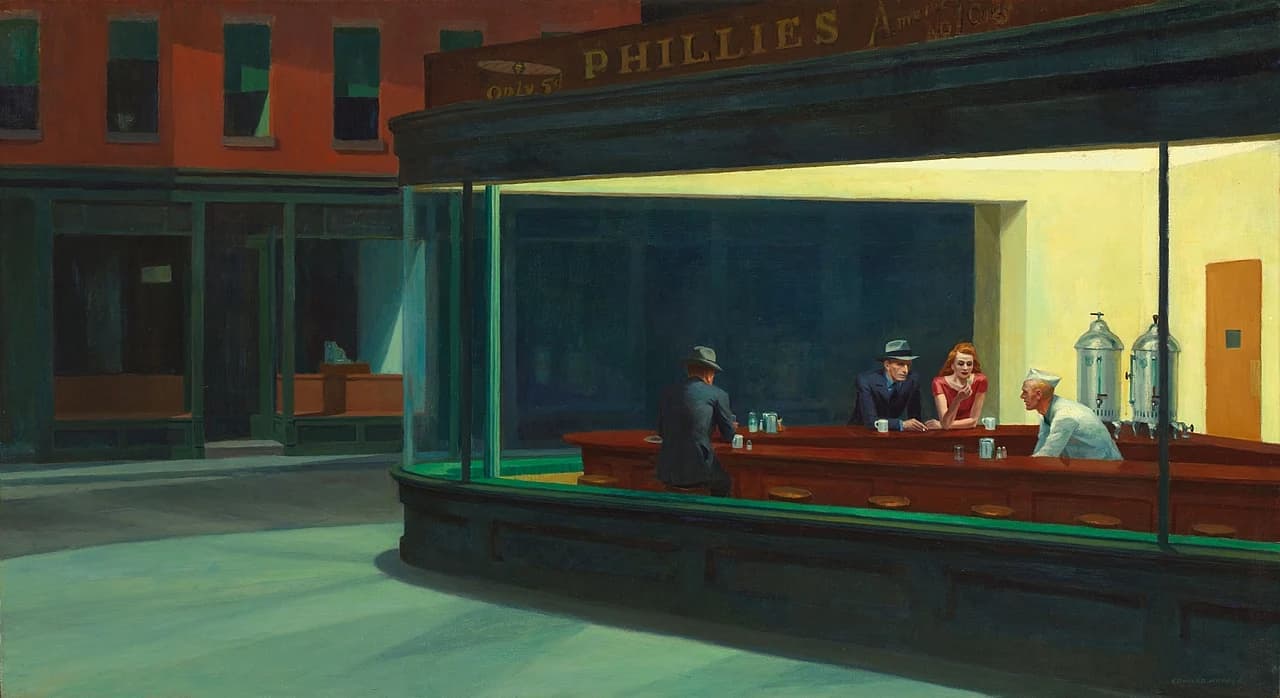
Nighthawks (1942), showing four people in a late-night diner viewed through its plate glass window, became one of the most recognized paintings in American art. Hopper said it was inspired by a Greenwich Village restaurant and admitted, "unconsciously, probably, I was painting the loneliness of a large city." He made 19 preparatory studies for the work. Hopper influenced Pop Art and New Realist painters of the 1960s and 70s. The Art Institute of Chicago owns Nighthawks. The Whitney Museum in New York holds the largest collection of his work. The Museum of Modern Art and Metropolitan Museum display major paintings.
Notable Works by Edward Hopper
8 paintings catalogued with museum locations
Museums with Edward Hopper's Work
5 museums display Hopper's works. Click any museum to see visiting info and the specific works they hold.
Related Artists
Other American Realism artists you might like
About Edward Hopper
Hopper painted scenes of urban isolation and everyday American life. Nighthawks (1942), showing a late-night diner, is one of the most recognized paintings in American art.
Nighthawks hangs at the Art Institute of Chicago, one of the museum's most visited works. It was sold to the museum for $3,000 shortly after completion.
The Whitney Museum holds the largest Hopper collection. The MoMA and Metropolitan Museum also display major works.
Hopper is the defining figure of American Realism. His work influenced Pop Art and New Realist painters of the 1960s and 70s.
Hopper painted diners, gas stations, movie theaters, hotel rooms, and empty offices. His scenes capture modern American life with psychological intensity and stark simplicity.
Josephine Nivison was Hopper's wife and fellow artist. She modeled for every female figure in his paintings, including the red-haired woman in Nighthawks.
Love Edward Hopper's Style?
Explore art inspired by American Realism.
Browse Collection