James Ensor
Belgian·1860–1949
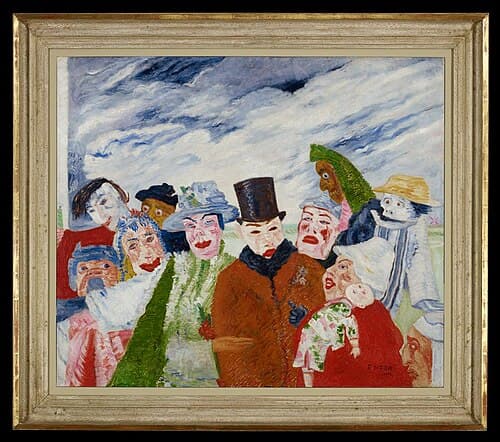
James Ensor (1860–1949) filled his canvases with masks, skeletons, and grotesque crowds. Born in Ostend, Belgium, the son of an English father and Belgian mother who ran a souvenir shop selling carnival masks and curiosities, he was fascinated by these masks from childhood. They would haunt his paintings for sixty years.
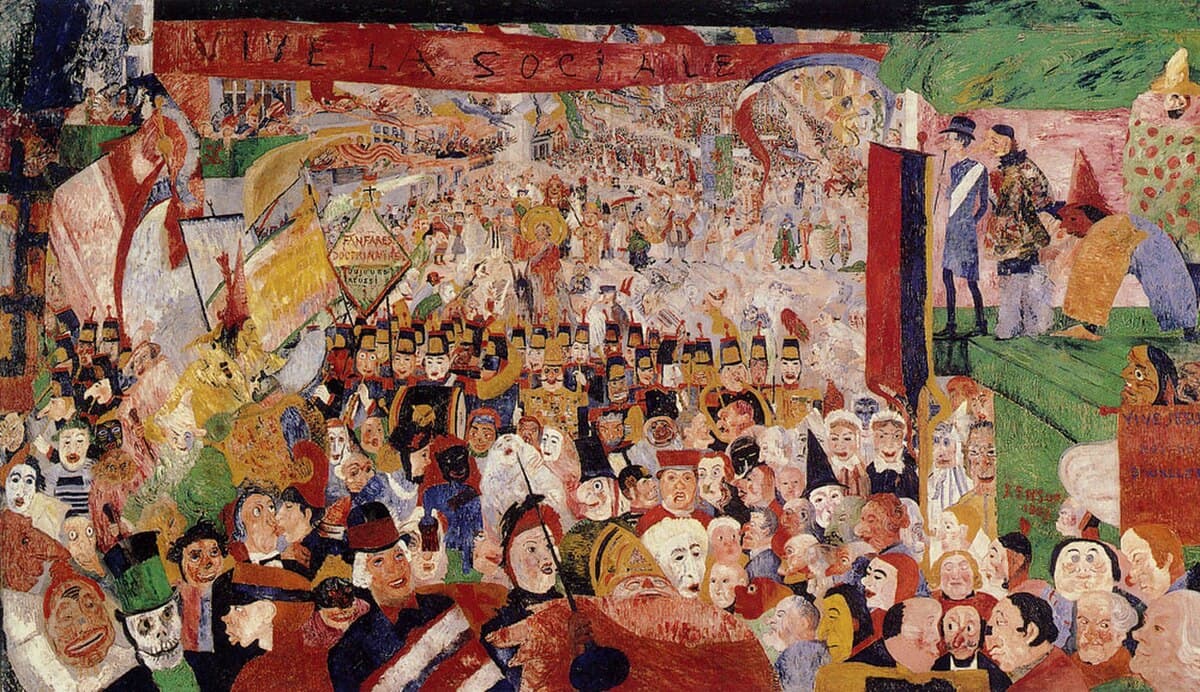
After studying at the Brussels Royal Academy, Ensor returned to Ostend and rarely left. His early realistic works gave way to bizarre subject matter by the mid-1880s. Paintings like Skeletons Fighting over a Hanged Man (1891) and The Scandalized Masks (1883) use carnival imagery to expose human ugliness. His masterpiece, the enormous Christ's Entry into Brussels in 1889 (1888), depicts Jesus amid a grotesque parade of masked revelers, a work considered a forerunner of 20th-century Expressionism.
For years, critics rejected his work as offensive and obscene. The avant-garde Les XX group expelled him. But recognition eventually came. In 1929, King Albert I made him a Baron. In 1933, France decorated him with the Legion of Honor. By his old age, Ensor was a beloved figure in Ostend, taking daily walks through the town. He influenced German Expressionists like Emil Nolde and George Grosz, and later the Surrealists. He died in Ostend at eighty-nine. His work fills the Royal Museums of Fine Arts in Brussels and the Museum of Modern Art.
Primary Genres
Notable Works by James Ensor
2 paintings catalogued with museum locations
Museums with James Ensor's Work
2 museums display Ensor's works. Click any museum to see visiting info and the specific works they hold.
Related Artists
Other Symbolism artists you might like
About James Ensor
Ensor was famous for grotesque masks, skeletons, and carnival imagery that satirized Belgian bourgeois society. His parents ran a souvenir shop selling carnival masks in Ostend, and these objects became central to his art. He used masks to expose what he saw as human ugliness hiding beneath respectable social facades.
His masterpiece Christ's Entry into Brussels is at the Getty Center in Los Angeles, purchased in 1987 for €9 million despite Belgian protests. Major collections are also at the Royal Museums of Fine Arts of Belgium in Brussels, the Museum of Modern Art in New York, and Mu.ZEE in his hometown Ostend.
Ensor is considered a forerunner of Expressionism and influenced the Surrealists. German Expressionists like Emil Nolde admired his aggressive brushwork and disturbing imagery. His treatment of macabre subjects anticipated 20th-century movements that rejected naturalism and academic conventions.
Christ's Entry into Brussels in 1889 (1888), a massive canvas measuring 2.5 by 4.3 meters, depicts Jesus amid a grotesque carnival parade where no one pays him any attention. He used brushes, palette knives, and spatulas with crude, heavy strokes. It's considered a landmark of modern art and precursor to Expressionism.
His parents ran a souvenir shop selling carnival masks in the Belgian seaside town of Ostend, where he spent his entire life. For Ensor, masks didn't hide the face but revealed inner human ugliness and hypocrisy. They gave him license to push artistic boundaries and expose the psychological deficiencies of Belgian society.
Love James Ensor's Style?
Explore art inspired by Symbolism.
Browse Collection