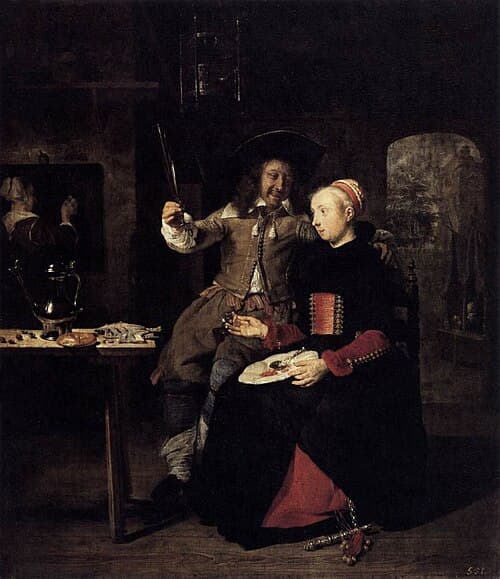
Paulus Potter
Dutch·1625–1654
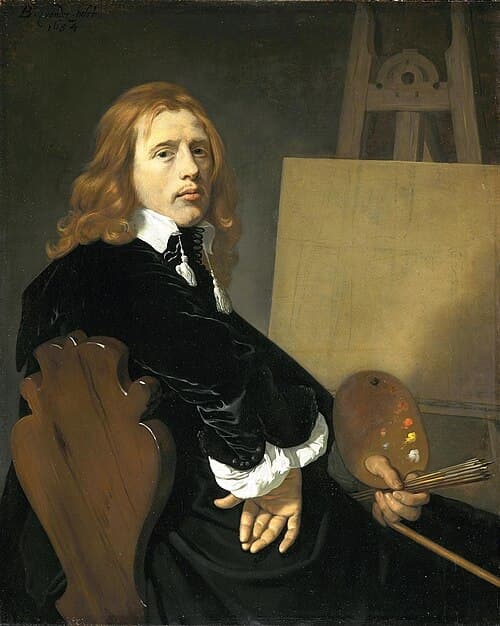
Dutch Golden Age painter Paulus Potter (1625-1654) was probably the first dedicated animal painter in Western art, producing about one hundred paintings before tuberculosis killed him at age twenty-eight. Born in Enkhuizen and trained by his father Pieter Symonsz Potter in Amsterdam, he joined the Guild of Saint Luke in Delft before moving to The Hague in 1649. His 1650 marriage to Adriana van Balckeneynde connected him to Dutch elite through his father-in-law, a leading building contractor, and in 1652, the famous physician Nicolaes Tulp invited him to Amsterdam.
Potter's animals appear prominently in all his works, usually silhouetted against the sky or grouped with peasant figures in extensive landscapes. His most famous painting, The Young Bull (1647), hangs at the Mauritshuis in The Hague. At nearly life-sized scale (235 x 339 cm), this almost hyperreal portrait combines parts from different bulls into a composite animal representing prosperity, the bull being a symbol of Dutch wealth. Napoleon seized the painting in 1795, and it hung in the Louvre for twenty years before its 1815 return. The Getty Museum notes that in 19th-century Netherlands, The Young Bull rivaled Rembrandt's Night Watch in fame. Potter's cow and cattle paintings, along with works featuring horses, dogs, and other livestock, hang at the Rijksmuseum, the Alte Pinakothek in Munich, and the Museum of Fine Arts, Boston. Despite his brief career, Potter established animal painting as a serious genre.
Notable Works by Paulus Potter
1 painting catalogued with museum locations

Museums with Paulus Potter's Work
1 museum displays Potter's works. Click any museum to see visiting info and the specific works they hold.
Related Artists
Other Dutch Golden Age artists you might like
About Paulus Potter
Potter worked during the Dutch Golden Age, pioneering animal painting as a dedicated genre worthy of monumental treatment. His scientific observation of cattle and horses elevated subjects previously considered minor to the status of history painting.
The Young Bull (1647) at the Mauritshuis is a nearly life-sized portrait of a bull that rivaled Rembrandt's Night Watch in 19th-century fame. Napoleon tried to steal it for the Louvre, considering it among Europe's greatest paintings.
Major works are at the Mauritshuis in The Hague, the Rijksmuseum in Amsterdam, and the Alte Pinakothek in Munich. His cattle paintings appear in major collections throughout Europe.
Potter painted for about ten years before dying of tuberculosis at age twenty-eight in 1654. Despite this tragically brief career, he produced around one hundred paintings that transformed how artists approached animal subjects, influencing painters for centuries.
Potter specialized in animal paintings featuring cattle, horses, sheep, and dogs in pastoral Dutch landscapes. His animals are often silhouetted dramatically against cloudy skies, portrayed with an attention to individual character that treated them as portrait subjects.
Love Paulus Potter's Style?
Explore art inspired by Dutch Golden Age.
Browse Collection