Wikimedia Commons • Public Domain
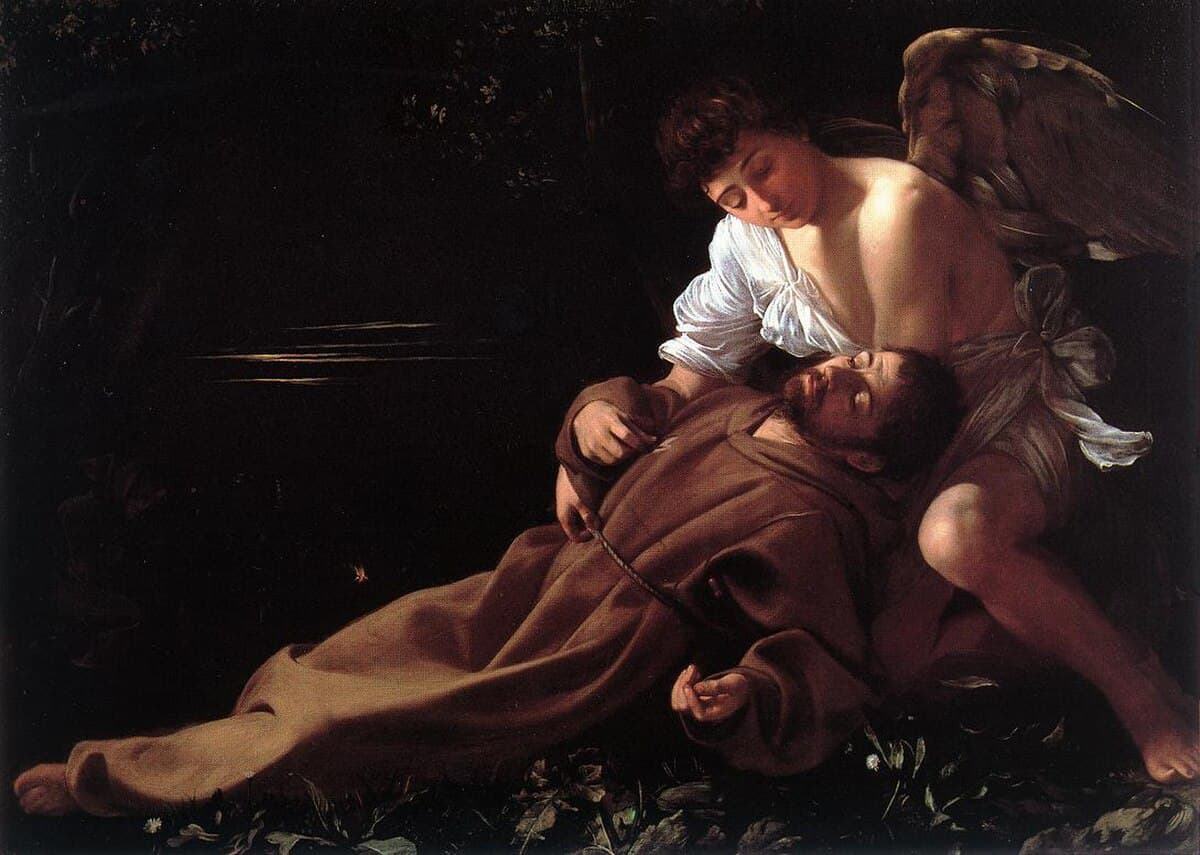
Saint Francis of Assisi in Ecstasy
by Caravaggio
Artwork Details
Cite or Embed This Work
APA · MLA · Chicago1-click academic citation and embeddable “On View” museum badge for articles, syllabi, and research.
Caravaggio composed this scene around 1594-1595, making it his first religious canvas. The subject honored his patron Cardinal Francesco Maria Del Monte, whose name-saint was Francis of Assisi. The painting shows Francis just after receiving the stigmata, the wounds of Christ's crucifixion appearing on his hands and side. An angel supports the swooning saint as he sinks backward in spiritual transport.
What makes Caravaggio's version unusual is its restraint. Earlier artists showed Francis confronted by a terrifying seraph, blood streaming from fresh wounds. Here there's almost nothing to indicate the subject beyond the Franciscan robe. The stigmata are barely visible. One wound on Francis's right hand may have been painted over, possibly by Caravaggio himself, shifting the drama from outward signs to inner feeling. The angel looks less like a divine messenger than a teenage boy in a sheet with stage-prop wings.
The Wadsworth Atheneum in Hartford, Connecticut acquired the painting in 1943 for $17,000, making it the first authenticated Caravaggio to enter an American public museum. Francis's face reportedly bears the features of Cardinal Del Monte himself, a common practice when patrons commissioned religious works featuring their patron saints.