Wikimedia Commons • Public Domain
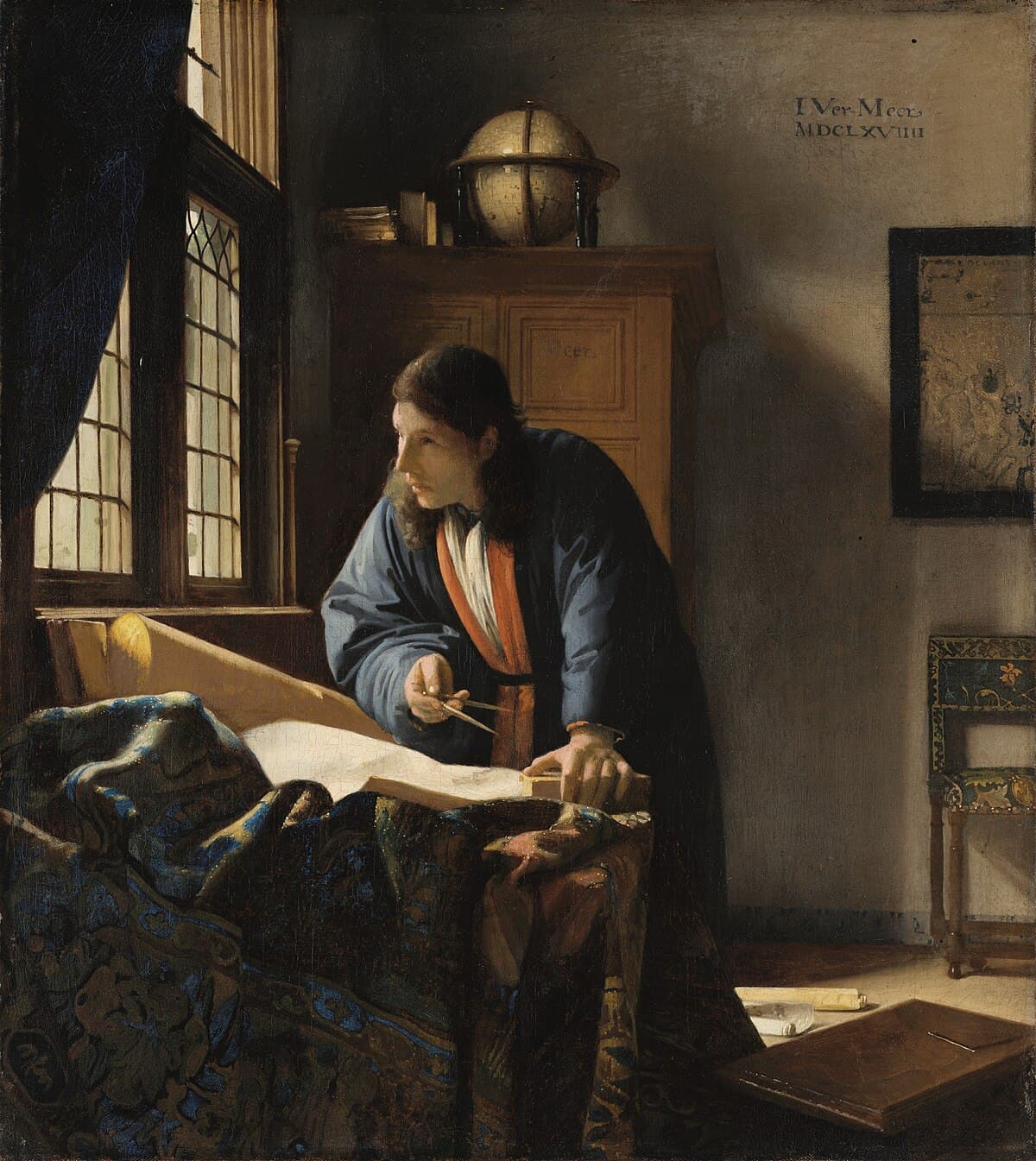
The Geographer
by Johannes Vermeer, 1668
Artwork Details
Details
- Year
- 1668
Johannes Vermeer painted The Geographer between 1668 and 1669, showing a scholar dressed in a Japanese-style robe, dividers in hand, caught mid-thought as he gazes toward a window. Maps, charts, and a celestial globe crowd the room. The figure leans forward with a kind of restless energy unusual for Vermeer's typically still compositions. Light floods in from the left, illuminating the geographer's face and the tools of his trade scattered across the table.
This is one of only three paintings Vermeer signed and dated, and he did it twice here. Technical examination confirmed both signatures are original. The painting forms a pair with The Astronomer, created around the same time using the same model and even canvas from the same bolt of material. Some art historians believe the sitter was Antonie van Leeuwenhoek, the pioneering microscopist who lived blocks away from Vermeer in Delft. Both men were born within a week of each other in 1632. Van Leeuwenhoek would later serve as trustee of Vermeer's estate after the artist's death.
The globe on the cupboard shows the Indian Ocean, a nod to Dutch maritime trade, while the wall chart depicts European coastlines published by Willem Blaeu. The Geographer now hangs at the Städel Museum in Frankfurt, where it remains one of the most studied examples of Dutch Golden Age painting.