Wikimedia Commons • Public Domain
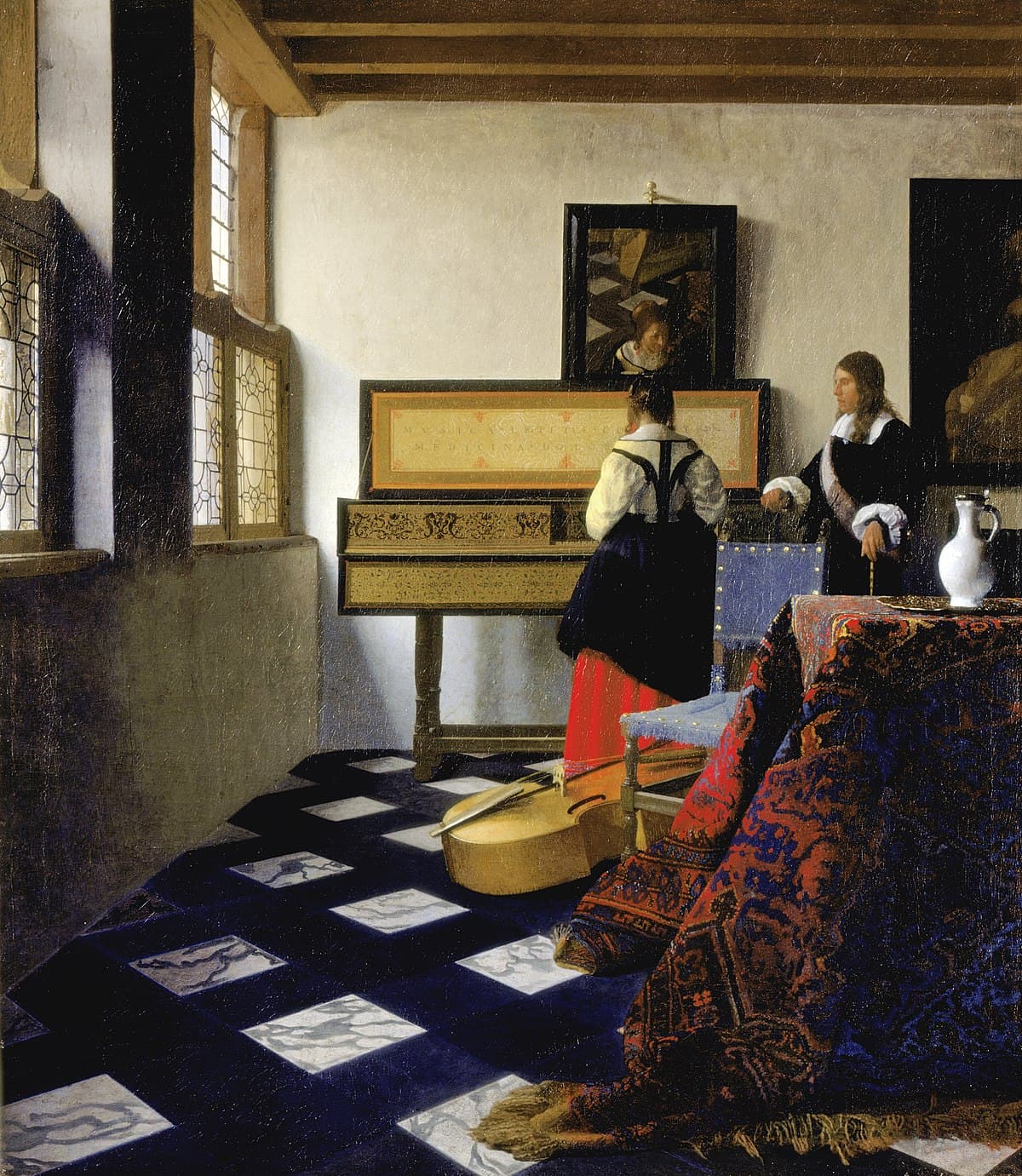
The Music Lesson
by Johannes Vermeer, 1675
Artwork Details
Details
- Year
- 1675
Johannes Vermeer painted The Music Lesson around 1662-1664, creating one of his most sophisticated explorations of space, light, and human connection. A young woman stands at a virginal (a type of keyboard instrument) while a gentleman watches from beside her. The instrument's lid bears a Latin inscription: "MUSICA LETITIAE COMES MEDICINA DOLORUM" (Music is the companion of joy and the medicine of sorrow).
Vermeer hides a secret in the tilted mirror above the virginal. While the woman appears to focus on her playing when viewed directly, her reflection shows her turning toward the man. This subtle revelation transforms a music lesson into something more intimate, suggesting romantic attachment beneath the formal surface. The painting brilliantly uses space, pulling viewers through the foreground table and chairs toward the distant figures.
King George III purchased this painting in 1762, and it has remained in the Royal Collection ever since. Unlike most Vermeers in public museums, it hangs in the private apartments of British monarchs, though it occasionally appears in exhibitions. The work demonstrates why Vermeer's interior scenes continue to fascinate viewers centuries later.