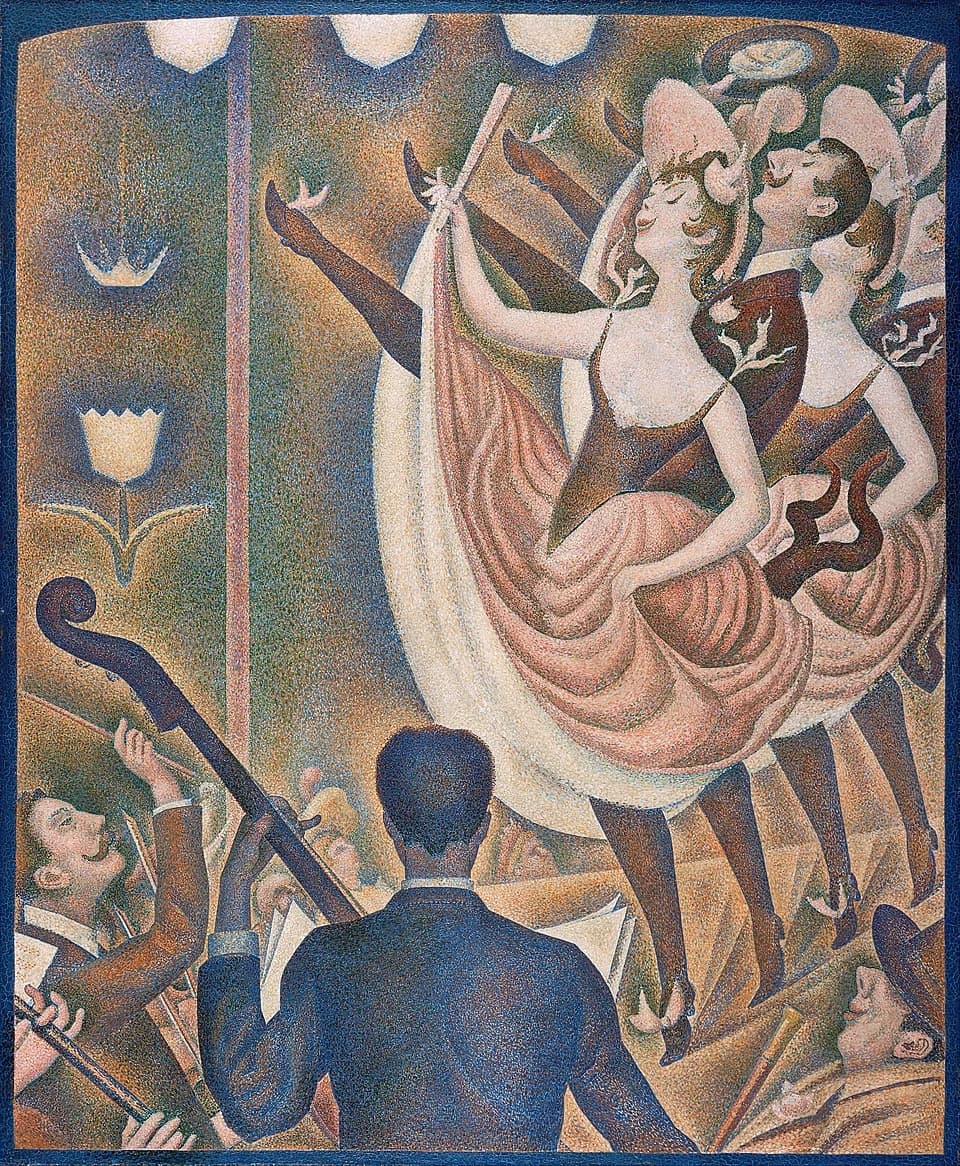
The Circus
by Georges Seurat, 1891
StylePost-Impressionism
Artwork Details
Details
- Year
- 1891
- Medium
- Oil on canvas
- Size
- 185.5 cm × 152.5 cm
Cite or Embed This Work
APA · MLA · Chicago1-click academic citation and embeddable “On View” museum badge for articles, syllabi, and research.
Georges Seurat began The Circus in 1890, his third major work exploring the theme. It shows a female rider balanced on horseback at the Circus Fernando (renamed Cirque Médrano after its famous clown). A ringmaster cracks his whip. Acrobats tumble in the background. The audience rises in tiered rows, their faces simplified into patterns of dots.
Seurat died of diphtheria in March 1891, just days after the Salon des Indépendants opened with this painting on display. He was 31. The work remained unfinished. You can still see the white ground and blue compositional grid showing through in places. At 185 by 152 centimeters, it's an ambitious final statement cut short.
The painting went to Paul Signac around 1900, then to American collector John Quinn, who donated it to the Louvre in 1927. It now hangs at the Musée d'Orsay. Seurat applied his Divisionist theories rigorously here, building forms from tiny dots of color that optically mix in the viewer's eye.