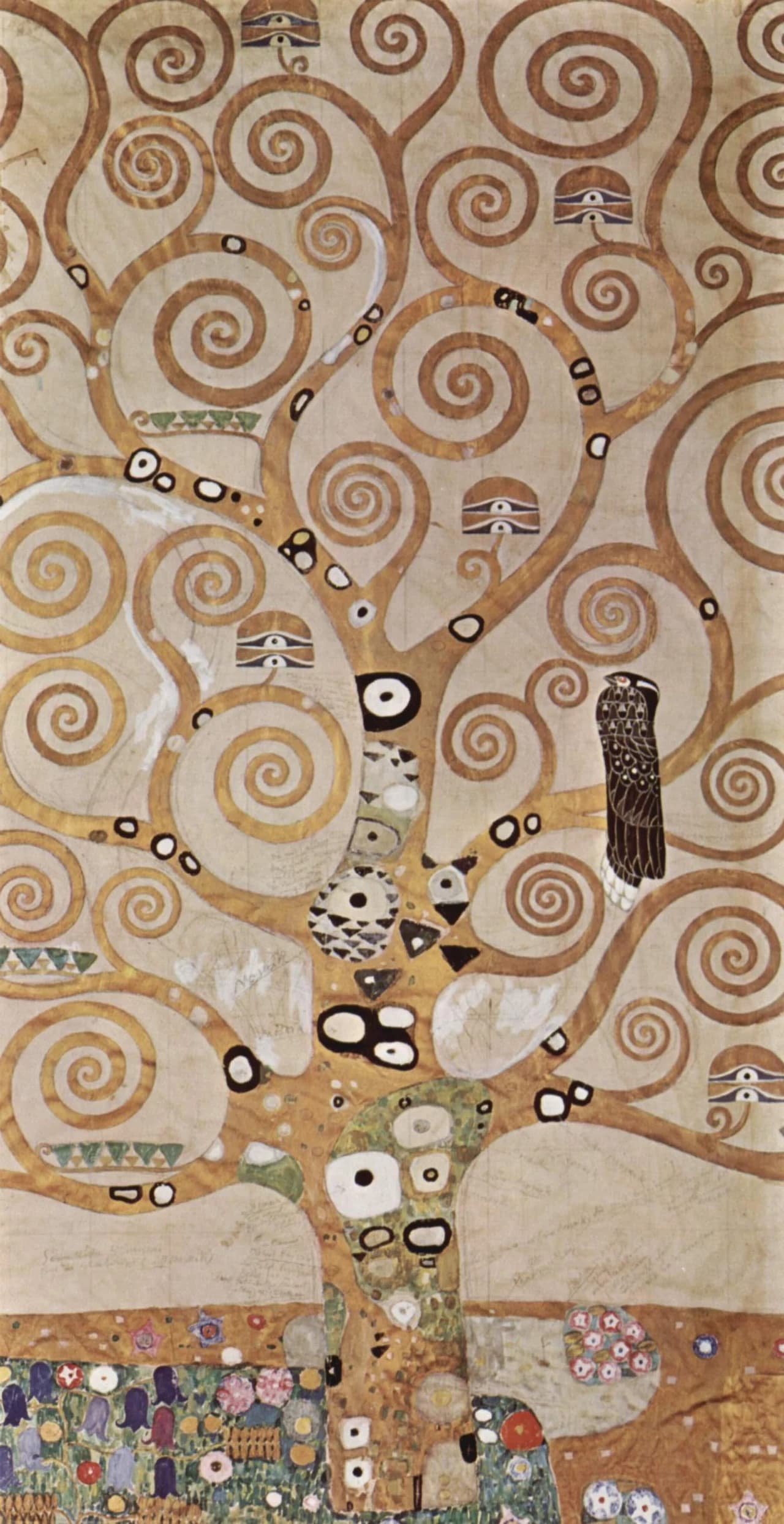
The Tree of Life
by Gustav Klimt, 1909
Artwork Details
Details
- Year
- 1909
- Medium
- Various media on paper
- Size
- 195 cm × 102 cm
Gustav Klimt created The Tree of Life between 1905 and 1911 as the central element of the Stoclet Frieze, a monumental mosaic commission for a Brussels mansion. The swirling tree spirals across the composition, its branches becoming elaborate volutes studded with symbolic motifs: eyes, triangles, birds, and flowers.
Belgian financier Adolphe Stoclet and his wife Suzanne hired architect Josef Hoffmann and the Wiener Werkstätte collective to design their new home. Klimt received the commission for the dining room frieze. His preparatory drawings, done at 1:1 scale, were executed as mosaics using enamel, mother-of-pearl, coral, and gold leaf. Only the finest materials were acceptable.
The preparatory paintings measure 195 by 102 centimeters and are housed at MAK Vienna (Museum of Applied Arts). The actual mosaic frieze remains in the Palais Stoclet, a UNESCO World Heritage Site since 2009 that's still privately owned and rarely accessible. This project represents Klimt's most ambitious decorative work, blending Art Nouveau, Byzantine, Egyptian, and Japanese influences.