Rudolf Ernst
Austrian·1854–1932
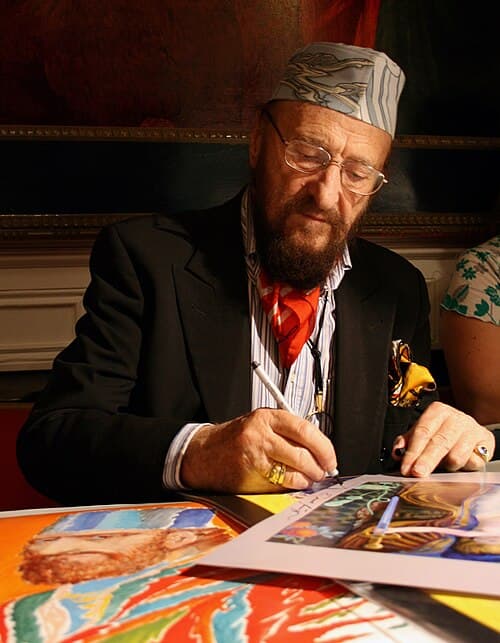
Rudolf Ernst (1854–1932) transported viewers to an idealized Islamic world. Born in Vienna to the architect Leopold Ernst, he began studying at the Academy of Fine Arts Vienna at fifteen. He spent time in Rome copying old masters before continuing lessons with August Eisenmenger and Anselm Feuerbach in Vienna.
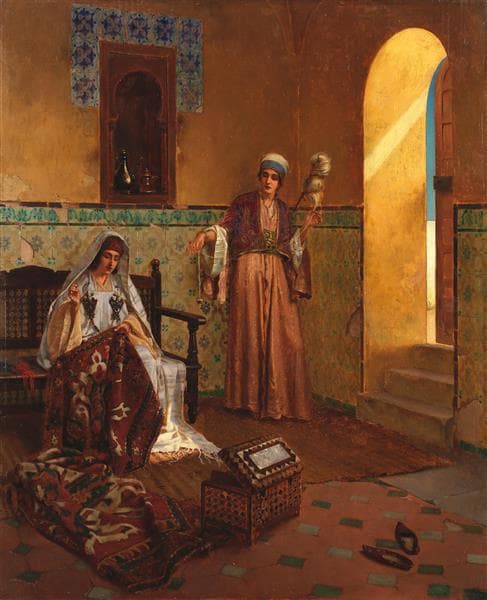
In 1876, Ernst settled in Paris, exhibiting under the French name "Rodolphe Ernst." He began as a genre painter but from 1885 devoted himself entirely to Orientalist subjects. He traveled to Spain, Morocco, Egypt, and Istanbul, sketching monuments and daily life. Back in his studio, he created richly detailed scenes of mosques, harems, markets, and palace interiors bathed in warm yellows and oranges.
His work often focuses on one or two figures in fantastical Islamic settings: harem guards, merchants, elegantly costumed women on luxurious terraces. He was friends with fellow Orientalist Ludwig Deutsch, and their styles share similarities. In 1905, Ernst moved to Fontenay-aux-Roses, where he set up a shop producing faience tiles with Orientalist themes. He decorated his home in Ottoman style and lived reclusive final years. His exact death date went unrecorded, but he died around 1932. His paintings appear at the Dahesh Museum of Art in New York and the Musée des Beaux-Arts de Nantes.
Notable Works by Rudolf Ernst
2 paintings catalogued with museum locations
Museums with Rudolf Ernst's Work
1 museum displays Ernst's works. Click any museum to see visiting info and the specific works they hold.
Related Artists
Other Orientalism artists you might like
About Rudolf Ernst
Ernst specialized in Orientalist subjects: mosque interiors with elaborate tilework, harem scenes, markets, and palace settings from the Islamic world. He painted with warm golden tones and fine detail, creating atmospheric scenes that transported European viewers to an exotic, romanticized East.
His work is at the Dahesh Museum of Art in New York, the Musée des Beaux-Arts de Nantes, and the Shafik Gabr Collection. Many paintings remain in private collections, as his detailed Orientalist scenes have attracted Middle Eastern collectors in recent decades.
Ernst was Austrian, born in Vienna in 1854, but he spent most of his career in Paris and exhibited under the French name 'Rodolphe Ernst.' He became a French citizen and was deeply connected to the Parisian art world's Orientalist circles throughout his long career.
Yes, he traveled extensively to Spain, Morocco, Egypt, and Istanbul to sketch Islamic monuments, daily life, and architectural details. These studies informed his studio paintings, giving them an authenticity of detail that set them apart. He was particularly fascinated by mosque architecture and decorative tilework.
In 1905, he moved to Fontenay-aux-Roses outside Paris and produced faience tiles with Orientalist themes, extending his aesthetic into decorative arts. He decorated his own home in Ottoman style with tiles, fabrics, and objects collected during his travels, living reclusively surrounded by his Middle Eastern collection until his death in 1932.
Love Rudolf Ernst's Style?
Explore art inspired by Orientalism.
Browse Collection