Public Domain
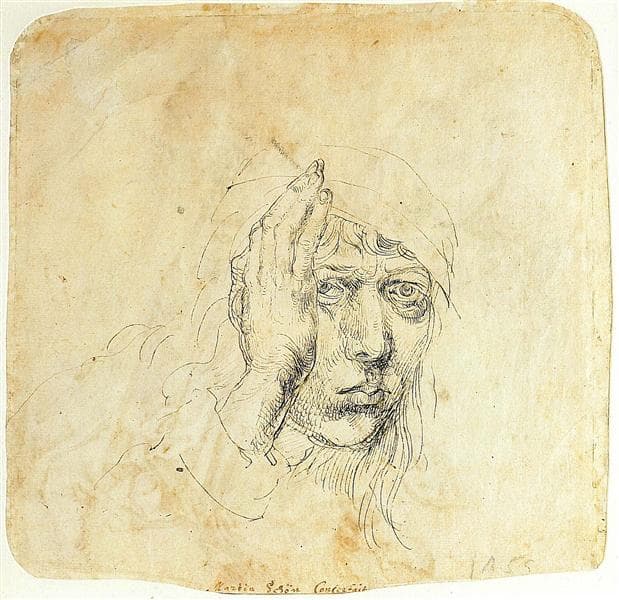
Self-Portrait with a wrap
Artwork Details
Albrecht Dürer created the silverpoint self-portrait in 1484 when he was just thirteen years old. The drawing shows the young artist in three-quarter view, wearing a cap and wrapped garment, his right hand pointing toward himself in a gesture that may indicate the difficulty of drawing with a mirror. The notable skill displayed at such a young age marks it as one of art history's most precocious works.
Silverpoint is an unforgiving medium. The metal stylus leaves permanent marks on specially prepared paper, allowing no erasure or correction. That a thirteen-year-old could produce such confident, accurate linework speaks to extraordinary natural talent combined with rigorous training in his father's goldsmith workshop. Dürer later added an inscription identifying the drawing as his own work from childhood, recognizing its significance to his artistic development.
This is the earliest known self-portrait by any artist who would go on to major historical importance. While medieval artists occasionally included themselves in larger compositions, the independent self-portrait as a genre barely existed before Dürer. The drawing now belongs to the Albertina in Vienna, where it represents the origins of both Dürer's career and the modern tradition of artistic self-examination.