Public Domain
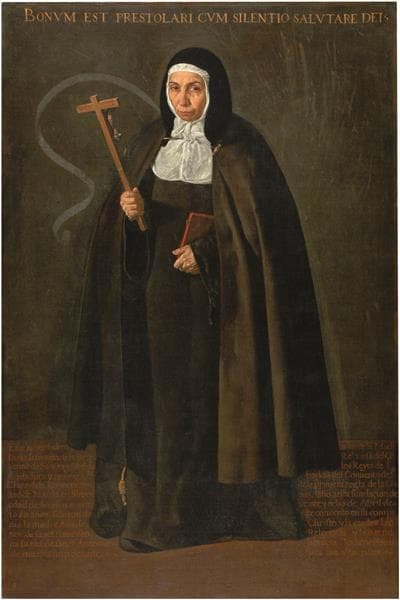
Madre Maria Jeronima de la Fuente
Artwork Details
Diego Velázquez executed this powerful portrait in 1620 when he was just twenty-one years old, capturing the Franciscan nun María Jerónima de la Fuente as she prepared to depart Spain for the Philippines. She traveled there to found a convent, a journey from which she knew she would never return. The inscription on the painting records her mission: to suffer and die for Christ among the pagans.
Velázquez portrays the nun with unflinching realism. Her weathered face shows determination rather than serenity, her grip on the crucifix suggesting fierce conviction. No softening idealization smooths her features. This directness was unusual for religious portraiture, which typically emphasized spiritual transcendence over physical presence. The young Velázquez already demonstrated the psychological penetration that would later make him court painter to Philip IV.
The dark background and stark lighting concentrate attention entirely on the sitter and her crucifix. This economy of means would remain characteristic of Velázquez's mature work. María Jerónima successfully established her convent in Manila and died there in 1630. Her portrait now hangs at the Museo del Prado in Madrid, an early work from one of history's greatest portrait painters.