Wikimedia Commons • Public Domain
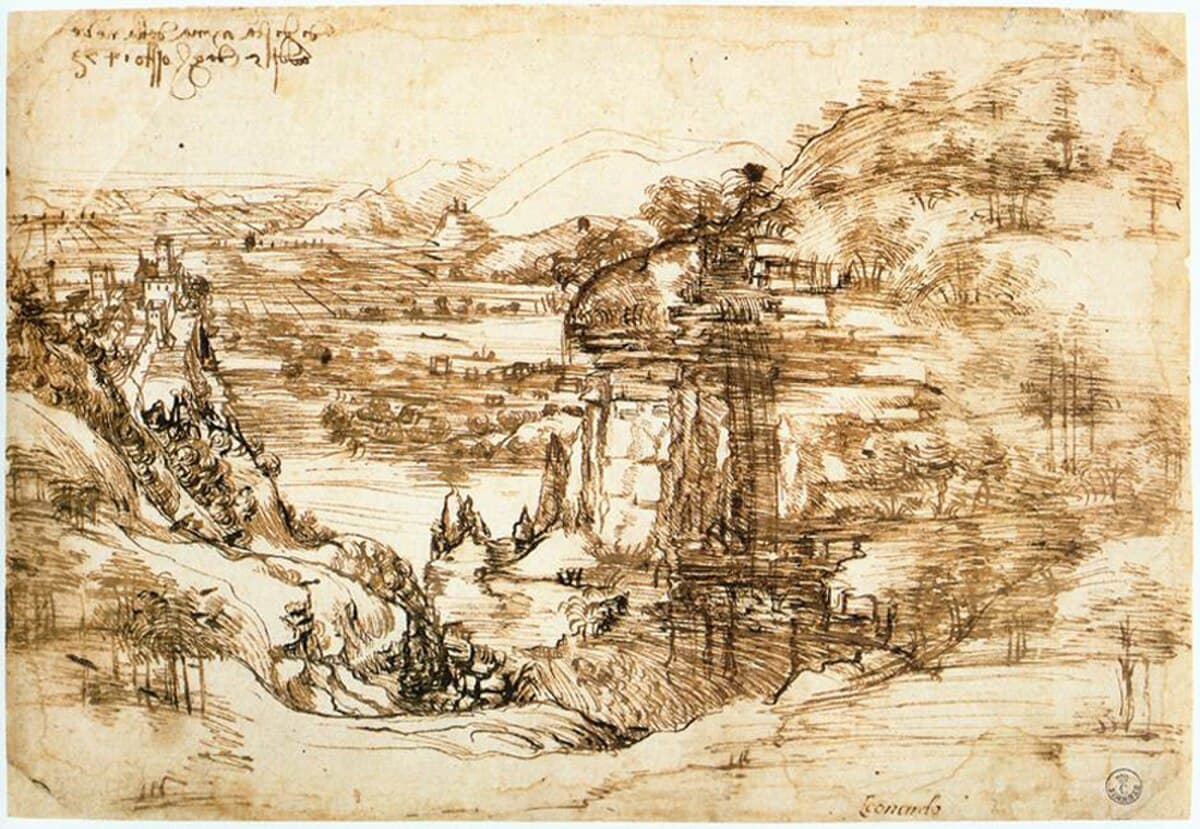
Landscape drawing for Santa Maria della Neve
Artwork Details
Leonardo da Vinci drew this landscape on August 5, 1473, inscribing the date in his characteristic mirror writing: "On the day of St. Mary of the Snow." He was twenty-one years old, still an apprentice in Verrocchio's workshop, and he'd just created something unprecedented. This is the first known pure landscape in Western art, a drawing made simply to record a view rather than serve as background for religious figures or historical scenes.
The scene shows the Arno valley near Vinci, Leonardo's hometown, with Montelupo Castle visible in the distance. Pen and ink capture the rolling Tuscan hills, a waterfall or rapids in the river below, and careful attention to how trees and rock formations occupy space. Before this drawing, landscapes existed only as settings for human stories. No artist had thought to make the land itself the subject. Peter Paul Rubens wouldn't paint a complete landscape for another two hundred years.
The small drawing measures just 19 by 28.5 centimeters. In 2019 it returned to Vinci for the 500th anniversary of Leonardo's death, the first time it had been in his birthplace since he created it. The sketch normally hangs at the Uffizi Gallery in Florence, where it's recognized as both Leonardo's earliest dated work and a turning point in the history of Western art.