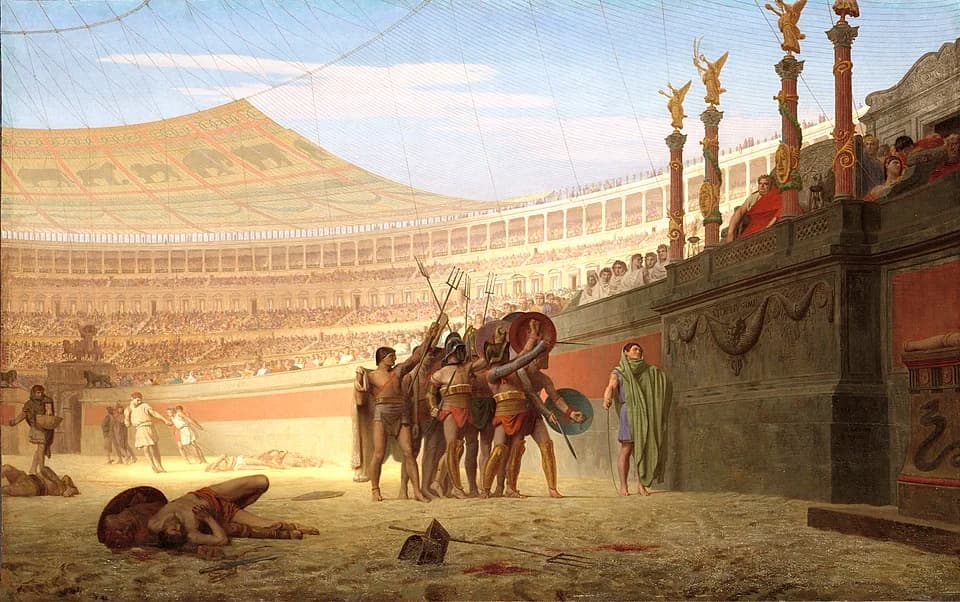
Pollice Verso
by Jean-Léon Gérôme, 1872
Artwork Details
Details
- Year
- 1872
- Medium
- Oil on canvas
- Size
- 97.5 cm × 146.7 cm
Cite or Embed This Work
APA · MLA · Chicago1-click academic citation and embeddable “On View” museum badge for articles, syllabi, and research.
Jean-Léon Gérôme painted this dramatic gladiatorial scene in 1872. A victorious fighter stands over his fallen opponent in a Roman arena, looking up at the Vestal Virgins who signal death with turned thumbs. The crowd roars from the stands, and the composition captures the violence and spectacle of ancient combat.
Gérôme researched Roman history carefully, basing the arena's architecture on accurate drawings and the gladiators' armor on artifacts found at Pompeii. But his most lasting contribution was an accident. The painting popularized the idea that thumbs down meant death and thumbs up meant life. Historians still debate whether ancient Romans actually used these gestures.
American retail magnate Alexander Turney Stewart bought the painting directly from Gérôme and exhibited it in New York City. It's now at the Phoenix Art Museum, where it inspired Ridley Scott to direct the film Gladiator after seeing it.