Wikimedia Commons • Public Domain
Leda and the Swan
by Pontormo
GenreMythological
Artwork Details
Cite or Embed This Work
APA · MLA · Chicago1-click academic citation and embeddable “On View” museum badge for articles, syllabi, and research.
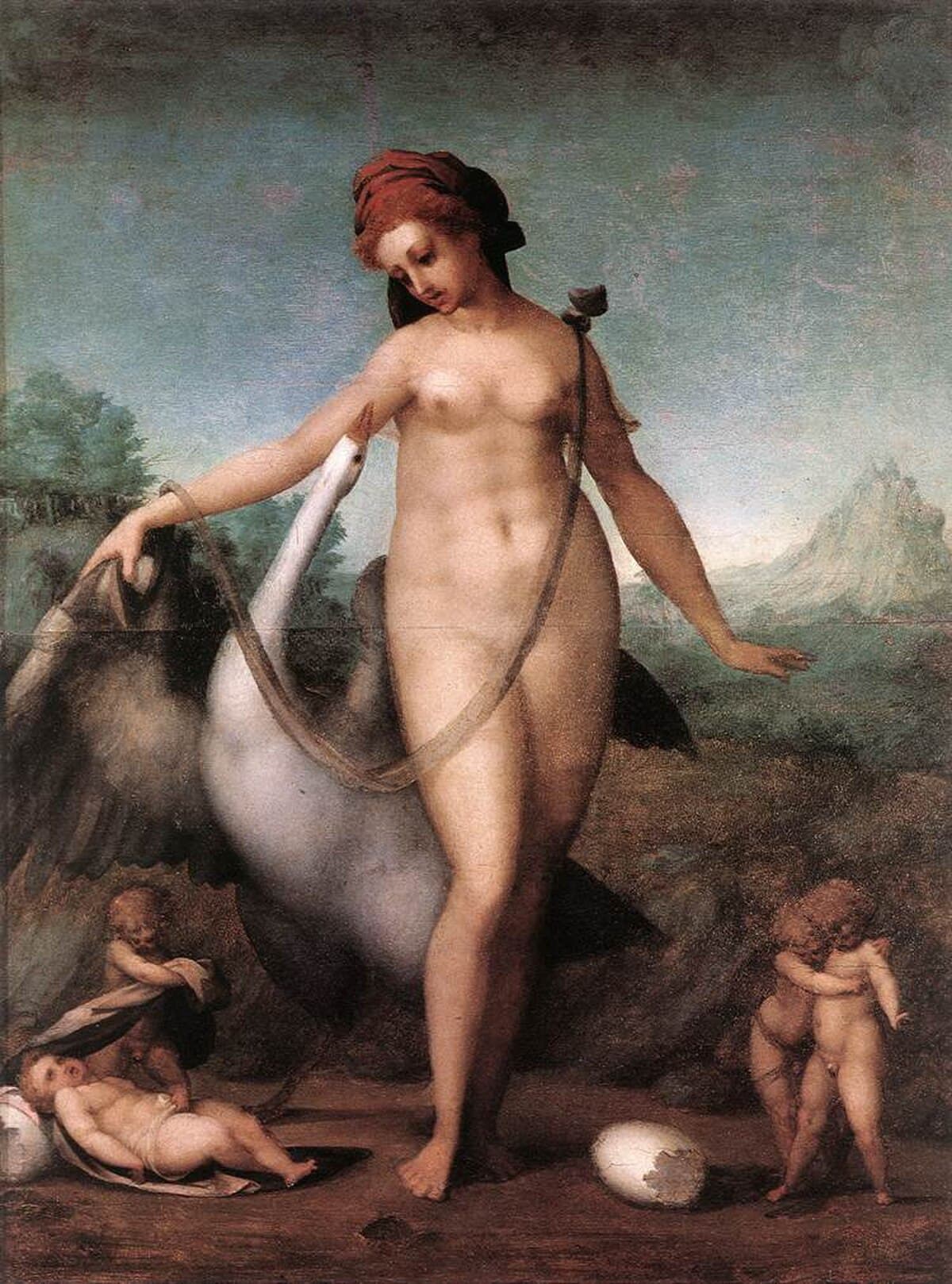
Pontormo executed this version of Leda and the Swan around 1512-1513, copying a lost composition by Michelangelo that has since been destroyed. The mythological scene shows the Spartan queen Leda embracing Zeus, who has transformed himself into a swan to seduce her. Their union would produce Helen of Troy and the twins Castor and Pollux.
Michelangelo's original painting disappeared, probably intentionally destroyed for its erotic content. Pontormo's copy, made while he was still a young artist, preserves some record of what the master created. The elongated forms and twisted pose already show the Mannerist tendencies that would define Pontormo's mature style. The figure wraps around the swan in an elegant spiral, displaying the complex poses that Mannerist painters prized.
Several copies of the lost Michelangelo exist, each offering slightly different interpretations. Pontormo's version now hangs at the Uffizi Gallery in Florence, where it represents both the influence of Michelangelo on younger artists and the transmission of classical mythology through Renaissance painting.