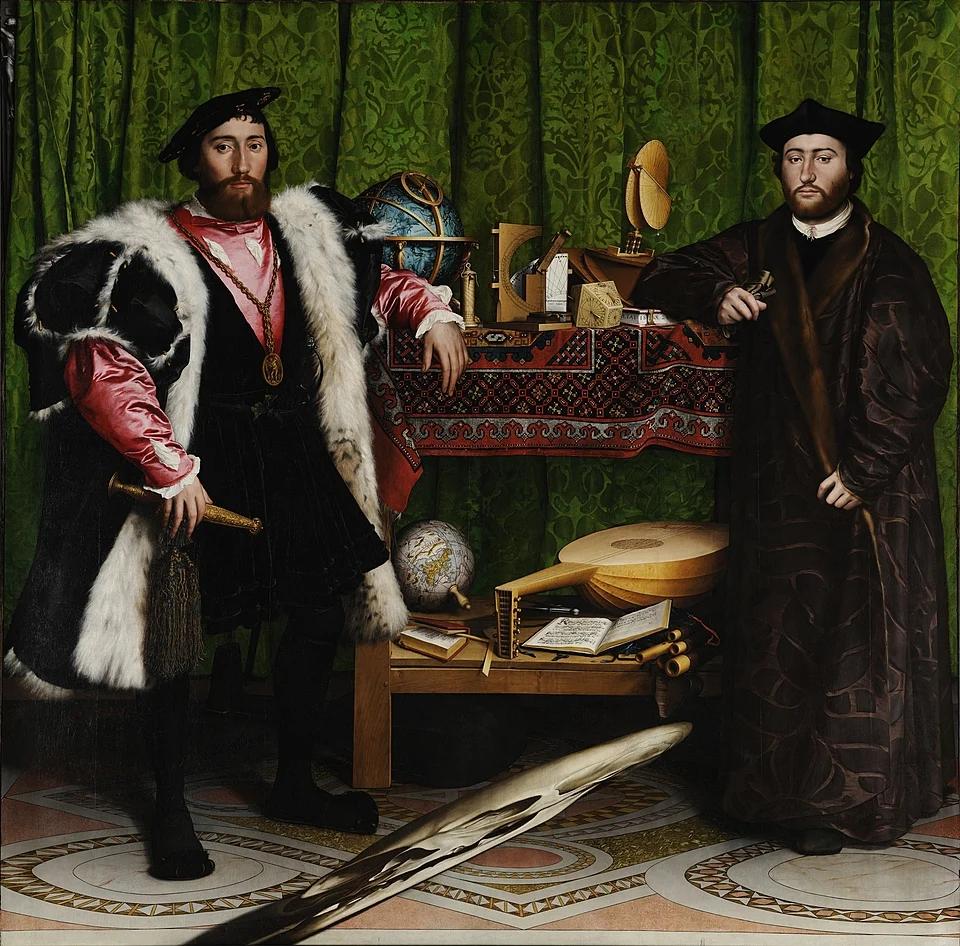
The Ambassadors
by Hans Holbein the Younger, 1533
StyleRenaissance
Artwork Details
Details
- Year
- 1533
- Medium
- Oil on oak
- Size
- 207 cm × 209.5 cm
Cite or Embed This Work
APA · MLA · Chicago1-click academic citation and embeddable “On View” museum badge for articles, syllabi, and research.
Hans Holbein the Younger painted this double portrait in 1533, depicting two French diplomats in London: Jean de Dinteville and Georges de Selve. The men stand on either side of a two-tiered table laden with objects representing the quadrivium: arithmetic, geometry, music, and astronomy. Globes, instruments, and a lute with a broken string fill the composition with symbolic detail.
The painting's most famous feature is the distorted skull stretched across the bottom. Viewed from the correct angle, the anamorphic shape resolves into a clear memento mori, reminding viewers of death's inevitability. This hidden element transforms a display of worldly accomplishment into a meditation on mortality. A tiny crucifix partially hidden by a curtain in the upper left offers the promise of salvation.
Holbein created this work at nearly life-size, its subjects looming over viewers with their rich clothing and impressive array of learning. It hangs in the National Gallery in London, where the skull's optical trick draws crowds daily.
More by Hans Holbein the Younger
View all →
Also at National Gallery
View all →T
The Piazza San Marco towards the Basilica
Francesco Guardi
National Gallery, London
T
The Japanis Bridge (Footbridge over the Water-Lily Pond)
Claude Monet
National Gallery, London
J
Jesus Christ s Body Carried to the Tomb
Rembrandt van Rijn
National Gallery, London
M
Miraculous Draught of Fishes
Raphael
National Gallery, London
Related Works
Works that share an artist, movement, museum, genre, palette or theme with The Ambassadors.
- Same artist
- Same movement
Folly at the Lectern
Hans Holbein the Younger
- Same artist
- Same movement
Head of a Male Saint
Hans Holbein the Younger
- Same artist
- Same movement
Marginal illustration for Erasmus 'In praise of Folly'
Hans Holbein the Younger
- Same movement
- Similar palette
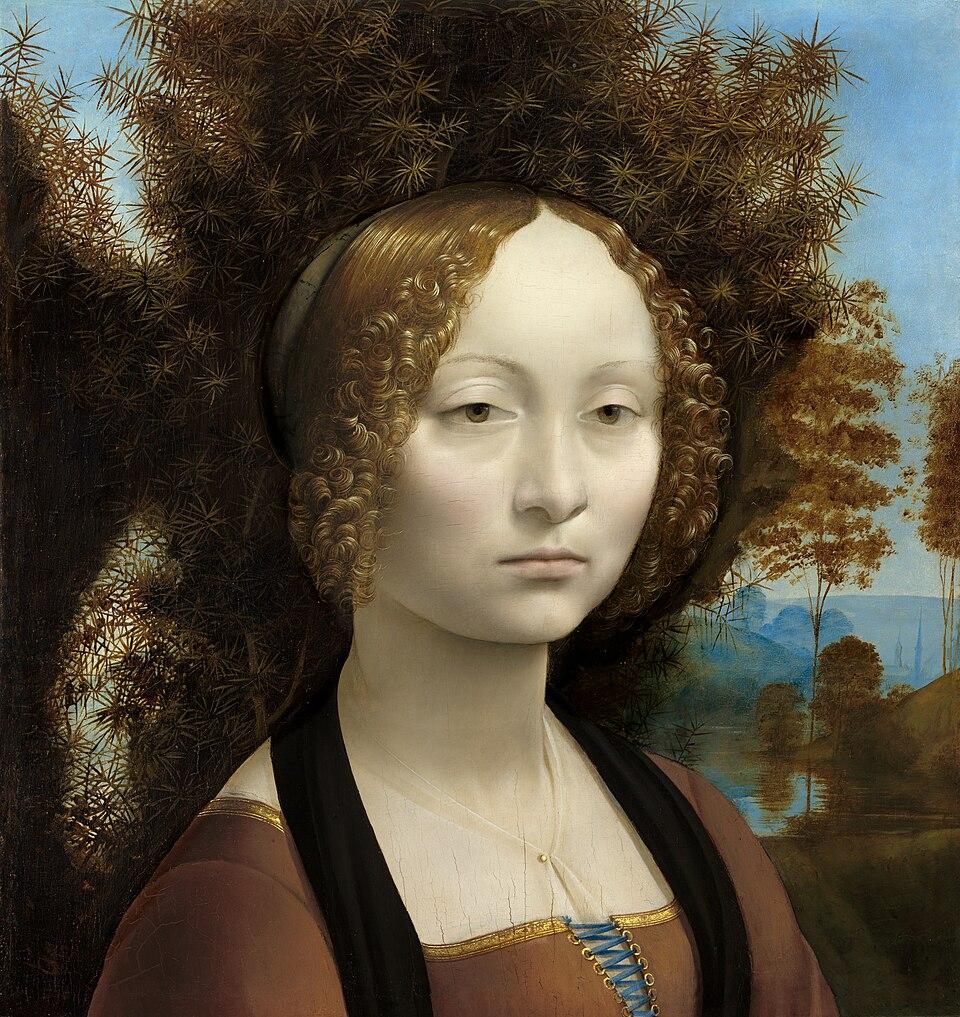
Ginevra de' Benci
Leonardo da Vinci, 1478
- Same movement
- Similar palette
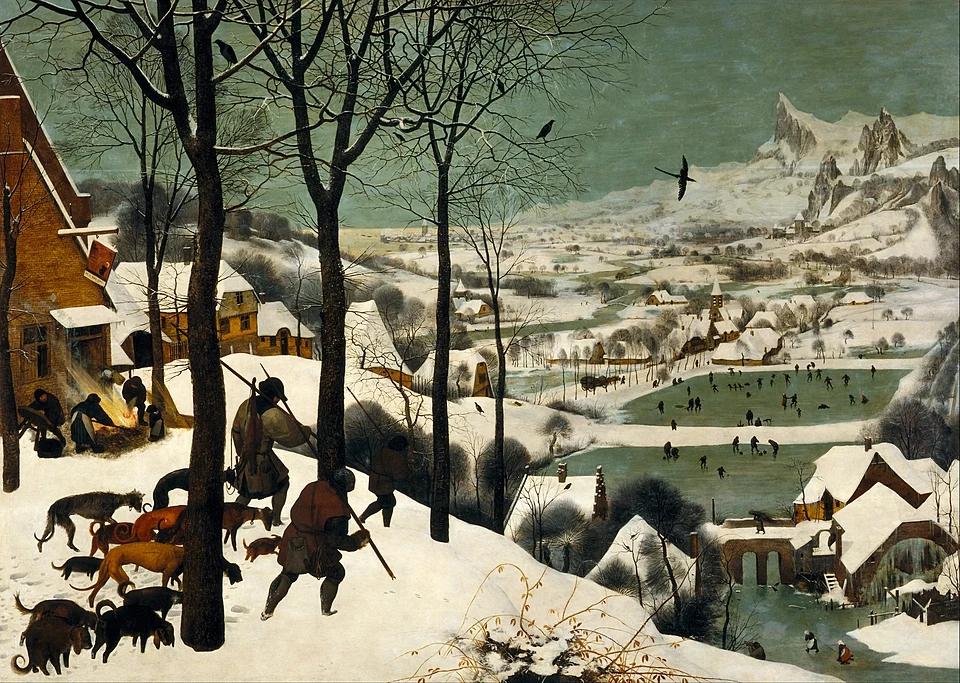
Hunters in the Snow
Pieter Bruegel the Elder, 1565
- Same movement
- Same museum
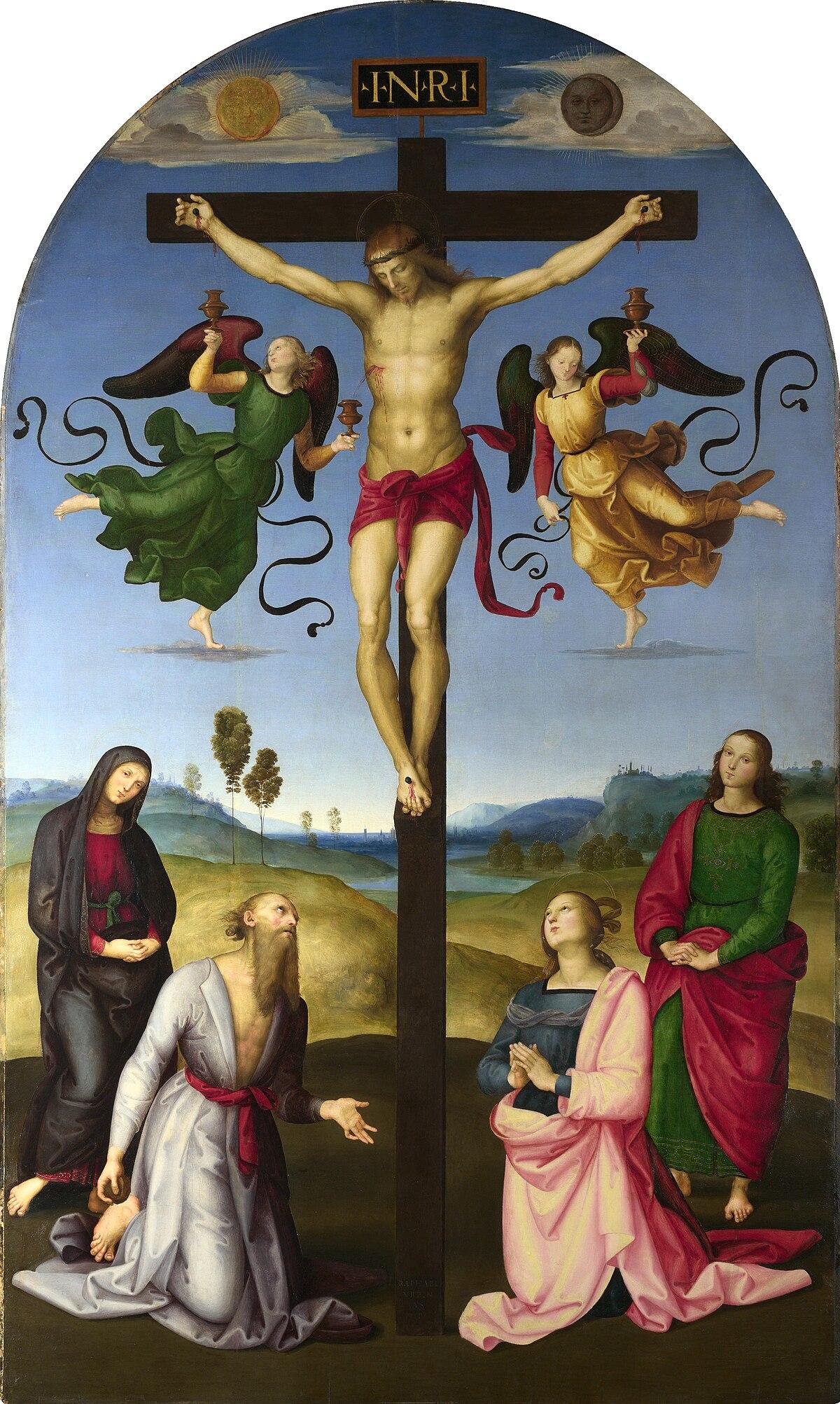
Crucifixion
Raphael
- Same movement
- Similar palette
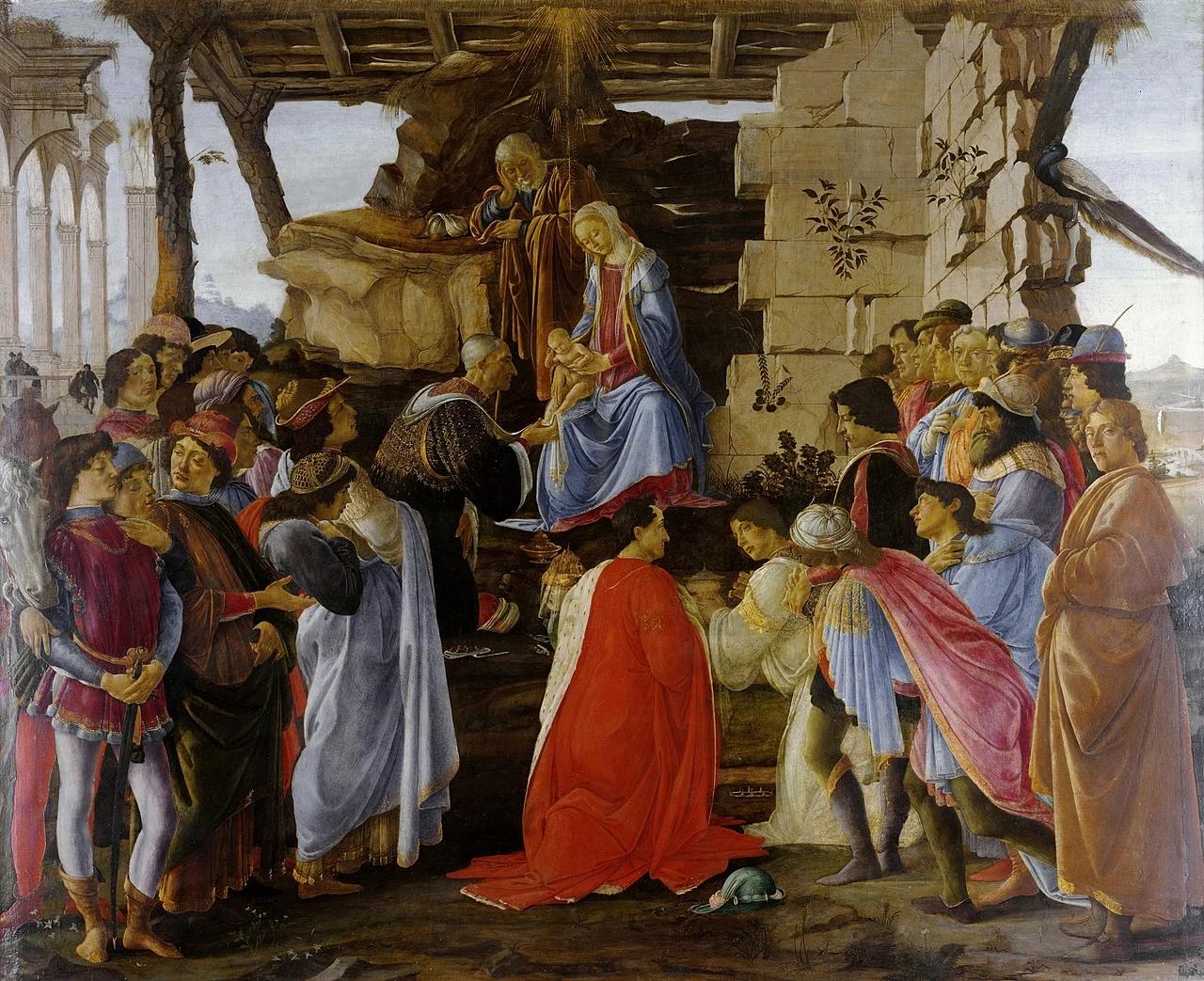
The Adoration of the Magi
Sandro Botticelli, 1476
- Same movement
- Similar palette
Sistine Madonna
Raphael, 1512
- Same movement
- Similar palette
The Alba Madonna
Raphael, 1510
- Same movement
- Similar palette
Venus with a Mirror
Titian, 1555
- Same movement
- Similar palette
Salvator Mundi
Leonardo da Vinci, 1500
- Same movement
- Same museum
The Origin of the Milky Way
Tintoretto, 1575
About The Ambassadors
It's at the National Gallery in London. Hans Holbein the Younger painted it in 1533. It's one of the most complex and symbolic portraits of the Northern Renaissance.
It's a skull, painted in anamorphic perspective. You can only see it properly by looking at the painting from a sharp angle (lower right side). It's a memento mori: a reminder of death amid all the wealth and knowledge displayed on the shelves. The distortion was a virtuosic demonstration of Holbein's skill.
The man on the left is Jean de Dinteville, French ambassador to England. On the right is Georges de Selve, Bishop of Lavaur. They were both about 29 years old. The objects between them (globe, lute, hymnal, sundials) represent their intellectual and diplomatic interests.
It measures 207 cm × 209.5 cm (81.5 × 82.5 inches), nearly a perfect square. The two men are painted life-size, making the encounter feel strikingly real. Holbein rendered the objects on the shelves with such precision that musicologists can identify the specific lute strings that are broken.
The upper shelf holds scientific instruments (celestial globe, sundials, quadrant), representing the heavens and learned knowledge. The lower shelf has earthly items (terrestrial globe, lute, hymnal). A broken lute string may symbolize discord in Christendom during the Reformation.
Own Art Like This
Luxury wall art with the same mood and energy. Gallery-quality canvas, no museum crowds.
Browse Collection