
Eye of Horus: Ancient Egyptian Eye Meaning, Symbolism & History
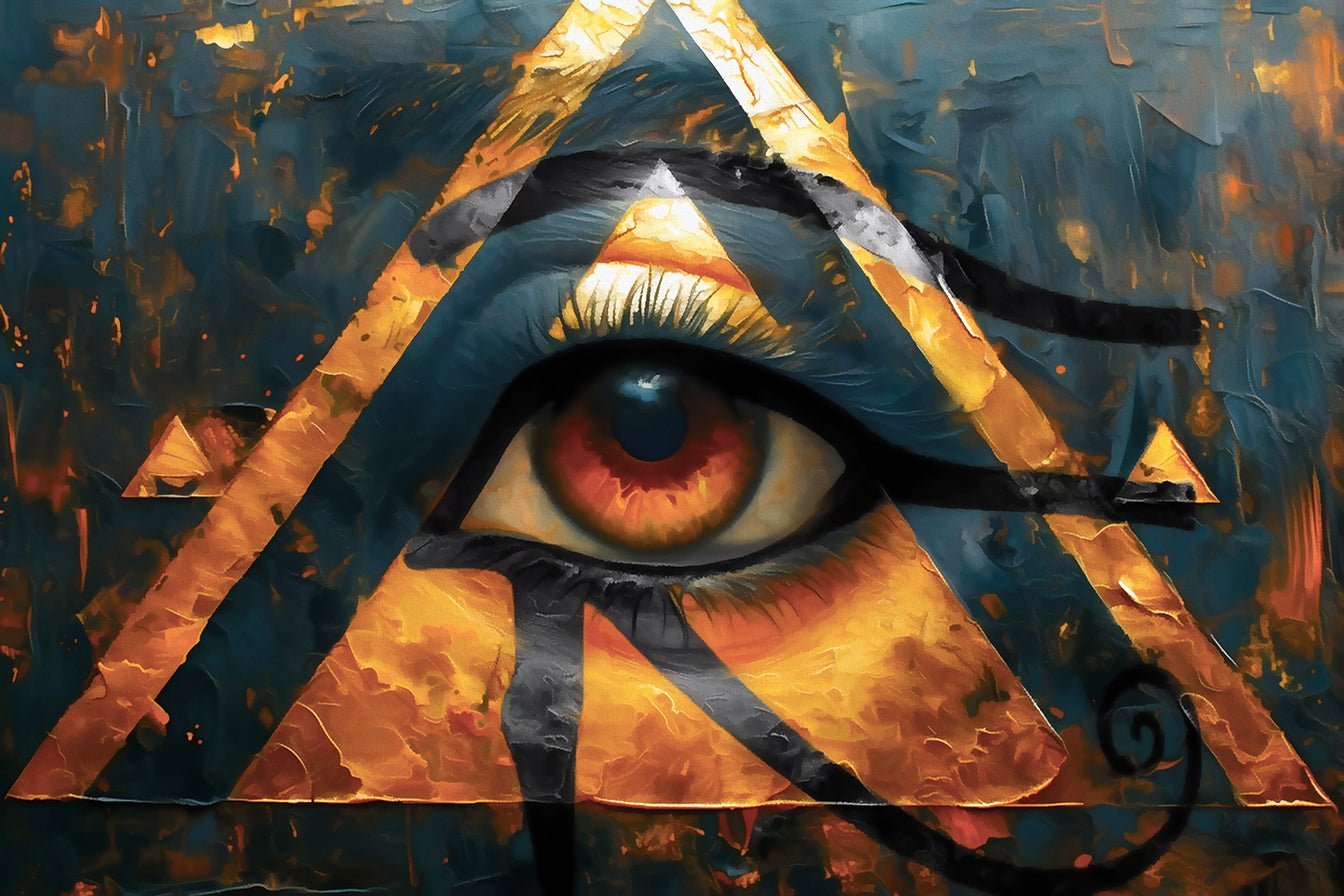

The All-Seeing Eye of Ancient Egypt
The Egyptian Eye, an emblem shrouded in mystery and steeped in legend, has fascinated historians and enthusiasts alike for centuries. This ancient symbol, often associated with the Eye of Horus and the Eye of Ra, represents protection, royal power, and good health. As we embark on this journey to unravel its mysteries, we step into a world where mythology and history intertwine, offering us a glimpse into the rich tapestry of ancient Egyptian civilization.
Symbol of Protection and Power
The Egyptian Eye of Ra, a powerful symbol in ancient Egyptian mythology, embodies the sun god's watchful gaze. This amulet was believed to ward off evil and bring about healing, playing a crucial role in both everyday life and religious rituals. The Eye of Ra's significance extends beyond mere decoration, symbolizing the pharaoh's divine right to rule and the balance between order and chaos in the universe.

Eye of Ra symbol. Source: Wikipedia.

Depictions of Horus and Thoth. Source: Wikipedia.
The Egyptian Eye of Horus
The Egyptian Eye of Horus, a powerful symbol from ancient Egypt, represents protection, health, and restoration. Beyond its immediate recognition as an eye, this symbol encompasses deeper meanings tied to the gods and the afterlife in Egyptian mythology. Horus, a sky god, is often depicted as a falcon, with the sun and moon considered his eyes. The right eye represents the sun, symbolizing power and unblemished completion, while the left represents the moon, reflecting healing and protection. This duality brings profound significance to the Eye of Horus, embedding it within the very fabric of ancient Egyptian Art and culture as a protective amulet against evil and misfortune.

Eye of Horus symbol. Source: Wikipedia.
The legend of Horus is a tale of resilience, battle, and triumph.
According to mythology, Horus fought with Set, the god of chaos and disorder, to avenge his father's death and claim the throne. In this epic battle, Horus's left eye was damaged, then restored by Thoth, the god of wisdom and magic, symbolizing the process of making whole what has been lost. In literature, the Egyptian Eye of Horus can symbolize a character's insight or moral integrity, while in visual arts, it often serves as a protective emblem or a representation of divine oversight.
Healing and Restoration
The mythological tales surrounding the Egyptian Eye of Ra are as captivating as they are enlightening. Central to these stories is the theme of healing and restoration, where the Eye, personified as a goddess, plays a vital role in the rebirth and rejuvenation of Ra, the sun god. This aspect of the Eye highlights the ancient Egyptians' deep understanding of the cycles of destruction and renewal that govern the natural world.
The Egyptian Eye in Art and Hieroglyphs
The Egyptian Eye is not just a symbol but a language in itself, intricately woven into the fabric of ancient Egyptian art and hieroglyphs. Each representation, be it in tombs, temples, or papyri, carries a profound meaning, often linked to divine protection, health, and royal authority. Deciphering these symbols offers us invaluable insights into the beliefs, values, and practices of one of history's most fascinating civilizations.
Secret Societies and The Egyptian Eye
The allure of The Egyptian Eye transcends time, finding its way into the lore of secret societies and modern mystical traditions. This symbol, often associated with knowledge, esoteric wisdom, and the unseen forces of the universe, continues to captivate the imagination of those seeking to uncover the hidden truths of our world.

The Relationship Between Ra and Horus
The relationship between Horus and Ra in ancient Egyptian mythology illustrates the interconnected nature of divine figures and their roles within the cosmos. Horus, often depicted as a falcon or a man with the head of a falcon, is primarily known as the god of the sky, kingship, and victory, while Ra, represented as a man with the head of a hawk and a sun disk resting upon his head, is the god of the sun and creation.
This relationship is deeply symbolic, with Horus often considered the protector of Ra during his nightly journey through the underworld, battling the forces of chaos to ensure the sun god's safe passage and the subsequent rise each morning. In certain myths, Horus is also seen as the son of Ra, embodying the divine authority and the pharaoh's right to rule, which were believed to be bestowed by Ra himself.
The Protective Powers of The Egyptian Eye
In ancient Egyptian culture, The Eye Egyptian was more than an artistic motif; it was a powerful talisman imbued with protective powers. Folklore and rituals surrounding this symbol emphasize its ability to safeguard individuals from harm, ensure safe passage into the afterlife, and maintain cosmic order. This enduring belief in the Eye's protective powers highlights its deep-rooted significance in the spiritual and daily life of the ancient Egyptians.
Eye of Horus vs Eye of Ra: What Is the Difference?
The two symbols look almost identical, yet they carry opposite energies. The Eye of Horus is a healing, protective, and restorative symbol tied to the moon and to wholeness after injury. The Eye of Ra is the active, fierce aspect of the sun god, a force of order sent out to punish enemies and keep chaos at bay. Put simply, the Eye of Horus shields you, while the Eye of Ra strikes for you.
| Aspect | Eye of Horus (Wedjat) | Eye of Ra |
|---|---|---|
| Celestial body | The moon | The sun |
| Core meaning | Protection, healing, restoration | Power, authority, destruction |
| Which eye | Often the left eye | Often the right eye |
| Mood | Watchful and benevolent | Fierce and avenging |
| Typical use | Amulets, tomb art, jewelry for safe passage | Royal authority, divine punishment |
Because the same drawing can stand for either eye depending on context, ancient artists relied on the surrounding hieroglyphs and color to signal which power they meant. That ambiguity is part of why the symbol still feels mysterious today.
The Left Eye and the Right Eye
In many traditions the left eye of Horus represents the moon and the right eye represents the sun. The lunar left eye is the one most people picture when they think of the Wedjat, the healed eye that Thoth restored after Set tore it apart during the struggle for the throne of Egypt. The solar right eye aligns more closely with Ra. When you choose Egyptian eye art for a room, the left eye reads as calm and protective, while the right eye reads as bold and commanding.
The Six Parts of the Eye and the Wedjat Fractions
Egyptian scribes broke the Eye of Horus into six pieces, and each piece doubled as a fraction used in measuring grain and medicine. The fractions are 1/2, 1/4, 1/8, 1/16, 1/32, and 1/64. Added together they reach 63/64, and the tiny missing 1/64 was said to be supplied by Thoth through magic, a poetic way of saying that wholeness is never purely mechanical.
- Sense of smell, the right side of the eye, 1/2
- Sense of sight, the pupil, 1/4
- Sense of thought, the eyebrow, 1/8
- Sense of hearing, the left side of the eye, 1/16
- Sense of taste, the curved tail, 1/32
- Sense of touch, the teardrop, 1/64
This blend of mathematics, anatomy, and myth is exactly why the Eye of Horus rewards a second look. It is not only a protective charm. It is a compact map of the senses and a reminder that the parts add up to a whole.
The Eye of Horus in the Modern World
The symbol never really disappeared. You will find it in fine jewelry, in tattoos chosen for protection, in album art, and in luxury interior design where a single graphic eye anchors a wall with quiet drama. Collectors are drawn to it because it carries thousands of years of meaning in one clean shape. On a gallery wall it works as a focal point that invites questions, which is the same effect it had on visitors to ancient temples.
Bring the Eye of Horus Home
Explore our curated gallery of Egyptian wall art, from gilded pharaohs to the protective Eye of Horus, printed on museum grade canvas.
Shop the Egyptian CollectionFAQ
What is the Egyptian Eye?
The Egyptian Eye, often referred to as the Eye of Horus or the Eye of Ra, is an ancient Egyptian symbol of protection, royal power, and good health.
What does the Eye of Horus represent?
The Eye of Horus symbolizes healing, protection, and restoration. It is associated with the myth of Horus, the sky god, whose eye was injured and then healed, representing the process of making whole and healing.
How was the Egyptian Eye used in ancient times?
In ancient Egypt, the Eye was used as an amulet for protection, to ward off evil, and in funerary rites to protect the deceased in the afterlife. It was also used in measurement systems, particularly in measuring ingredients for medicines.
Is there a difference between the Eye of Horus and the Eye of Ra?
While both symbols are often used interchangeably, they have distinct origins and associations: the Eye of Horus is linked with the moon and healing, while the Eye of Ra represents the sun and power.
Can the Egyptian Eye be found in modern culture?
Yes, the Egyptian Eye has been adopted in various forms in modern culture, including jewelry, tattoos, and artwork, often symbolizing protection, wisdom, and insight.
What is the difference between the left and right Eye of Horus?
The left Eye of Horus is linked to the moon and represents protection and healing, while the right eye is linked to the sun and to Ra, representing power and authority. The lunar left eye is the version most often shown as the classic Wedjat amulet.
Is the Eye of Horus the same as the Evil Eye?
No. The Eye of Horus is a protective symbol meant to guard the wearer, while the Evil Eye refers to a harmful curse cast by a malicious glare. The Eye of Horus is often used as a defense against the Evil Eye, not as the curse itself.
Is the Eye of Horus good luck?
Yes. The Eye of Horus is widely regarded as a symbol of good luck, protection, and good health. For thousands of years it has been used on amulets, jewelry, and tomb art to attract well being and to keep negative forces away from the person who carries it.
What are the six parts of the Eye of Horus?
The Eye of Horus is divided into six parts that represent the six senses and double as fractions: smell (1/2), sight (1/4), thought (1/8), hearing (1/16), taste (1/32), and touch (1/64). Together they total 63/64, with the final fraction supplied by the god Thoth.
Related Readings


Written by Luxury Wall Art · Art experts passionate about helping you find pieces that speak to your space.