Wikimedia Commons • Public Domain
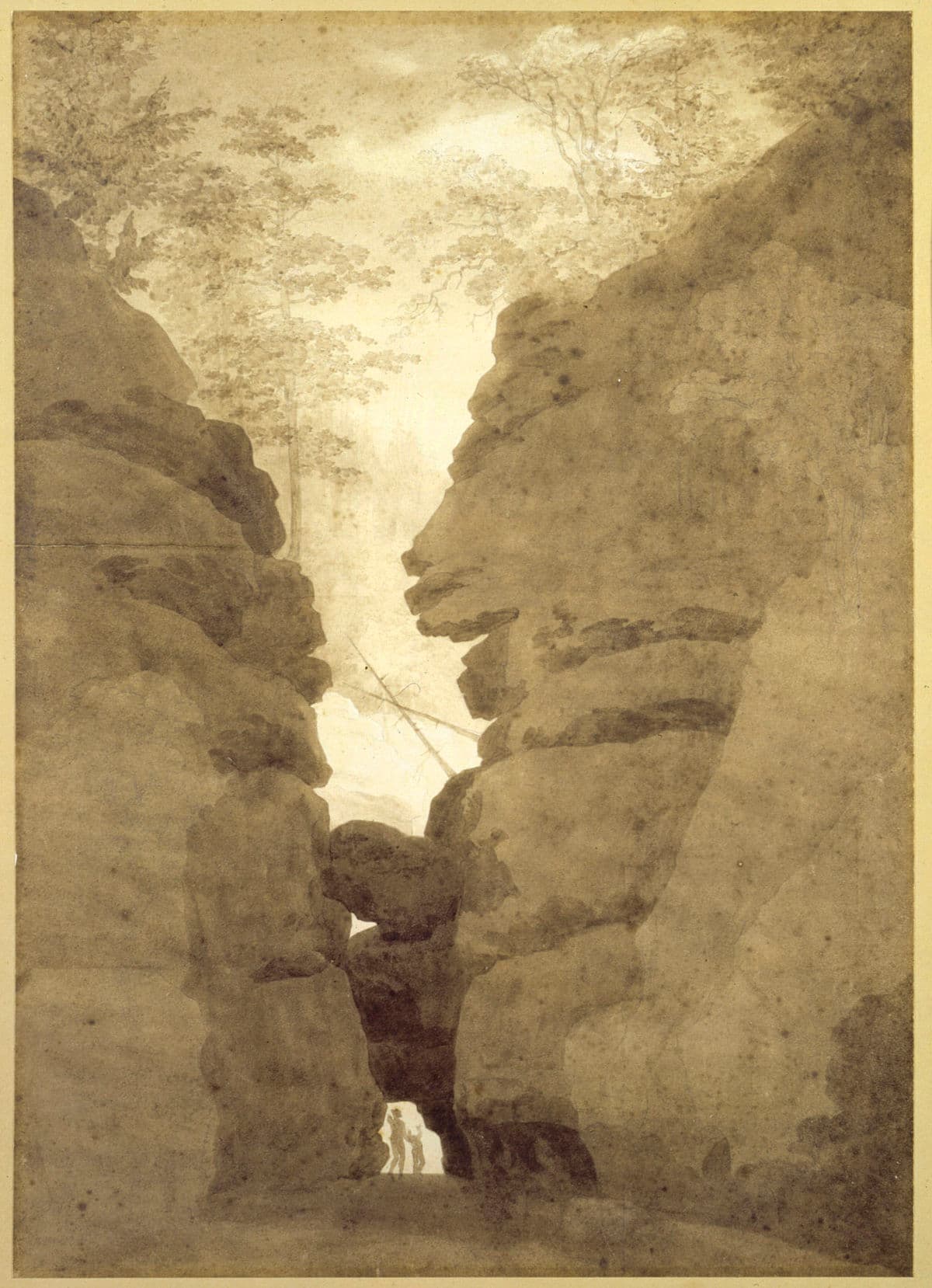
Rock arch in the Uttewalder Grund
StyleRomanticism
Artwork Details
Cite or Embed This Work
APA · MLA · Chicago1-click academic citation and embeddable “On View” museum badge for articles, syllabi, and research.
Caspar David Friedrich painted the view of a natural rock arch around 1801, during his early explorations of the Elbe Sandstone Mountains near Dresden. The dramatic stone formation frames a glimpse of forest beyond, its massive weight seemingly suspended overhead. The careful observation of geological detail shows Friedrich developing the precise naturalism that would underpin his more symbolic later works.
The Uttewalder Grund is a narrow gorge in what is now Saxon Switzerland, an area Friedrich returned to throughout his career. These sandstone formations, carved by erosion into dramatic shapes, offered ready-made Romantic subjects: ancient, mysterious, untouched by human hands. Friedrich documented them with scientific accuracy while finding in their forms suggestions of something beyond mere geology.
This early painting already hints at Friedrich's emerging Romantic sensibility. Nature appears both beautiful and somewhat threatening, its scale dwarfing any potential human presence. The arch frames the view like a cathedral window, inviting spiritual interpretation of the landscape. The work now belongs to the Folkwang Museum in Essen, where it represents the origins of a vision that would make Friedrich Germany's greatest Romantic landscape painter.