Wikimedia Commons • Public Domain
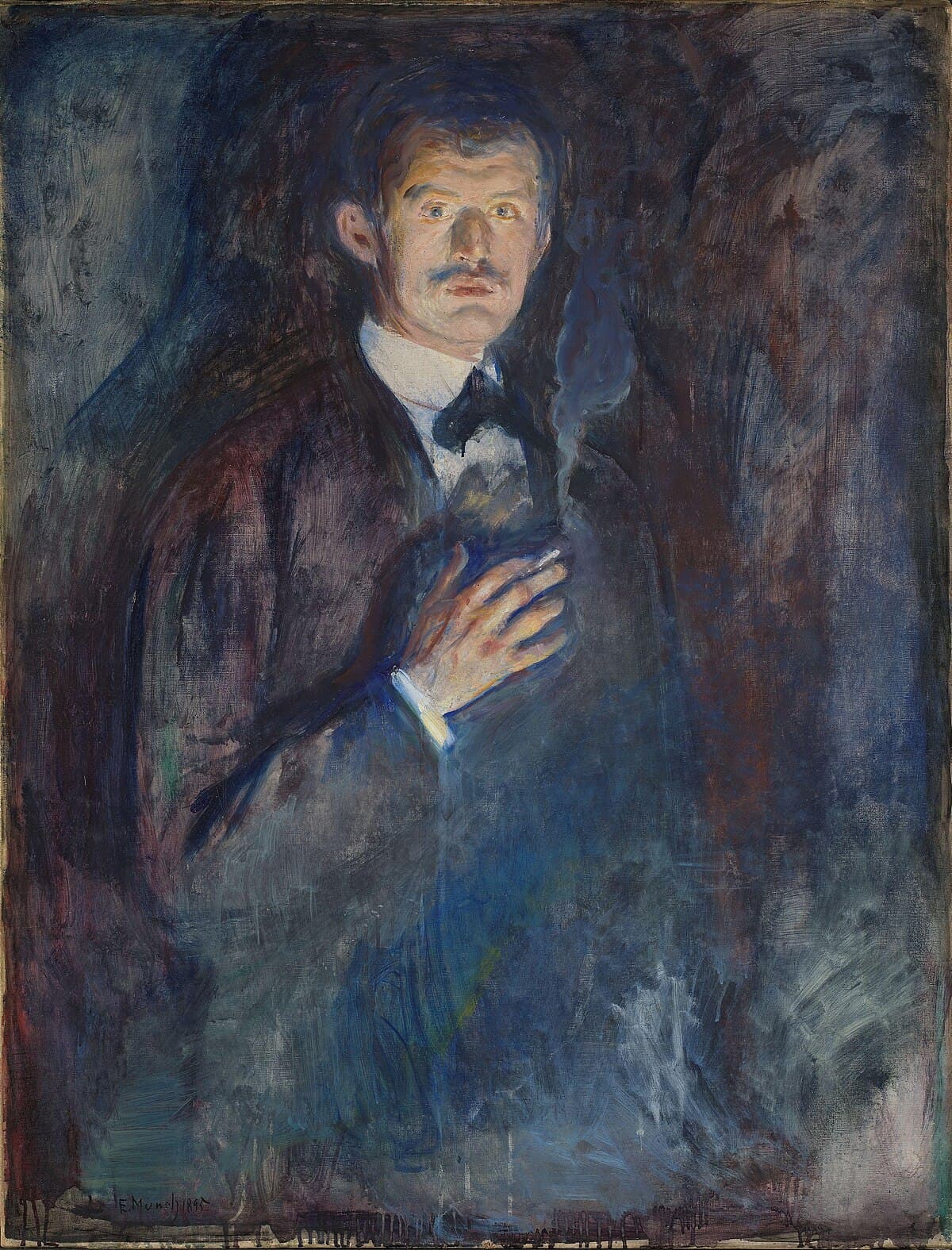
Self portrait
by Edvard Munch
Artwork Details
This painting by Edvard Munch lithograph in Berlin in 1895, one of his first experiments with the medium. His face emerges from solid black, illuminated only by a white rectangle at his neck and the ghostly form of his own features. At the bottom of the image, a skeletal arm appears, resting on what seems to be the picture's frame. The bones serve as a memento mori, a reminder of death that transforms the whole composition into something like a funerary tablet.
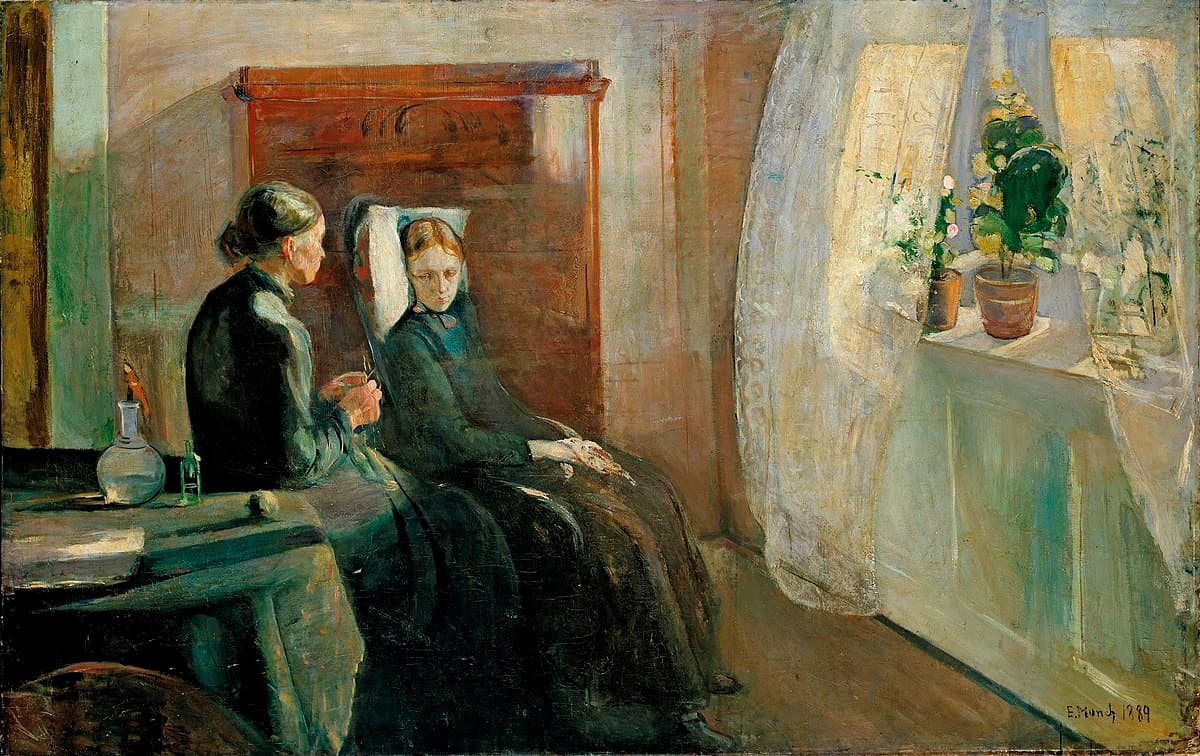
Munch was thirty-two years old and at a vibrant point in his career, embraced by avant-garde circles in Berlin alongside August Strindberg and other artists exploring psychological unease. Yet death had stalked him since childhood. His mother died of tuberculosis when he was five. His sister Sophie died of the same disease when he was fourteen. "I was born dying," Munch claimed as an old man. "Sickness, insanity and death were the dark angels standing guard at my cradle."
The technique mimics a woodcut more than a typical lithograph, with thick ink wash brushed over lithographic chalk to create that impenetrable black ground. Years later, Munch reprinted the image with the skeletal arm blacked out, as if even he found the mortality symbol too direct. The original version is held at the National Gallery of Norway in Oslo.