Wikimedia Commons • Public Domain
Sister Inger
by Edvard Munch
Artwork Details
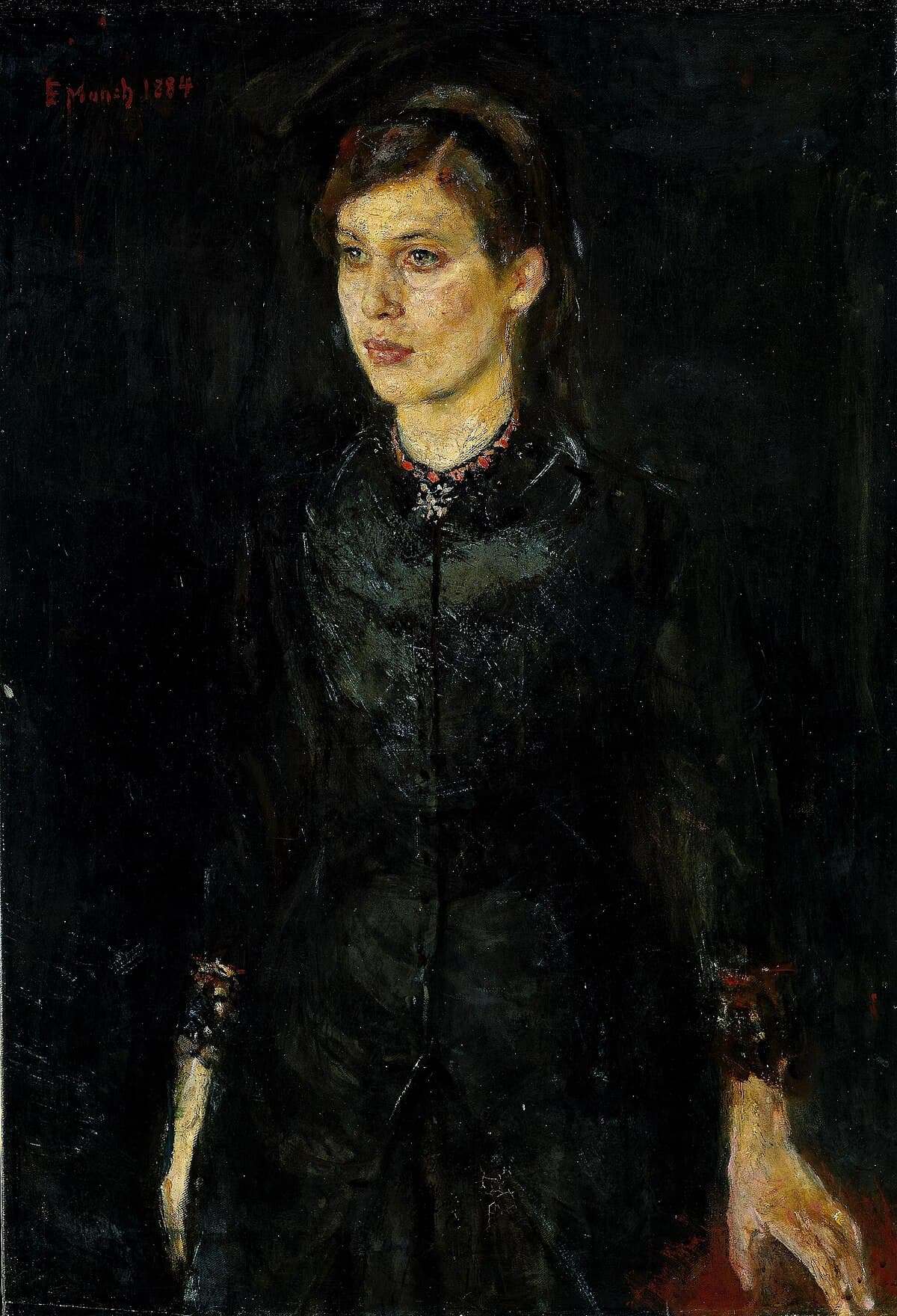
Edvard Munch executed this large portrait of his younger sister Inger in 1892, showing her standing face-on in a black and violet dress. She appears monumental, erect, her expression controlled yet guarded. Her hands clasp together at her stomach in a protective gesture. The pose feels constrained, the gaze thoughtful and introverted, revealing little of whatever lies behind that composed exterior.
Inger Munch was born in 1868 and would outlive her famous brother, dying in 1952. Unlike their sister Sophie, who succumbed to tuberculosis at fourteen, Inger remained healthy and became one of Oslo's first photographers to document the Akerselva river running through the city. She stayed close to Edvard throughout his life, one of the few stable relationships in an existence marked by anxiety and psychological turmoil.
The painting measures 172.5 by 122.5 centimeters, a substantial canvas that gives Inger's figure real presence. Munch renders the black and violet dress with careful attention to the dotted pattern, the somber palette matching his sister's reserved demeanor. The National Gallery of Norway purchased the work in 1899, just seven years after its completion, recognizing early that this quiet portrait stood among Munch's finest.