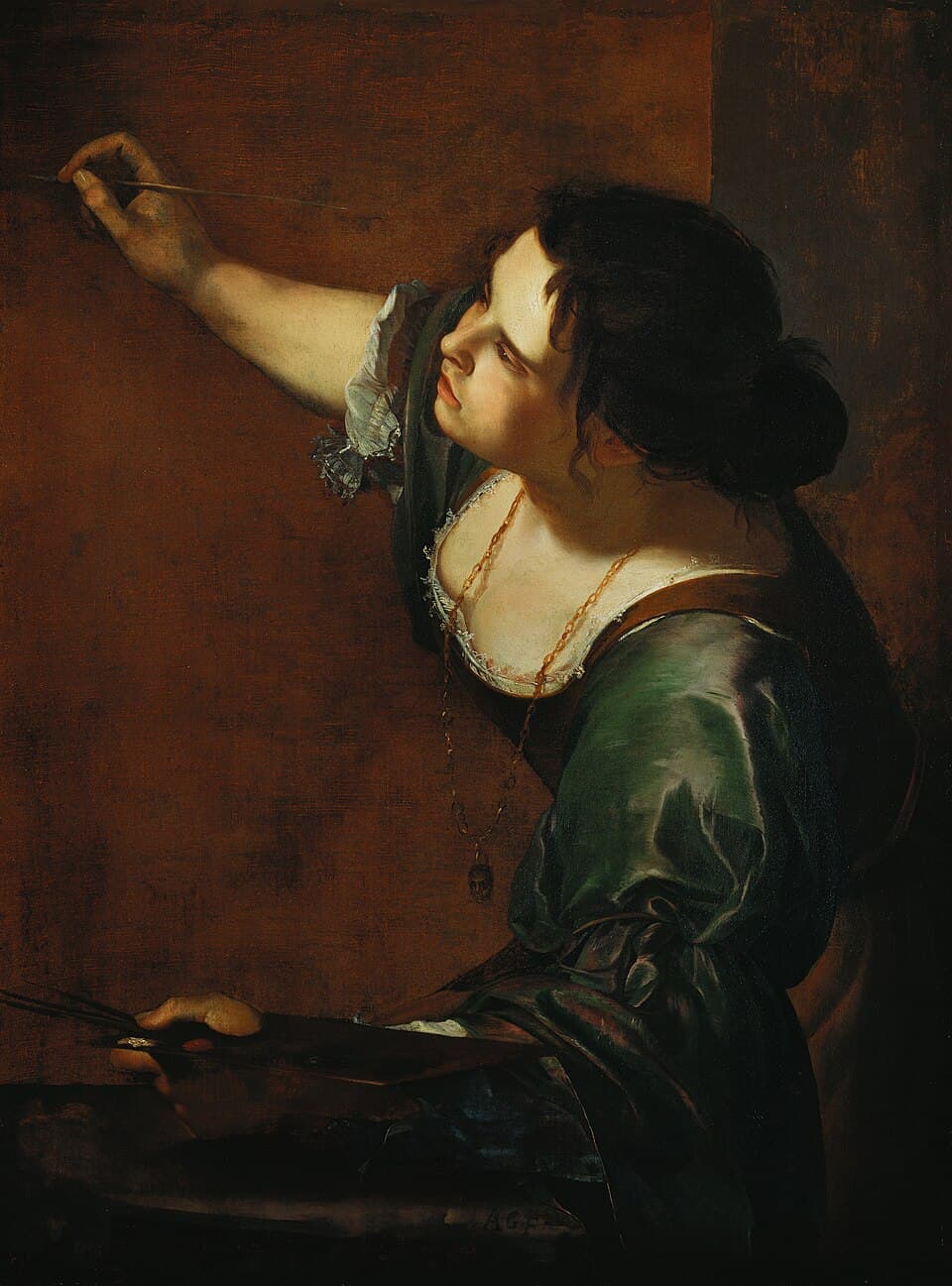
Self-Portrait as the Allegory of Painting
by Artemisia Gentileschi, 1639
Artwork Details
Details
- Year
- 1639
- Medium
- Oil on canvas
- Size
- 98.6 cm × 75.2 cm
Circa 1639, Artemisia Gentileschi painted this herself as the personification of Painting around 1638-39, during her stay in London at the court of Charles I. She leans over a canvas with brush in hand, sleeves pushed up to reveal muscular forearms, straining to observe her subject. A gold chain with a mask pendant hangs around her neck.
The composition follows Cesare Ripa's guidelines for depicting "Pittura" from his influential book Iconologia: a beautiful woman with disheveled hair and arched eyebrows suggesting imaginative thought. But only a woman could paint this particular subject, since the allegory required the artist to depict herself as both creator and symbol.
Artemisia came to England in 1638 to join her father Orazio, who had worked at Charles I's court since 1626. The painting entered the Royal Collection and remains there today, displayed at Hampton Court Palace. Her signature "A.G.F." (Artemisia Gentileschi Fecit) appears prominently on the grinding stone.