The Bookworm
by Carl Spitzweg, 1850
StyleRomanticism
Artwork Details
Details
- Year
- 1850
- Medium
- Oil on canvas
- Size
- 49.5 cm × 27 cm
Cite or Embed This Work
APA · MLA · Chicago1-click academic citation and embeddable “On View” museum badge for articles, syllabi, and research.
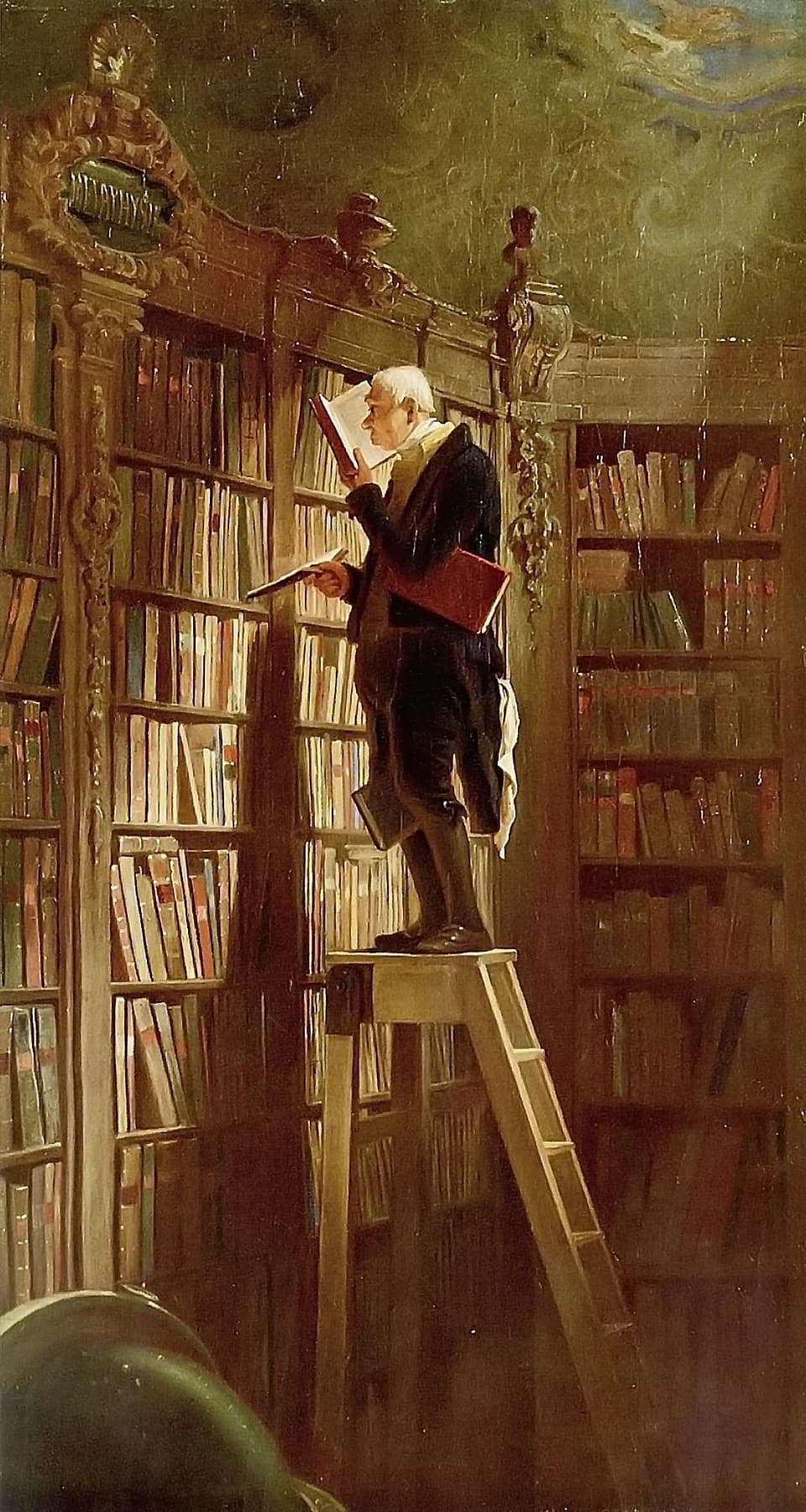
Carl Spitzweg painted The Bookworm around 1850, creating what would become his most recognized work. An elderly scholar perches atop a library ladder in a grand Baroque space, several large volumes jammed under his arms and between his legs as he squints at yet another book. He's in the Metaphysics section, a detail that underlines his complete disconnection from practical concerns. Soft golden light streams in from an unseen window, but the old man cares about that light only insofar as it lets him read.
The German title is "Der Bücherwurm," a term that was derisive in the 19th century, describing someone who had "eaten his way through books" while remaining laughably out of touch with reality. Spitzweg painted during the Biedermeier period, an era of political conservatism and domestic focus following the Napoleonic Wars. The painting gently mocks that introspective mood while embodying it. The scholar couldn't care less about revolutions or world affairs. He has his books.
Spitzweg produced at least three versions of this composition between 1850 and 1884. The earliest, originally titled "The Librarian," now belongs to the Museum Georg Schäfer in Schweinfurt. Norman Rockwell later referenced the image directly for a 1926 Saturday Evening Post cover, proving the bookworm had become a universal type.