Public Domain
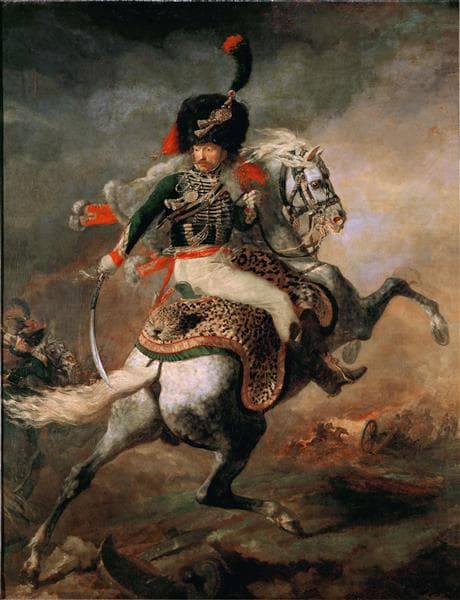
Officer of the Chasseurs Charging on Horseback (Charging Hussar)
Artwork Details
Théodore Géricault painted the Officer of the Chasseurs Charging on Horseback around 1812, a large oil on canvas showing a Napoleonic cavalry officer ready to attack. The horse rears dramatically, its rider twisting in the saddle to face an unseen threat. This was Géricault's first exhibited work, establishing him as a major talent at just twenty-one.
The composition recalls Jacques-Louis David's Napoleon Crossing the Alps, but Géricault moves away from classical restraint. The diagonal arrangement and vigorous paint handling signal French Romanticism. Thick impasto gives the horse and rider a three-dimensional quality. The turning figure derives from Rubens' early Saint George, though viewed from a different angle.
The Chasseurs were elite cavalry, symbols of French military prowess during the Napoleonic Wars. Géricault would continue pushing away from classicism, culminating in his work The Raft of the Medusa (1818-19). The painting shows horse and rider in dynamic motion. It remains in a private collection.