
Geometric Art Explained: Shapes and Patterns in Modern Design
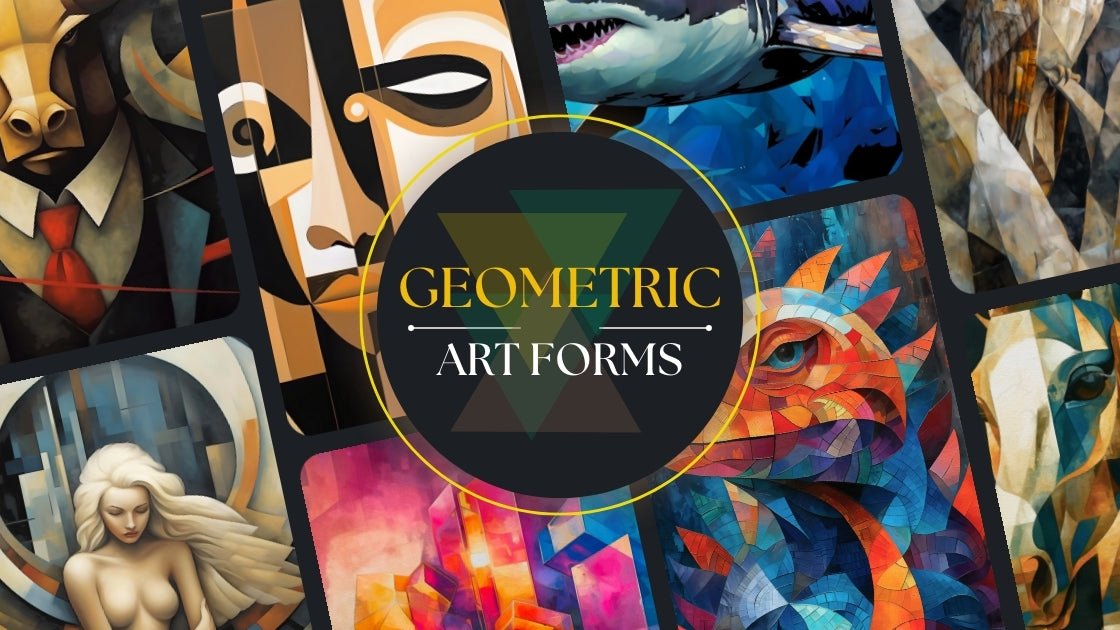

Geometric art uses circles, triangles, and squares to create order and visual impact, a language artists have relied on for thousands of years. This piece traces that history from Mondrian's primary-color grids and Kandinsky's emotional shapes to sacred geometry and the Bauhaus movement, then covers how to style a geometric piece in a modern room.
Shapes & PatternsMondrian & BauhausSacred GeometryModern Interiors
At a glance
| Oldest patterns | 70,000+ years old |
| Mondrian's style | Grids, primary colors |
| Bauhaus founded | Germany, 1919 |
| Circle meaning | Unity and infinity |
Geometric Art Explained: Shapes and Patterns in Modern Design
Circles, triangles, squares. At first glance, geometric art seems almost too simple to be taken seriously. Yet these basic shapes have captivated artists, mathematicians, and philosophers for thousands of years. From the pyramids of Egypt to the canvases of Kandinsky, geometry has served as humanity's visual language for expressing order, meaning, and beauty.
What makes geometric art so enduring? Part of it is biological. Our brains are wired to recognize patterns and find comfort in symmetry. When we see clean lines and balanced forms, something clicks. There's a sense of rightness that transcends culture and era. It's why geometric patterns appear in Islamic mosques, Buddhist mandalas, and modern corporate logos alike.
Geometric art strips away the noise. No narratives to interpret, no emotions to decode. Just pure visual structure that speaks directly to the eye and mind.
The Origins of Geometric Art
Geometric patterns are older than recorded history. Archaeological evidence shows that humans were creating geometric designs at least 70,000 years ago. These weren't random doodles. They were deliberate attempts to impose order on the chaos of existence, to mark territory, to communicate ideas that transcended spoken language.
The ancient Greeks took this further, believing that geometry was the foundation of reality itself. Pythagoras and his followers saw mathematical relationships as divine truths. The golden ratio, found in everything from seashells to spiral galaxies, became a template for beauty in art and architecture.

Mondrian and the Birth of Modern Geometric Art
Fast forward to the early 20th century, and geometric art underwent a radical transformation. Piet Mondrian, a Dutch painter, stripped his canvases down to their absolute essentials: black lines on white backgrounds, filled with blocks of primary colors. His grids weren't decorative. They were philosophical statements about the nature of reality.
Mondrian believed that horizontal and vertical lines represented the fundamental forces of the universe: masculine and feminine, earth and sky, material and spiritual. By reducing art to these basic elements, he thought he could reveal universal truths hidden beneath the surface of everyday life.

"Composition II in Red, Blue, and Yellow" by Piet Mondrian (1930). Public domain via Wikimedia Commons.
His influence spread far beyond painting. Fashion designers like Yves Saint Laurent created Mondrian dresses. Architects incorporated his grid systems into building facades. Today, you can see his legacy in everything from IKEA furniture to smartphone interfaces. The clean, grid-based aesthetic that defines modern design owes much to a man who just wanted to paint squares.
Our geometric art collection draws on this same tradition of using shapes and patterns to create visual impact without unnecessary complexity.

Kandinsky: Geometry with Soul
While Mondrian pursued pure abstraction, Wassily Kandinsky took a different approach. The Russian-born painter believed that shapes had emotional properties. Circles felt calm and spiritual. Triangles suggested aggression and ambition. Squares conveyed stability and earthiness.
Kandinsky composed his paintings like symphonies, arranging geometric forms to create emotional experiences. He even associated specific colors with specific shapes: yellow with triangles, blue with circles, red with squares. His goal wasn't to depict reality but to make the viewer feel something through pure visual form.

The Bauhaus Movement
The Bauhaus school, founded in Germany in 1919, brought geometric principles into every aspect of design. Founded by architect Walter Gropius, the school taught that form should follow function, and that beauty emerges naturally from efficient design.
Bauhaus artists and designers created furniture, typography, architecture, and textiles based on geometric principles. Their influence is still visible in modern design: the clean lines of Apple products, the minimalist aesthetic of Scandinavian furniture, the grid-based layouts of websites and apps. When you see something described as "modern" or "contemporary," there's a good chance it owes something to Bauhaus.

The Bauhaus building in Dessau, Germany (1925-26). Public domain via Wikimedia Commons.


Sacred Geometry: Shapes with Meaning
Beyond aesthetics, many cultures have assigned spiritual significance to geometric forms. Sacred geometry appears in religious architecture worldwide, from Gothic cathedrals to Hindu temples. These patterns weren't chosen randomly. Each shape carried meaning.
The circle represents wholeness and eternity, having no beginning or end. The triangle, pointing upward, symbolizes aspiration toward the divine. The square represents the material world and earthly stability. The hexagon, found in beehives and snowflakes, suggests natural perfection. When these shapes combine in mandalas or rose windows, they create maps of spiritual reality.
Common Geometric Symbols and Their Meanings:
• Circle – Unity, wholeness, infinity, the cosmos
• Triangle – Stability, aspiration, the trinity, change
• Square – Earth, stability, material world, foundation
• Hexagon – Harmony, balance, natural perfection
Geometric Wall Art in Modern Interiors
Today, geometric wall art has found its place in homes ranging from minimalist apartments to maximalist mansions. The appeal is versatile: geometric pieces can feel modern or traditional, playful or serious, bold or subtle, depending on color, scale, and placement.
In minimalist spaces, a single geometric piece can serve as a focal point without overwhelming the room. The clean lines and defined shapes complement sparse furniture and neutral palettes. In busier rooms, geometric patterns can actually help organize visual chaos by providing structure and rhythm.

Color plays a crucial role too. Black and white geometric art reads as sophisticated and timeless. Bold primary colors recall Mondrian and mid-century modern design. Earth tones feel organic despite the precise shapes. Metallics like gold and silver add luxury without fuss.
The key is matching the energy of the art to the energy of the space. A home office might benefit from sharp angles and clear lines that promote focus. A bedroom might call for softer curves and muted colors that encourage relaxation. Browse our abstract wall art to see how different geometric approaches create different moods. For bolder statements, our colorful wall art collection offers vibrant geometric pieces that command attention.
Why Geometric Art Endures
After thousands of years, geometric art shows no signs of fading. If anything, it's more relevant than ever. In a world of information overload and visual noise, there's something restful about shapes that make sense. Geometric art doesn't demand interpretation or backstory. It just exists, balanced and complete.
Maybe that's what humans have always sought in these simple forms: a reminder that beneath the chaos, there's order. That despite the mess of daily life, beauty can be found in a well-placed line, a perfect circle, a triangle pointing toward something beyond itself. Geometry is the skeleton of the visible world, and geometric art lets us see those bones.
FAQ
What is geometric art?
Geometric art uses mathematical shapes like circles, triangles, squares, and lines as its primary visual elements. Rather than depicting realistic subjects, it creates meaning through the arrangement of pure forms, patterns, and colors.
Who are the most famous geometric artists?
The most influential geometric artists include Piet Mondrian, known for his grid paintings with primary colors, and Wassily Kandinsky, who explored the emotional properties of shapes. Other notable figures include Kazimir Malevich, Josef Albers, and Bridget Riley.
What is the difference between geometric and abstract art?
All geometric art is abstract, but not all abstract art is geometric. Geometric abstract art uses precise mathematical shapes, while other abstract styles may feature organic forms, gestural marks, or fluid compositions without defined shapes.
What is sacred geometry?
Sacred geometry refers to geometric patterns believed to hold spiritual significance. These include the Flower of Life, the golden ratio, and Metatron's Cube. Many religious buildings incorporate these patterns in their architecture and decoration.
What rooms work best for geometric wall art?
Geometric wall art works in nearly any room. Home offices benefit from sharp lines that promote focus. Living rooms can handle bold colors and large scales. Bedrooms suit softer geometric patterns in muted tones that encourage relaxation.
What is the Bauhaus movement?
The Bauhaus was a German art school (1919-1933) that unified art, craft, and technology. It emphasized geometric forms and the principle that form should follow function. Its influence shaped modern architecture, furniture design, and graphic design.
How do I choose geometric art for my space?
Match the energy of the art to your space. Bold colors and sharp angles create energy and focus. Soft curves and muted tones feel calming. Consider your existing furniture style: geometric shapes artwork pairs naturally with modern and minimalist decor but can also add contrast to traditional spaces.
Written by Luxury Wall Art · Art experts passionate about helping you find pieces that speak to your space.


Leave a comment
Comments will be approved before showing up.