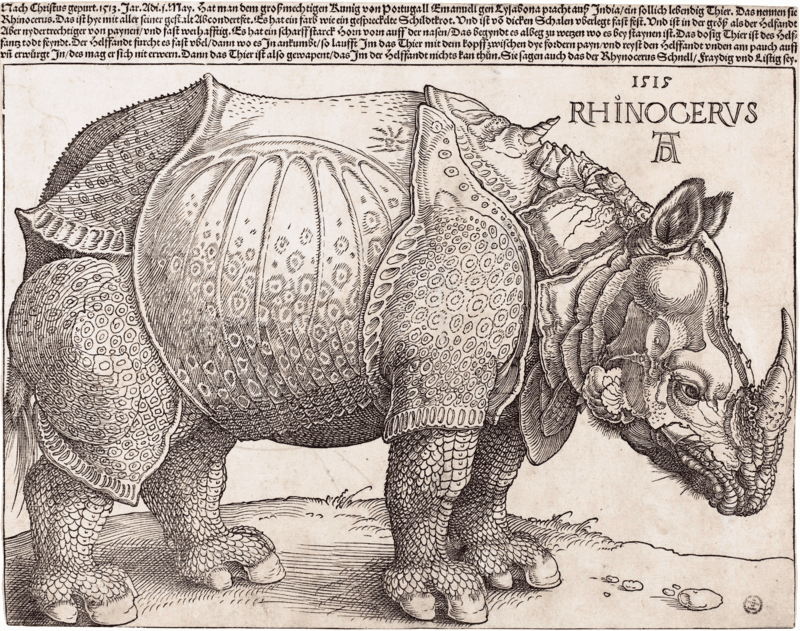
Rhinoceros
by Albrecht Dürer, 1515
StyleNorthern Renaissance
Artwork Details
Details
- Year
- 1515
- Medium
- Woodcut
- Size
- 23.5 cm × 29.8 cm (9.3 × 11.7 in)
Cite or Embed This Work
APA · MLA · Chicago1-click academic citation and embeddable “On View” museum badge for articles, syllabi, and research.
Dürer's Rhinoceros depicts an Indian rhinoceros that arrived in Lisbon in 1515, the first seen in Europe since Roman times. Albrecht Dürer never saw the animal himself, creating this woodcut from descriptions and a sketch sent from Portugal. The resulting image, while inaccurate in details, became the definitive rhinoceros image in Europe for centuries.
Dürer showed the rhinoceros with armor-like plates, a small horn on its shoulders, and scaly legs, none of which Indian rhinos actually have. Despite these errors, the image's power made it the accepted representation of rhinoceroses until live specimens became common in European zoos. The woodcut demonstrates how art could shape scientific understanding.
Impressions exist in many museums, including the British Museum.