Wanderer above the Sea of Fog
by Caspar David Friedrich, 1818
StyleRomanticism
Artwork Details
Details
- Year
- 1818
- Medium
- Oil on canvas
- Size
- 94.8 cm × 74.8 cm
Cite or Embed This Work
APA · MLA · Chicago1-click academic citation and embeddable “On View” museum badge for articles, syllabi, and research.
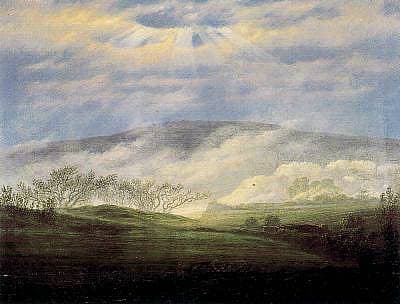
German artist Caspar David Friedrich painted this Wanderer above the Sea of Fog around 1818, depicting a man standing on a rocky precipice overlooking a fog-filled valley. The figure, seen from behind, wears a dark green coat and holds a walking stick. Mountain peaks emerge from the mist like islands in a white sea.
The painting epitomizes German Romanticism's fascination with sublime nature and human insignificance before it. Friedrich used the Rückenfigur technique, showing figures from behind so viewers share their perspective. We don't see the wanderer's face, allowing us to project ourselves into his contemplation of the vast landscape.
The setting likely combines several locations in Saxony and Bohemia that Friedrich sketched during his travels. The wanderer may represent a specific person or serve as a universal symbol of humanity confronting nature and infinity. The painting hangs at the Hamburger Kunsthalle in Germany, where it remains the museum's most famous work.