
Decorating With Boat Art: Coastal Wall Decor Ideas
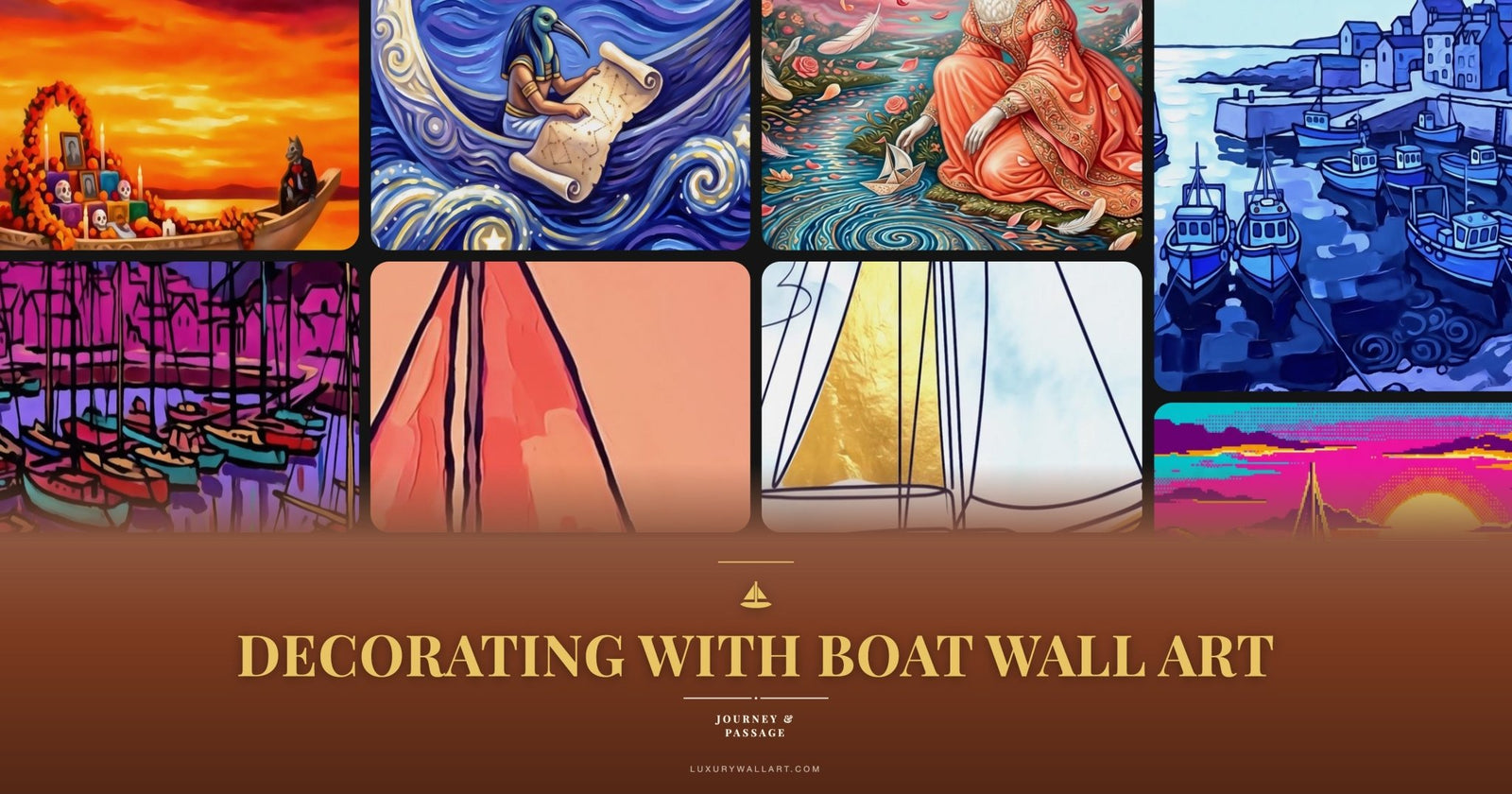

Boat Art: Symbolism and Meaning in Art
Boats have been central to human civilization for millennia, facilitating trade, exploration, and spiritual journeys. Their forms and functions have evolved dramatically, from simple rafts to complex modern vessels. This deep history is reflected in art across cultures and centuries, making Boat art a rich and meaningful choice for any interior.
As an art historian, I find the enduring appeal of boats in art fascinating. They represent so much of the human experience: adventure, peril, tranquility, and the relentless march of progress. Understanding this historical and symbolic weight can greatly enhance how we appreciate and integrate boat imagery into our living spaces.
Boats embody journeys and transformation,: offering a timeless connection to humanity's oldest stories of exploration and hope.
Quick facts: Decorating With Boat Wall Art
- Ancient Egyptian tomb paintings from the New Kingdom (circa 1550-1070 BCE) often depicted boats for the journey to the afterlife.
- J.M.W. Turner painted 'The Fighting Temeraire' in 1838, a powerful image of a warship being towed to its final berth.
- The Dutch Golden Age in the 17th century saw a rise in detailed marine painting, with artists like Willem van de Velde the Elder.
- Viking longships, dating from the 8th to 11th centuries, were not only vessels of exploration but also symbols of power and craftsmanship.
| Era/Movement | Artist/Culture | Key Characteristics/Works |
|---|---|---|
| Ancient Egypt (c. 1550-1070 BCE) | Egyptian Artists | Tomb paintings of sun barks and funerary boats, symbolizing passage to the afterlife. |
| Dutch Golden Age (17th Century) | Willem van de Velde the Younger | Detailed ship portraits, naval battles, and calm seascapes, reflecting maritime dominance. |
| Romanticism (Early 19th Century) | J.M.W. Turner | Dramatic seascapes, often depicting ships battling elements or in symbolic transition, like 'The Fighting Temeraire' (1838). |
| Impressionism (Late 19th Century) | Claude Monet | Focus on light and atmosphere, capturing fleeting moments of boats in harbors, exemplified by 'Impression, Sunrise' (1872). |
| American Realism (Mid 20th Century) | Edward Hopper | Solitary boats in stark, clear light, often evoking introspection or a sense of quiet observation, like 'The Martha McKeen of Wellfleet' (1944). |
Ancient Civilizations and the Symbolic Boat
From the earliest records, boats held profound symbolic meaning. In ancient Egypt, boats were essential for transportation along the Nile and were believed to carry the deceased into the afterlife. Funerary boats, sometimes full-sized, were placed in tombs, illustrating the journey of the soul. The sun god Ra was said to traverse the sky daily in his solar bark, battling chaos and ensuring the sun's rebirth.

Mesopotamian cultures, particularly the Sumerians and Babylonians, also depicted boats in their art and myths. The Epic of Gilgamesh features a great flood and an ark-like vessel built by Utnapishtim, underscoring the boat's role in survival and divine intervention. Even in religious rituals, boat-shaped censers, like the Thurible, were used to carry incense, symbolizing offerings ascending to the heavens.
Across the Pacific, Polynesian cultures developed sophisticated outrigger canoes, depicted in rock art and oral traditions. These vessels were not merely transport; they represented ancestral connections, navigation prowess, and the spirit of exploration that allowed for the colonization of vast ocean expanses. Each culture imbued its boats with unique spiritual and practical significance.
The Golden Age of Maritime Painting: 17th and 18th Centuries
The 17th century, particularly in the Netherlands, marked a significant period for marine painting. The Dutch Republic, a leading maritime power, commissioned numerous paintings celebrating its naval strength and bustling trade. Artists like Willem van de Velde the Elder and Younger created highly detailed and atmospheric depictions of naval battles, shipping scenes, and calm harbors, capturing the national identity tied to the sea.

These works were not just decorative; they served as historical documents and symbols of national pride. They often showed specific ships and events, providing a window into the naval technology and daily life of the era. The careful rendering of rigging, sails, and sea conditions demonstrated both artistic skill and a deep understanding of maritime life.
In the 18th century, British artists like Samuel Scott and Canaletto, working in Venice, continued this tradition. Scott's depictions of the Thames and naval engagements offered a British perspective, while Canaletto's Venetian lagoon scenes romanticized the city's relationship with its waterways. These paintings became popular among collectors, further solidifying Sailboat and ship art as a recognized genre.
- Willem van de Velde the Elder (Dutch, 1611-1693): Known for grisaille pen paintings of naval engagements.
- Willem van de Velde the Younger (Dutch, 1633-1707): Master of detailed ship portraits and calm seascapes.
- Ludolf Bakhuizen (Dutch, 1631-1708): Famous for dramatic storm scenes and agitated waters.
- Samuel Scott (British, c. 1710-1772): Depicted views of London and naval battles on the Thames.
- Canaletto (Italian, 1697-1768): Celebrated for his Venetian lagoon views featuring gondolas and sailing vessels.
Romanticism and Impressionism: Emotion and Light on the Water
The 19th century brought new artistic sensibilities to boat art. Romanticism emphasized emotion, drama, and the sublime power of nature. J.M.W. Turner, the great English Romantic painter, often depicted ships battling storms or shrouded in mist, using light and color to convey intense feeling. His 'The Fighting Temeraire,' painted in 1838, is a poignant meditation on the passing of an era, as a grand warship is towed to its demise.

Impressionism, emerging in the latter half of the 19th century, shifted focus to capturing fleeting moments, light, and atmosphere. Claude Monet, a pioneer of the movement, frequently painted boats in his landscapes. His 'Impression, Sunrise' (1872), which gave the movement its name, features small boats in the misty harbor of Le Havre, emphasizing the ephemeral quality of light on water rather than precise detail.
Other Impressionists like Édouard Manet and Gustave Caillebotte also explored boating themes. Manet's 'Boating' (1874) captures a leisurely outing, while Caillebotte's 'Oarsmen' (1877) focuses on the figures and their interaction with the water. These artists used boats not just as subjects but as vehicles to experiment with color, brushwork, and the effects of natural light.
Modern Interpretations: From Realism to Abstraction
The 20th century saw a diversification of artistic approaches to boats. American Realists like Edward Hopper painted solitary figures in boats, often conveying a sense of introspection or isolation. His 'The Martha McKeen of Wellfleet' (1944) showcases a sailboat under a stark, clear sky, typical of his atmospheric style.
Abstract artists, on the other hand, deconstructed the form of the boat, using lines, shapes, and colors to evoke its essence rather than represent it literally. Artists might use the curved lines of a hull or the triangular shape of a sail as starting points for non-representational compositions. This allows for a more conceptual engagement with the idea of a boat.
Contemporary artists continue to explore boat imagery in various media, from photography to sculpture and digital art. These works often engage with themes of migration, environmental concerns, or personal journeys, reflecting current societal dialogues. The boat remains a powerful and adaptable symbol in the artistic lexicon.
- Edward Hopper (American, 1882-1967): Realistic depictions of boats, often with melancholic undertones.
- Lyonel Feininger (German-American, 1871-1956): Cubist-inspired boat and seascape paintings with angular forms.
- Henri Matisse (French, 1869-1954): Employed boat motifs in his cut-outs, simplifying forms and using bold colors.
- Richard Diebenkorn (American, 1922-1993): Incorporated abstracted boat shapes into his Ocean Park series.
- Vija Celmins (Latvian-American, born 1938): Known for highly detailed, photo-realistic drawings and paintings of oceans and boats.
Decorating with Boat Art: Historical Context in Your Home
Integrating boat art into your decor is more than just choosing a pretty picture; it's about connecting with a rich vein of human history and symbolism. A piece depicting an ancient Egyptian funerary boat can spark conversations about spirituality and the afterlife. A 17th-century Dutch marine painting evokes a sense of historical grandeur and naval power.
When selecting boat art, consider the era and style that resonates most with your personal aesthetic and the atmosphere you wish to create. A vibrant Impressionistic sailboat scene can bring a sense of light and movement to a room. A minimalist contemporary piece featuring abstract boat forms can offer a sleek, modern touch while still hinting at deeper meanings.
Think about the colors, the composition, and the emotional resonance of the artwork. Does it convey tranquility, adventure, or reflection? By understanding the historical and artistic context of boat imagery, you can choose pieces that not only complement your decor but also tell a story, adding layers of meaning to your living environment.
FAQ
If you're building out this theme, our guide to Lighthouse Art: Symbolism, Hope, and Coastal Style is worth a look.
For a related angle, see Angelic Art: Symbolism, Meaning, and Style.
You may also like our piece on Golf Art: History, Symbolism, and Style.
What does boat art symbolize?Boat art often symbolizes journeys, exploration, discovery, and the passage of time. It can also represent hope, resilience in the face of challenges, or a connection to nature and freedom. In many ancient cultures, boats were linked to spiritual journeys and the afterlife.
Which artists are famous for boat paintings?
Many artists across different eras are renowned for their boat paintings. Key figures include the Dutch masters Willem van de Velde the Elder and Younger from the 17th century, J.M.W. Turner from the Romantic era, and Impressionists like Claude Monet and Édouard Manet. More recently, Edward Hopper also produced notable boat-themed works.
How did boats feature in ancient Egyptian art?
In ancient Egyptian art, boats were frequently depicted in tomb paintings and reliefs. They symbolized the journey of the deceased to the afterlife and the daily voyage of the sun god Ra across the sky in his solar bark. Elaborate funerary boats were sometimes buried with pharaohs for their spiritual journey.
What is the difference between a ship and a boat in art?
Generally, in art and common usage, a ship refers to a larger vessel, often ocean-going, while a boat is typically smaller. However, the distinction can be fluid. Artists often use the terms interchangeably or focus on the aesthetic qualities of the vessel, regardless of its precise classification, to convey their message.
Why was boat art popular during the Dutch Golden Age?
During the 17th-century Dutch Golden Age, boat art was immensely popular because the Dutch Republic was a leading maritime power. Marine paintings celebrated their naval victories, vast trading empire, and connection to the sea, reflecting national pride and prosperity. Artists like the Van de Veldes met this demand with highly detailed works.
Can boat art fit into modern decor?
Absolutely. Boat art can seamlessly integrate into modern decor. Abstract representations of boats, minimalist sailing scenes, or contemporary photography of maritime subjects offer a sleek, updated feel. Even traditional boat art, when framed thoughtfully, can provide a classic, sophisticated contrast in a modern setting.
What historical period is 'The Fighting Temeraire' from?
'The Fighting Temeraire' is a famous painting by J.M.W. Turner, completed in 1838. It belongs to the Romantic period of art. The work is renowned for its poignant depiction of a grand old warship being towed to its final berth, symbolizing the end of an era and the advance of steam power.
Written by Luxury Wall Art · Art experts passionate about helping you find pieces that speak to your space.