
Jellyfish Art: The Ethereal Beauty of Deep Sea Creatures
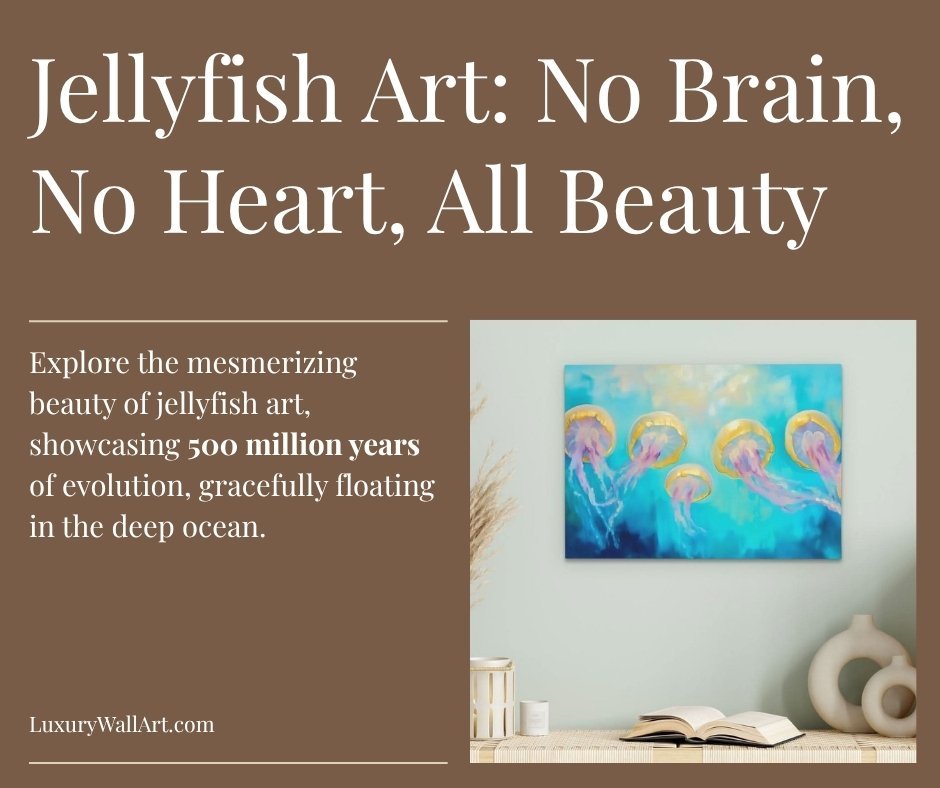

Jellyfish art captures a creature with no brain, no heart, and 500 million years of survival, and somehow it reads as one of the most soothing subjects for a wall. This piece covers the biology behind their glow, how Ernst Haeckel's illustrations shaped their look in design, and where jellyfish pieces work best, from pastel bedrooms to bold, neon living rooms.
Calm & GlowAncient SpeciesPastel to NeonBedroom & Bath
At a glance
| Age | About 500 million years |
| Body composition | 95% water |
| Box jellyfish eyes | 24, four form images |
| Pairs well with | Navy, charcoal, deep green |
Jellyfish Art: No Brain, No Heart, All Beauty
Jellyfish have been floating through the ocean for at least 500 million years. They predate dinosaurs, fish, and trees. They have no brain, no heart, no blood, and no centralized nervous system. And somehow they're one of the most visually striking creatures on the planet.
That paradox is exactly why jellyfish art has taken off in interior design. These animals look like they were designed by a glass artist, not by evolution. Their translucent bodies pulse with bioluminescent light. Their tentacles trail like silk ribbons. They move with a slow, hypnotic rhythm that makes you forget they're among the oldest predators on Earth.
The Biology Behind the Beauty
A jellyfish is roughly 95% water. They're so fragile that they dissolve within hours of washing ashore. Yet they survive in every ocean on Earth, from surface waters to the deepest trenches. Some species are smaller than a fingernail. Others, like the lion's mane jellyfish, can trail tentacles over 100 feet long.
The visual magic comes from two things: translucency and bioluminescence. Many jellyfish species produce their own light through chemical reactions in their tissues. Deep-sea species glow blue, green, or purple in the dark. This isn't decoration. It's defense, communication, and hunting. But the effect is undeniably beautiful.

Jellyfish Symbolism: Going with the Flow
Unlike lions or owls, jellyfish don't carry heavy cultural mythology. They weren't common in classical art or ancient religious symbolism. Their meaning in culture is more recent and more personal. But the symbolism that's developed around them is interesting precisely because it's organic rather than handed down.
Jellyfish represent going with the flow. They can't swim against currents. They move by pulsing their bells, but the ocean mostly decides where they end up. For people who resonate with ideas of acceptance, surrender, and trusting the process, the jellyfish has become a meaningful symbol.
They also represent resilience through simplicity. No brain, no complex organs, no elaborate social structure. Just the most basic biological toolkit. And yet they've survived five mass extinctions. There's a lesson in that. Sometimes the simplest approach outlasts the most complex one.
Strange fact: Box jellyfish have 24 eyes, including four that can form images. They work through using visual landmarks on the shore. This is remarkably complex behavior for an animal with no brain. How they process visual information without a centralized nervous system is still not fully understood.
In Japanese culture, jellyfish (kurage) appear in folklore and are associated with the sea and the unknown. The Nihon Shoki, one of Japan's oldest texts, describes the world before creation as resembling a jellyfish floating in the sea: formless, translucent, and drifting.
Box jellyfish have 24 eyes, including four that can form images. They work through using visual landmarks on the shore. How they process this without a brain is still an open question.

Jellyfish in Art and Design
Jellyfish entered the art world largely through Ernst Haeckel, the 19th-century biologist whose illustrated book Kunstformen der Natur (Art Forms in Nature) featured jellyfish in compositions so beautiful they influenced Art Nouveau architecture and design. Haeckel drew them with scientific precision and artistic flair, treating each specimen like a work of decorative art.
His illustrations proved that jellyfish are naturally photogenic. The bell shape, the symmetrical tentacle arrangement, and the translucent body create compositions that look designed. This is why jellyfish art translates so well to wall art. The subject already has visual balance, organic flow, and a color palette that ranges from soft pastels to electric neon.
Contemporary glass artist Dale Chihuly has created jellyfish-inspired sculptures that hang in museums worldwide. His blown glass pieces capture the translucency and flowing movement of real jellyfish while scaling them up to room-filling size. The connection between jellyfish and glass art is natural: both are fragile, translucent, and change appearance with shifting light.
Jellyfish Wall Art: Calm That Glows
Jellyfish wall art creates a specific mood that's hard to get from other subjects: calm with visual interest. A beach scene is calm but can feel static. An abstract might be dynamic but not particularly soothing. Jellyfish art hits both at once. The slow, drifting movement implied by the tentacles creates a sense of quiet motion.
Jellyfish Pod captures the social side of jellyfish, multiple creatures drifting together in soft pastel tones. Purple Jellyfish brings vivid tropical hues with lavender purples and coral pinks that add playful energy to any room.

Design tip:Jellyfish art pairs naturally with dark walls. Navy, charcoal, and deep green backgrounds let the translucent quality pop. In lighter rooms, go with pieces that have stronger color saturation so they hold their presence against the background.
For bathrooms and bedrooms, softer pastel jellyfish pieces set the right tone. Save the neon and electric hues for living rooms and hallways where you want more visual punch.

FAQ
What do jellyfish symbolize?
Jellyfish symbolize acceptance, flow, resilience, and simplicity. They represent the ability to survive and thrive without complexity. Their drifting movement has become associated with going with the flow and trusting the process. In Japanese creation mythology, the pre-creation world is described as resembling a jellyfish.
Do jellyfish have brains?
No. Jellyfish have no brain, no heart, and no blood. They have a decentralized nerve net that allows them to sense light, gravity, and chemicals in the water. Despite this, some species like box jellyfish have 24 eyes and can work through using visual landmarks.
Why is jellyfish art so popular?
Jellyfish art has surged in popularity because the subject combines calming movement with visual drama. The translucent bodies and flowing tentacles create natural compositions that work as wall art. Their bioluminescent colors, from soft pastels to electric neons, suit a wide range of interior styles.
What rooms are best for jellyfish art?
Jellyfish wall art works well in bathrooms, bedrooms, meditation spaces, and anywhere you want a calming atmosphere. It also makes a strong statement in hallways and living rooms when placed against dark walls. The implied movement in the tentacles keeps the art visually engaging without being overstimulating.
What is the immortal jellyfish?
Turritopsis dohrnii, the "immortal jellyfish," is a species that can revert from its adult medusa form back to its juvenile polyp stage. This means it can theoretically cycle through its life stages indefinitely, avoiding death from old age. Scientists are studying its cellular processes for insights into aging and regeneration.
Written by Luxury Wall Art · Art experts passionate about helping you find pieces that speak to your space.
Browse Jellyfish Wall Art
You May Also Enjoy:
• Shark Art: Power and Beauty of Ocean Predators
• Lighthouse Art: Maritime Beauty and Coastal Symbolism
• Zen Art and Minimalism: Finding Peace Through Japanese Aesthetics