
Peacock Art: Symbolism of Pride and Beauty in Home Decor
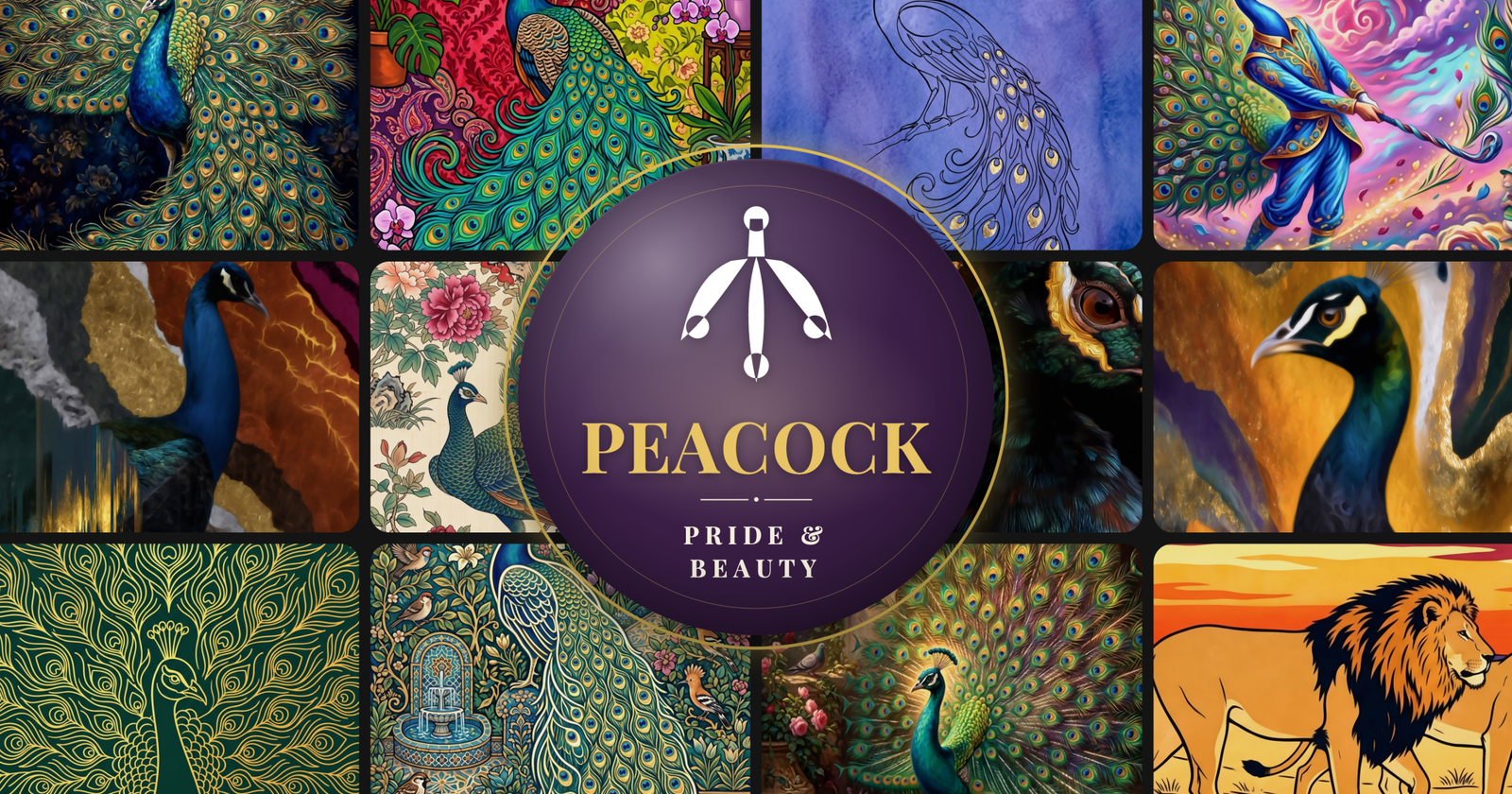

Peacock Art: The Bird That Taught Humans About Showing Off
A male peacock's tail contains around 200 feathers. Each one has an iridescent "eye" that shifts between blue, green, and gold depending on the angle of light. The whole display exists for one reason: to impress a female who will spend about three seconds deciding if she's interested.
Humans have been watching this performance for thousands of years, and we've never gotten tired of it. Peacock art shows up in ancient mosaics, medieval manuscripts, Art Nouveau jewelry, and mid-century modern textiles. The bird's visual impact is so strong that artists across every era have tried to capture it. Most of them admit they can't quite do it justice.
That's part of the appeal. A peacock painting isn't competing with a photograph. It's interpreting something that already looks designed, already looks like art. The peacock did the hard work. The artist just has to keep up.
Peacock Symbolism Across Cultures
In Hindu tradition, the peacock is the mount of Lord Kartikeya, the god of war. It also appears alongside Saraswati, goddess of wisdom, learning, and the arts. India made the peacock its national bird in 1963. In temples across South Asia, peacock feathers are placed near deities as symbols of beauty and divine grace.
Greek mythology tied the peacock to Hera, queen of the gods. The story says Hera placed the hundred eyes of the giant Argus onto the peacock's tail after Hermes killed him. So every "eye" on a peacock feather is, mythologically speaking, an all-seeing guardian. Greeks associated the bird with immortality and the watchful protection of the heavens.

The Peacock in Islamic and Persian Art
In Islamic art, the peacock occupies a complicated position. Some traditions associate it with paradise, describing peacocks as birds that walk in the gardens of heaven. Persian miniature paintings feature peacocks prominently, their tails rendered in painstaking detail with lapis lazuli blue and real gold leaf.
The Peacock Throne, commissioned by Mughal Emperor Shah Jahan in the 17th century, was one of the most valuable objects ever created. Covered in gems and gold, with two peacock figures studded with sapphires, rubies, and emeralds, it represented the peak of Mughal power. When the Persian ruler Nader Shah conquered Delhi in 1739, he took the throne as plunder. It became a symbol of Persian royal authority until it was eventually broken apart.
That story captures something essential about peacock symbolism: it's always been connected to wealth, power, and the kind of beauty that makes people do reckless things to possess it.
Art Nouveau and the Peacock Obsession
If any art movement was made for the peacock, it was Art Nouveau. The flowing, organic lines of late 19th-century decorative art found a perfect subject in the peacock's sweeping tail feathers. Louis Comfort Tiffany created peacock-themed stained glass windows. Alphonse Mucha worked peacock feather patterns into his famous posters.
But the most famous peacock project of the era was James McNeill Whistler's Harmony in Blue and Gold: The Peacock Room. Originally a dining room in a London townhouse, Whistler painted over the owner's expensive leather wall coverings with gilded peacocks. The owner was furious. Whistler painted two fighting peacocks on the end wall, one representing himself and the other his patron. The room now lives in the Smithsonian. The leather is gone. The peacocks remain.

The Science Behind the Feathers
Here's something that might change how you look at peacock art: peacock feathers aren't actually blue or green. The colors come from microscopic structures in the feather barbs that interfere with light waves. It's called structural coloration, and it means the colors you see depend entirely on the angle you're looking from.
This is why peacock paintings are so hard to get right. The bird's real colors literally change as it moves. A photograph captures one angle. A painting has to suggest all of them. The best peacock art doesn't try to freeze the colors. It captures the feeling of iridescence, that sense that the image is slightly shifting even while you're standing still.
Why iridescence matters: Peacock feather "eyes" are called ocelli. Each one contains layers of melanin rods spaced at precise intervals measured in nanometers. The spacing determines the color. Change the spacing by a fraction and blue becomes green. It's one of nature's most precise engineering feats.
Peacock Wall Art: Color That Commands a Room
Peacock wall art does something most animal art doesn't: it doubles as a color statement. A lion painting is about the lion. A horse painting is about the horse. A peacock painting is about the lion and about blue, green, gold, and purple working together on your wall.
That makes peacock art one of the more versatile choices for interior design. It can anchor a jewel-toned room. It can be the one bold element in a neutral space. It can tie together a room that mixes blues and greens that otherwise don't quite connect.
Our peacock wall art collection ranges from the bold, dreamlike quality of Peacock Enigma to the surreal color shifts of Surreal Peacock. For spaces that want bird art without the full peacock intensity, browse our bird art collection for alternatives, Soft Peacock offers similar iridescent energy at a different scale.


Pride, Vanity, and Owning It
The peacock has always carried a whiff of vanity. Aesop's fables mocked it. Medieval morality tales warned against "peacock pride." Even the English word "peacocking" means showing off.
But here's the thing: cultural attitudes have shifted. What used to be called vanity is now called confidence. Self-expression. Knowing what you're worth and not being shy about it. The peacock doesn't apologize for its feathers. It presents them fully fanned, take it or leave it.
That shift in meaning is part of why peacock art has surged in home decor. People aren't looking for subtle, apologetic art anymore. They want pieces that own the wall. A peacock does that naturally. It's a bird that was designed, by millions of years of evolution, to be the center of attention. On a wall, it does exactly the same job.
FAQ
What does a peacock symbolize?
The peacock symbolizes beauty, pride, royalty, and renewal. In Hindu culture, it represents grace and divine protection. In Greek mythology, the "eyes" on its tail feathers symbolize watchfulness. In Christianity, the peacock represents resurrection and eternal life.
Why are peacock feathers iridescent?
Peacock feathers get their color from structural coloration, not pigment. Microscopic layers of melanin rods in the feather barbs interfere with light waves, creating colors that shift depending on viewing angle. The feathers aren't actually blue or green. The structure of the feather manipulates light to produce those colors.
What rooms work best for peacock wall art?
Peacock wall art works well in living rooms, dining rooms, and entryways where you want a bold color statement. The blue-green palette pairs naturally with jewel-toned rooms but also adds a striking focal point against neutral walls. Bedrooms can work with more subdued peacock compositions.
Is peacock decor still in style?
Yes. Peacock art and decor have remained popular because the bird's color palette (blue, green, gold, purple) is naturally harmonious and works with multiple design styles. From Art Nouveau to contemporary maximalism, peacock imagery adapts to trends without losing its appeal.
What is the Peacock Room?
The Peacock Room is a famous decorative interior by James McNeill Whistler, originally created in 1877 for a London dining room. Whistler painted the walls with gilded peacock designs, covering the owner's expensive leather wall coverings without permission. The room now resides in the Smithsonian's Freer Gallery of Art in Washington, D.C.
Written by Luxury Wall Art · Art experts passionate about helping you find pieces that speak to your space.