
The Great Wave: Japanese Art and Hokusai's Legacy
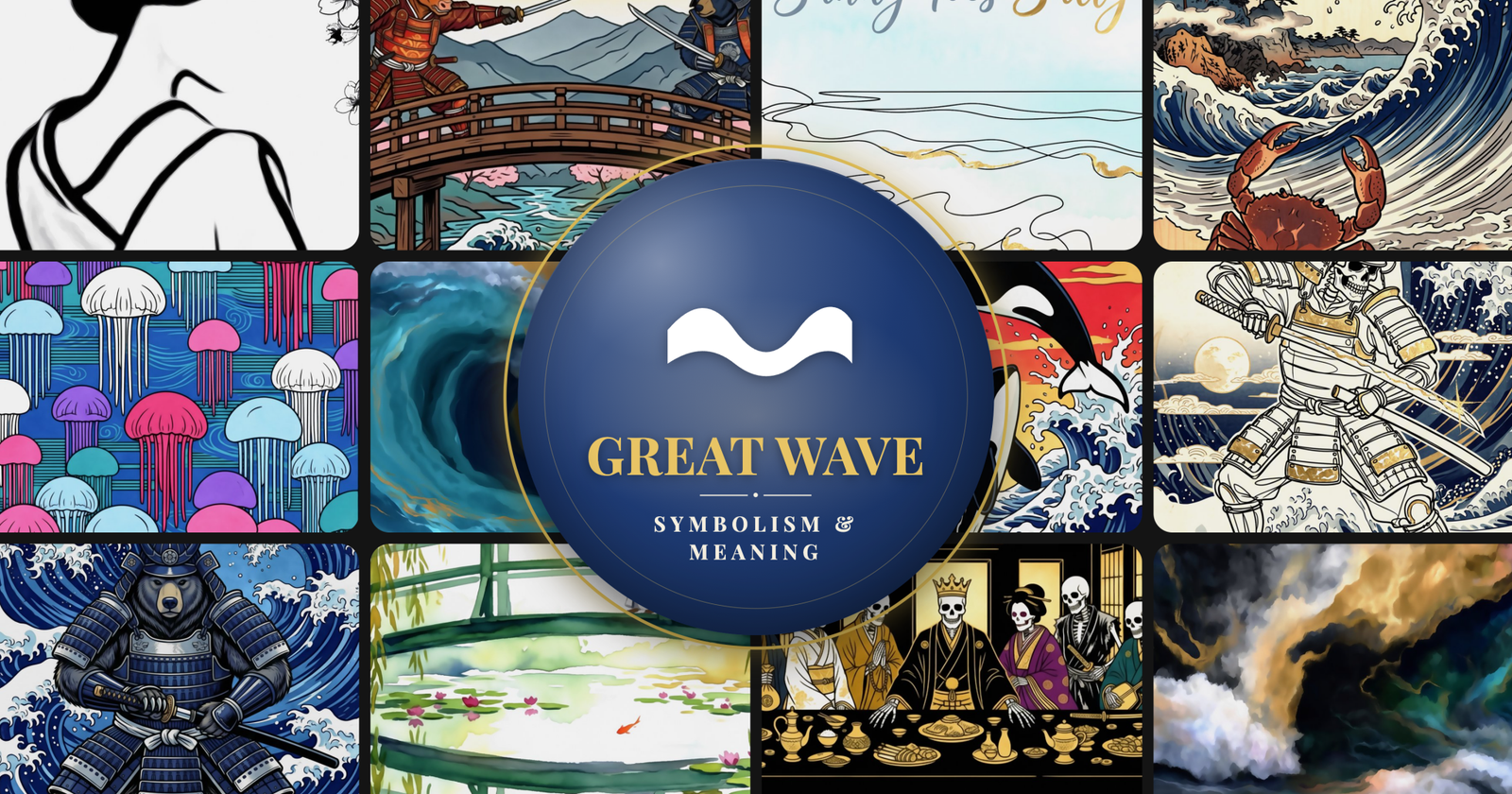

The Great Wave: How One Japanese Print Changed Art Forever
You've seen it on t-shirts, phone cases, coffee mugs, and dorm room posters. The Great Wave off Kanagawa is probably the most reproduced artwork in history. But most people who recognize it couldn't tell you the name of the artist, the technique behind it, or the fact that he was 70 years old when he made it.
Katsushika Hokusai created this woodblock print around 1831 as part of his series Thirty-six Views of Mount Fuji. It wasn't a painting. It was a print, made from carved wooden blocks, inked and pressed onto paper by hand. Thousands of copies were produced and sold cheaply to everyday people in Edo-period Japan. Nobody at the time thought they were collecting fine art. They were buying the equivalent of a postcard.
That postcard went on to reshape how the entire Western world thought about composition, color, and nature in art.
Ukiyo-e: The "Floating World" Behind Japanese Wave Art
Japanese wave art belongs to a broader tradition called ukiyo-e, which translates to "pictures of the floating world." The name itself says a lot. These prints captured life's fleeting pleasures: theater, beauty, nature, travel. They were made for a growing merchant class that couldn't afford painted scrolls but wanted art in their homes.
The process was collaborative. An artist designed the image. A carver cut it into cherry wood blocks, one for each color. A printer applied pigment and pressed paper against the blocks by hand. A single image might require ten or more separate blocks, each aligned with precision that still impresses printmakers today.

What Makes The Great Wave So Powerful
Look at the composition. Really look at it. The wave towers over everything, its claw-like fingers reaching down toward three fishing boats. Mount Fuji, the tallest peak in Japan, sits in the background looking almost small. That contrast is the whole point. Nature dwarfs everything human. The mountain that seems permanent is reduced to a triangle in the distance. The ocean, constantly moving, dominates the frame.
Hokusai used Prussian blue, a synthetic pigment that had recently arrived in Japan from Europe. It was cheaper than traditional indigo and didn't fade as quickly. That deep, vivid blue became the defining color of the series and, eventually, a signature of Japanese art in the Western imagination.
The foam at the wave's crest breaks into tiny droplets that look almost like snow falling on the boats below. Some art historians see this as Hokusai connecting water and sky, ocean and mountain, chaos and stillness. Others think he just thought it looked good. Both interpretations work.
Fun fact: Hokusai changed his artist name at least 30 times during his career. He also moved house over 90 times. The man clearly got restless.
How Hokusai Changed Western Art
When Japan opened its ports to trade in the 1850s, ukiyo-e prints flooded into Europe. The story goes that some were used as packing material for ceramics. French artists found them, and their world shifted.
Japonisme, the craze for all things Japanese, swept through Paris. Claude Monet collected ukiyo-e prints. Edgar Degas borrowed their asymmetric compositions. Vincent van Gogh copied them directly, calling Japanese prints "my religion." The flat areas of color, bold outlines, and unusual angles in Hokusai's work gave the Impressionists permission to break free from the rigid rules of European academic painting.
Without Hokusai, Impressionism might have taken a different path entirely. Without Impressionism, modern art as we know it might not exist. One wave painting made by a restless old man in Edo rippled outward for centuries.
The Tradition of Wave Art in Japanese Culture
Hokusai didn't invent Japanese wave art. Water has been central to Japanese aesthetics for centuries. An island nation surrounded by ocean, dependent on fishing and vulnerable to tsunamis, Japan developed a complex relationship with the sea. It was a source of food, a path for trade, a carrier of storms, and a spiritual force.
In Shinto tradition, water purifies. In Buddhist philosophy, its constant movement represents impermanence. Japanese gardens use water (or raked gravel mimicking water) to create spaces for contemplation. Waves carved into sword guards, painted on screens, and woven into textiles were everywhere long before Hokusai picked up a brush.

Why Wave Art Works in Modern Interiors
There's a reason people keep putting wave paintings on their walls. Water art does something that most other subjects can't: it simultaneously energizes and calms. The movement in a wave creates visual interest that keeps the eye engaged. But the blues and greens associated with ocean scenes trigger a relaxation response that interior designers call the "coastal effect."
Research backs this up. Studies on color psychology consistently show that blue tones lower heart rate and reduce anxiety. A room with ocean-inspired art doesn't just look good. It can genuinely make you feel more at ease.
From a design perspective, wave art is flexible. It works in coastal-themed homes where it reinforces the setting. It works in coastal homes where it reinforces the setting. It works in urban apartments where it provides a visual escape. It works in offices where its calming influence counteracts screen fatigue. It pairs naturally with zen art and nature-inspired pieces. The subject matter is universal enough that it doesn't clash with existing decor the way some art themes can.


Choosing the Right Wave Art for Your Space
Not all wave paintings create the same mood. The spectrum runs from soft and meditative to bold and turbulent. Choosing the right one depends on what you want the room to feel like.
For bedrooms and reading nooks, lean toward calmer compositions with softer color palettes. Gentle swells and muted blues create a sense of stillness. For living rooms and offices, bolder waves with deeper contrast hold their own against larger spaces and more visual competition.

Hokusai's Final Years and Lasting Influence
Hokusai didn't stop after The Great Wave. He kept working until his death at 88, producing paintings, prints, and illustrated books right up to the end. On his deathbed in 1849, he reportedly said, "If only heaven will give me just another ten years... just another five more years, then I could become a real painter."
That relentless drive shows in the work. His late paintings of waves, dragons, and phoenixes have an intensity that younger artists rarely match. He understood something about creative momentum: you don't peak and decline. You keep pushing until the work surprises even you.
His influence runs deeper than most people realize. The composition of The Great Wave, with its dramatic diagonal and asymmetric balance, shows up everywhere from film cinematography to graphic novel panels. Japanese animation owes a clear debt to ukiyo-e's flat perspectives and dynamic motion lines. Every time a filmmaker frames a landscape with something massive in the foreground dwarfing what's behind it, they're borrowing from Hokusai whether they know it or not.
Worth knowing:The original woodblocks for The Great Wave were likely destroyed after printing roughly 5,000 copies. Surviving prints in good condition are rare. In 2024, one sold at auction for over $3.6 million. Not bad for something that originally cost the equivalent of a bowl of noodles.
Museums around the world hold surviving prints, including the Met in New York, the British Museum, and the National Museum in Tokyo. Each one shows slightly different color intensity depending on how many prints were pulled before it.

FAQ
Who painted The Great Wave?
Katsushika Hokusai, a Japanese artist, created The Great Wave off Kanagawa around 1831. It's actually a woodblock print, not a painting. It was part of his series Thirty-six Views of Mount Fuji, created when he was approximately 70 years old.
What does The Great Wave symbolize?
The print represents the power of nature over human endeavor. The massive wave dwarfs both the fishing boats and Mount Fuji in the background. It reflects Japanese philosophical ideas about impermanence and humanity's small place within natural forces. The contrast between the violent ocean and the calm mountain also suggests the tension between chaos and stability.
What is ukiyo-e?
Ukiyo-e means "pictures of the floating world." It's a genre of Japanese art that flourished from the 17th through 19th centuries. These woodblock prints depicted scenes of daily life, landscapes, theater, and nature. They were affordable art for common people and later had a major influence on European Impressionism.
Why is Japanese wave art so popular in home decor?
Japanese wave art combines visual energy with calming color palettes. The blues and greens associated with ocean scenes trigger a relaxation response, while the movement in waves keeps the eye engaged. This makes wave paintings versatile enough for bedrooms, living rooms, and offices alike.
How much is an original Great Wave print worth?
Original prints in good condition are extremely rare. Roughly 5,000 copies were made from the original woodblocks, but most have deteriorated over nearly 200 years. Well-preserved originals have sold at auction for over $3.6 million. The value depends heavily on condition, color vibrancy, and provenance.
Written by Luxury Wall Art · Art experts passionate about helping you find pieces that speak to your space.