Niagara
by Frederic Edwin Church, 1857
Artwork Details
Details
- Year
- 1857
- Medium
- Oil on canvas
- Size
- 101.6 cm × 229.9 cm
Cite or Embed This Work
APA · MLA · Chicago1-click academic citation and embeddable “On View” museum badge for articles, syllabi, and research.
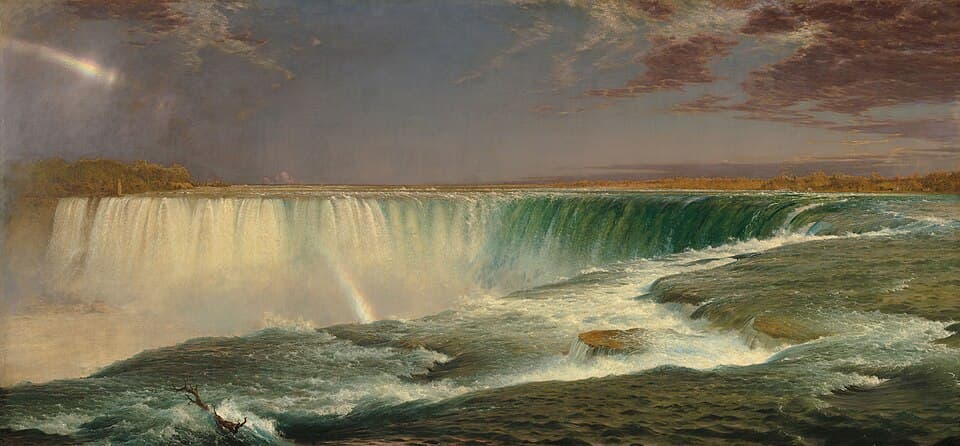
Frederic Edwin Church completed this panoramic view of Niagara Falls in 1857, capturing the thundering cascade from the Canadian side. The composition eliminates the horizon and any human presence, placing viewers at the very edge of the rushing water. The effect is vertiginous, almost frightening in its immersive power.
Church visited Niagara in March 1856, making oil sketches in freezing temperatures. The finished painting, nearly eight feet wide, caused a sensation when exhibited in New York. Lines formed around the block. Critics praised how Church conveyed the falls' awesome scale and terrifying beauty without any of the tourist apparatus that cluttered other depictions.
The painting established Church as America's foremost landscape painter. It toured England, where John Ruskin praised it despite his usual criticism of American art. The Corcoran Gallery of Art in Washington purchased it in 1876, where it anchored their collection until the gallery closed. It's now displayed at the National Gallery of Art.