
Owl Symbolism: Wisdom and Mystery in Art and Culture
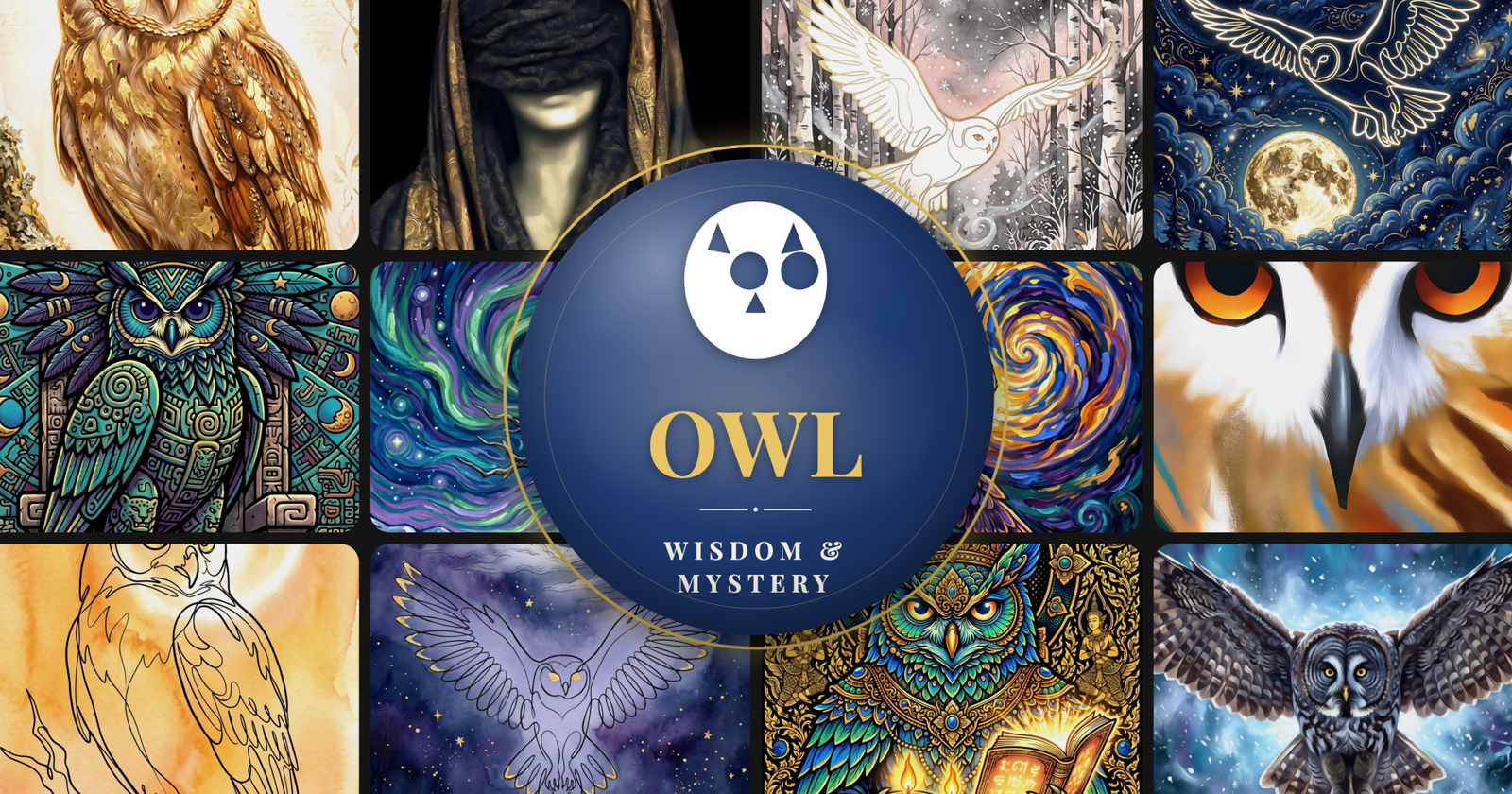

Owl Symbolism: The Bird That Sees What We Can't
No other bird divides cultures like the owl. In ancient Greece, seeing an owl meant Athena was on your side. In medieval Japan, it was a protector of children. But in ancient Rome, an owl's cry predicted death. In parts of India, the owl is associated with Lakshmi and good fortune. In other parts, it's a bad omen.
This split runs through the entire history of owl symbolism. The same bird means wisdom in one place and doom in another. That contradiction is actually what makes owls so powerful as subjects in art. They carry weight from multiple directions. A painting of an owl doesn't settle into one simple meaning. It stays interesting.
Athena's Owl: How Wisdom Got Wings
The connection between owls and wisdom starts with Athena, the Greek goddess of wisdom and war strategy. Her companion was a little owl (Athene noctua, which literally has her name). It appeared on Athenian coins, on pottery, on shields, and in sculpture. The phrase "owls to Athens" meant something like "bringing coals to Newcastle" because the city was already full of them, both real and symbolic.
Why an owl? The Greeks probably noticed what anyone who's watched one can confirm: owls look like they're thinking. That forward-facing stare, the slow head turn, the way they sit completely still and observe. They look patient, deliberate, and focused. Whether or not an owl is actually smarter than a pigeon is debatable, but it certainly looks the part.

Owls in World Mythology
In Hindu tradition, the owl serves as the vahana (vehicle) of Lakshmi, goddess of wealth and prosperity. This association makes owls a symbol of good fortune in many parts of India, particularly during Diwali. The connection is practical: owls hunt the rodents that eat stored grain. Protecting crops means protecting wealth.
Native American traditions vary widely. For the Hopi, the burrowing owl is a god of the dead and protector of the underworld. For the Tlingit people of the Pacific Northwest, owls are figures of wisdom. Some Cherokee stories describe owls as medicine birds with healing powers. The common thread is that owls are messengers between worlds: the seen and unseen, the living and dead, the known and unknown.
In Celtic mythology, the owl was associated with the crone aspect of the goddess, representing wisdom that comes only through age and experience. Blodeuwedd, a woman made from flowers in Welsh mythology, was transformed into an owl as punishment. She was condemned to fly only at night, shunned by other birds. A harsh sentence, but it gave the owl its mystical status in Celtic art.
Night vision: Owls can see in light levels six times lower than what humans need. Their eyes aren't spheres like ours. They're tube-shaped and fixed in the skull, which is why owls rotate their heads up to 270 degrees. They can't move their eyes, so they move their entire head instead.
Picasso was obsessed with owls. He kept them as pets, painted and sculpted them repeatedly, and even created ceramic owl-shaped pitchers. His owls are playful, almost cartoon-like, with huge eyes and stubby bodies.
Harry Potter put owls back in the spotlight for a whole generation. Hedwig made snowy owls a cultural touchstone, and owl imagery in home decor surged after the first film. The association with hidden knowledge found its biggest audience.

Owls in Art: From Cave Paintings to Harry Potter
Some of the oldest known owl depictions are cave engravings in Chauvet Cave, France, dating back roughly 30,000 years. The artist captured a snowy owl looking over its shoulder, its flat face and large eyes unmistakable even after thirty millennia. People have been drawing owls for a very long time.
Hieronymus Bosch placed owls throughout his paintings as symbols of evil and folly. In The Garden of Earthly Delights, owls lurk in trees and peer out from dark corners. Albrecht Durer drew an owl clutched in the talons of other birds, being mobbed and attacked, which was a metaphor for wisdom being persecuted by ignorance.
Picasso was obsessed with owls. He kept them as pets, painted and sculpted them repeatedly, and even created ceramic owl-shaped pitchers. His owls are playful, almost cartoon-like, with huge eyes and stubby bodies. They're some of his most popular works.
And then there's Hedwig. Harry Potter put snowy owls on the cultural map in a way that nothing else had in decades. After the first film released, snowy owl sightings became front-page news. Pet owl purchases spiked so dramatically that J.K. Rowling had to publicly ask people to stop buying them. The owl's association with magic and hidden knowledge found its biggest audience ever.
Owl Art for Your Home
Owl wall art carries a different energy than most animal art. It's not about power (like a lion) or elegance (like a horse). It's about presence. An owl on the wall watches the room. Those forward-facing eyes create the feeling that the art is looking back at you, which gives it an intensity that other bird art doesn't have.
Style-wise, owls work across an unusually wide range. They belong alongside pieces from our bird art collection. Surreal Owl leans into the mystical side with dreamlike color and atmosphere. It's the kind of piece that fits reading rooms, studies, and spaces where you want to feel like you've stepped into another world. More realistic owl art works in rustic and woodland-themed interiors where it reinforces a connection to nature.

Owls pair particularly well with warm earth tones: deep greens, rich browns, amber, and charcoal. They also work against dark walls, where those bright eyes become the natural focal point of the room.
In bedrooms and studies, owl art adds a contemplative quality that suits spaces meant for thinking and rest. The nocturnal association works in your favor there.

FAQ
What does an owl symbolize?
The owl symbolizes wisdom, knowledge, and intuition in Western culture, primarily through its association with the Greek goddess Athena. In other traditions, owls represent mystery, transition between worlds, and messages from the spiritual realm. Some cultures view them as protectors, while others consider them omens.
Why are owls associated with wisdom?
The association comes from Athena, the Greek goddess of wisdom, whose companion was a little owl. The owl's forward-facing eyes, patient demeanor, and habit of sitting still and observing give it an appearance of contemplation that ancient Greeks connected to intellectual thought.
Are owls good or bad omens?
It depends on the culture. In Greek tradition, owls were positive symbols of wisdom and divine protection. In Roman tradition, they were death omens. In Hindu culture, the owl is associated with the goddess Lakshmi and prosperity. Native American traditions vary by tribe, with owls representing everything from wisdom to messages from the dead.
What rooms are best for owl art?
Owl wall art works well in studies, home offices, libraries, and reading nooks where its association with wisdom feels natural. It also suits bedrooms (owls are nocturnal guardians) and living rooms with earthy or woodland-inspired decor. They also fit beautifully into dark academia and nature art collections. The forward-facing eyes create a strong focal point in any room.
What is the Owl of Athena?
The Owl of Athena (also called the Owl of Minerva) is a little owl that served as the companion and symbol of the Greek goddess Athena. It appeared on ancient Athenian coins and pottery. The philosopher Hegel later used the phrase "the owl of Minerva spreads its wings only with the falling of dusk" to mean that wisdom comes only in hindsight.
Written by Luxury Wall Art · Art experts passionate about helping you find pieces that speak to your space.